
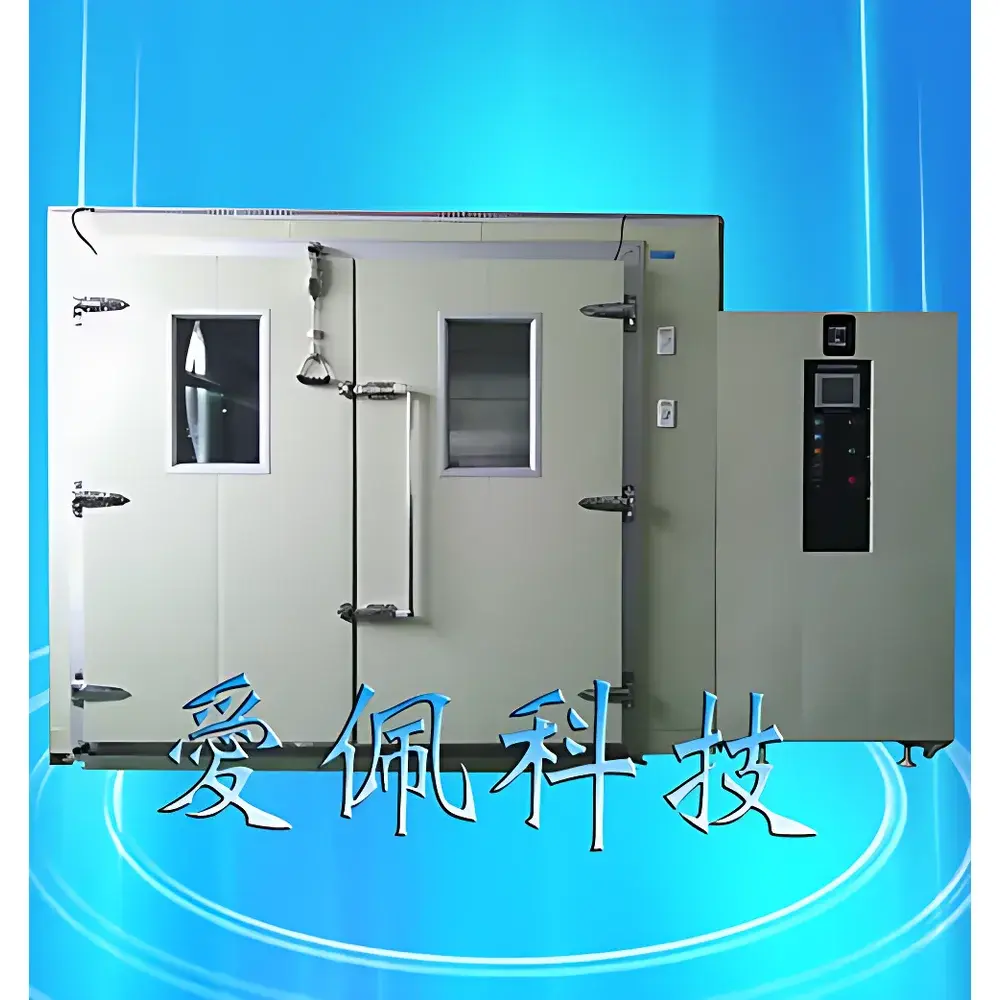
Apkji AP-KF-18m³ Walk-in Environmental Test Chamber for High-Temperature Aging and Thermal Stability Testing of Electronic Scales
| Brand | Apkji (APKJ) |
|---|---|
| Origin | Guangdong, China |
| Manufacturer Type | Direct Manufacturer |
| Country of Origin | China |
| Model | AP-KF-18m³ |
| Quotation | Available Upon Request |
| Internal Dimensions (D×W×H) | 3000 × 3000 × 2800 mm |
| External Dimensions (D×W×H) | 3240 × 3240 × 3040 mm |
| Temperature Range | Ambient to +60 °C (adjustable in 0.1 °C increments) |
| Temperature Uniformity | ±2.0 °C |
| Temperature Fluctuation | ±1.0 °C |
| Display Resolution | 0.1 °C |
| Heating Rate | ≥1.0–3.0 °C/min (at no-load condition) |
| Timer Range | 1 second to 9999 hours (selectable units) |
| Total Power Consumption | 22 kW |
| Supply Voltage | AC 380 V / 50 Hz |
Overview
The Apkji AP-KF-18m³ Walk-in Environmental Test Chamber is an engineered solution for long-duration thermal aging, stability validation, and environmental stress screening of precision electronic weighing instruments—including industrial floor scales, platform scales, and high-capacity load cell-based systems. Designed explicitly for metrological integrity under thermal load, the chamber operates on forced-air convection principles with vertically oriented airflow distribution to minimize thermal stratification across its 18 m³ test volume. Its structural architecture supports static loads up to 10 tonnes—enabling concurrent conditioning of multiple large-format weighing devices or full-scale production batches under controlled, repeatable ambient conditions. The system complies with fundamental thermal testing frameworks defined in GB/T 2423.2–2001 (equivalent to IEC 60068-2-2) for high-temperature testing, and aligns with mechanical design and safety requirements outlined in JB/T 5520–1991 for industrial drying and thermal processing equipment.
Key Features
- Structural load-bearing frame fabricated from welded I-beams and channel steel, rated for 10,000 kg distributed static load without deflection or resonance
- Double-layer insulated wall panels using either polyurethane foam (density ≥40 kg/m³) or high-temperature resistant rock wool (up to 700 °C continuous service), achieving thermal transmittance (U-value) <0.35 W/(m²·K)
- Observation system comprising two 400 × 500 mm multi-layer laminated tempered glass windows with anti-fog heating elements and argon-filled interlayers for optical clarity and thermal decoupling
- Heavy-duty stainless-steel interior door panel with marine-grade cam-latch mechanism (single or dual swing configuration), integrated with magnetic seal and over-center locking
- High-efficiency axial-flow circulation system featuring low-noise, high-torque stainless-steel fan motor (IP55 rated) and multi-blade impeller optimized for uniform vertical air movement
- Industrial-grade heating assembly utilizing Ni-Cr alloy infrared heating elements with PID-controlled SSR output and redundant over-temperature cut-off at 65 °C
- Comprehensive safety architecture including phase failure/phase reversal detection, motor thermal overload protection, earth leakage circuit interruption (ELCI), audible (120 dB) and visual alarm activation, and automatic power disconnection upon fault detection
Sample Compatibility & Compliance
The chamber accommodates full-size electronic weighing systems—including those equipped with strain-gauge or electromagnetic force compensation sensors—without requiring disassembly. Its internal dimensions (3.0 × 3.0 × 2.8 m) permit placement of calibration weights, auxiliary instrumentation (e.g., data loggers, reference standards), and environmental monitoring probes within the active test zone. All materials in contact with the test space meet RoHS Directive 2011/65/EU restrictions on hazardous substances. Electrical design conforms to GB 5226.1–2019 (IEC 60204-1) for safety of machinery. While not certified to ISO/IEC 17025 or accredited per ILAC-MRA, the system provides traceable temperature control suitable for internal quality assurance protocols aligned with GLP and pre-GMP manufacturing environments.
Software & Data Management
The embedded controller features a 7-inch TFT-LCD HMI interface with real-time graphical trend display, programmable multi-step profiles (up to 99 segments), and event logging with timestamped parameter records (temperature setpoint, actual value, elapsed time, alarm status). Optional RS485 Modbus RTU or Ethernet TCP/IP connectivity enables integration into centralized SCADA or MES platforms. Data export is supported via USB flash drive in CSV format. Audit trail functionality includes operator login tracking, parameter change history, and alarm acknowledgment logs—supporting basic 21 CFR Part 11 compliance when deployed with external identity management and electronic signature workflows.
Applications
- Thermal aging validation of load cells, junction boxes, and indicator electronics prior to field deployment
- Stability assessment of calibration coefficients across extended temperature excursions (e.g., 0–60 °C cycling)
- Environmental stress screening (ESS) of newly manufactured weighing systems to identify latent solder joint failures or material creep effects
- Pre-shipment conditioning for export-bound equipment destined for tropical or arid climates
- Supporting ISO 9001:2015 clause 8.5.1 (control of production and service provision) through documented thermal process validation
- Facilitating root cause analysis during nonconformance investigations involving drift, hysteresis, or zero-shift anomalies
FAQ
What is the maximum payload capacity of the chamber floor?
The structural steel frame supports up to 10,000 kg of uniformly distributed static load—verified via finite element analysis and factory load testing.
Can the chamber be configured for sub-zero temperatures?
Standard configuration covers ambient to +60 °C. Sub-zero capability requires retrofitting with refrigeration modules and modified insulation; contact Apkji engineering for custom quotation.
Is temperature mapping performed before delivery?
Yes—each unit undergoes 3-point temperature uniformity verification at three load conditions (empty, 50% load, full load) per GB/T 2423.2–2001 Annex B prior to shipment.
Does the system include calibration documentation?
A factory calibration certificate (traceable to CNAS-accredited national standards) is provided for the primary temperature sensor; optional third-party calibration services are available upon request.
What maintenance intervals are recommended?
Biannual inspection of fan bearings, heater element resistance, door gasket integrity, and electrical terminations is advised; filter replacement every 6 months under continuous operation.



