
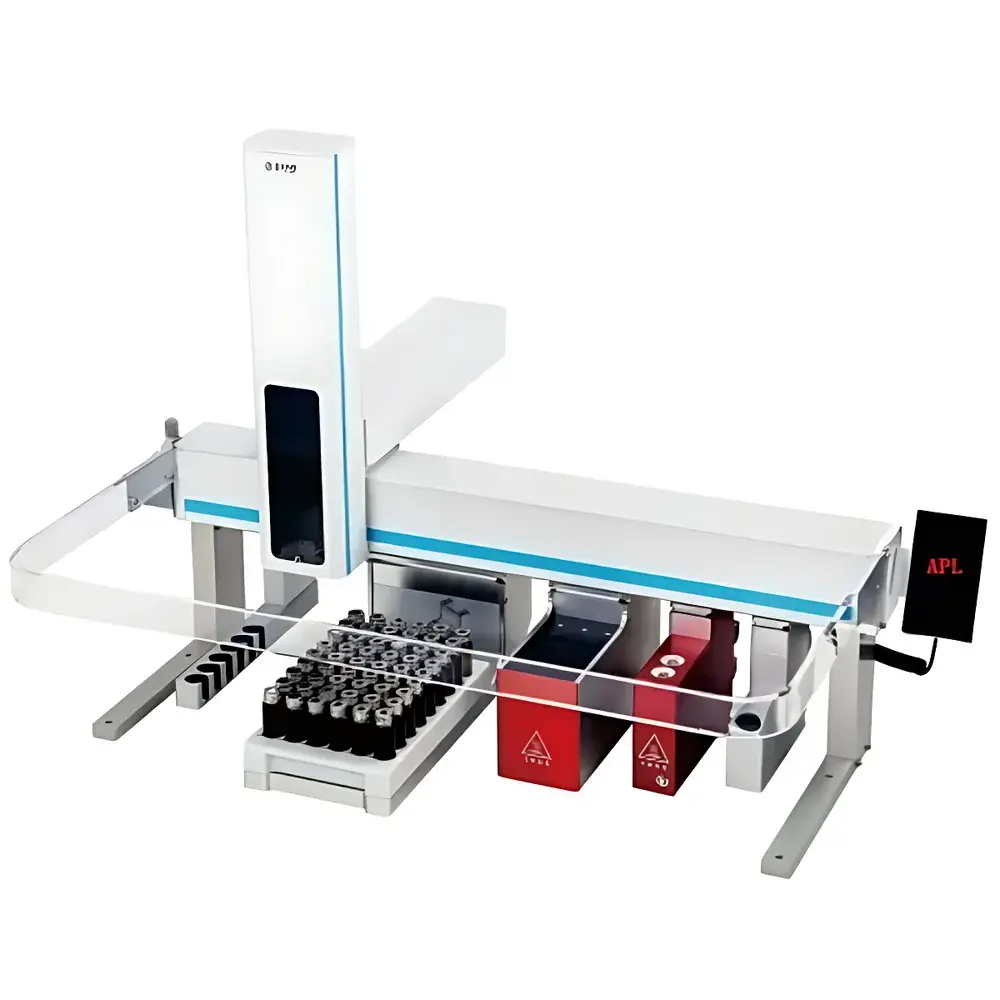
APL APL-FHS 300 Multifunctional Autosampler for GC Systems
| Brand | APL |
|---|---|
| Origin | Sichuan, China |
| Manufacturer Type | OEM Manufacturer |
| Product Category | Domestic |
| Model | APL-FHS 300 |
| Instrument Type | Multifunctional Autosampler |
| Max Sample Capacity | 180-position liquid tray / 70-position headspace tray / 70-position SPME tray |
| Minimum Liquid Injection Volume | 0.01 µL |
| Motion Control | XYZ three-axis precision positioning |
Overview
The APL APL-FHS 300 Multifunctional Autosampler is an engineered solution for high-throughput, multi-technique sample introduction in gas chromatography (GC) laboratories. Designed around a modular architecture with dual CAN bus communication, it integrates three distinct sampling modalities—liquid-phase injection, headspace analysis, and solid-phase microextraction (SPME)—within a single, compact platform. Its core operation relies on closed-loop encoder feedback for XYZ-axis motion control, ensuring positional repeatability ≤ ±0.1 mm and long-term mechanical stability under unattended 24/7 operation. The system adheres to fundamental GC interface requirements: precise syringe actuation, temperature-controlled vial handling, inert sample path design, and deterministic timing synchronization with GC acquisition triggers. It is intended for use in regulated environments where method reproducibility, audit readiness, and cross-platform interoperability are critical—particularly in environmental testing, pharmaceutical QC, food safety, and petrochemical analysis labs.
Key Features
- 5-inch capacitive touchscreen HMI with intuitive, step-guided workflow configuration—no command-line input required
- Real-time encoder-based position verification across all three axes (X/Y/Z), minimizing drift and enabling sub-microliter volumetric accuracy
- Dual CAN bus internal architecture supporting hot-swappable functional modules (liquid, headspace, SPME) without firmware reflash
- Modular expansion capability: liquid tray scalable from 180 to 360 positions; headspace and SPME trays expandable to 140 positions each
- Universal I/O interface set compliant with industry-standard TTL, relay, and analog signal protocols—validated for seamless integration with Agilent, Thermo Fisher, Shimadzu, and PerkinElmer GC systems
- Integrated needle protection mechanism with force-sensing detection and automatic retraction upon collision or resistance anomaly
- Automatic module recognition via embedded EEPROM identifiers—eliminates manual configuration of tray type, position offset, or thermal zone mapping
- Multi-speed stepper motor drive with programmable acceleration/deceleration profiles to maintain consistent injection velocity across volume ranges (0.01–250 µL)
- Full bidirectional USB 2.0 and 10/100 Mbps Ethernet connectivity with native Modbus TCP/RTU support for custom SCADA or LIMS integration
- Built-in data validation engine performing real-time range checks, unit consistency verification, and inter-parameter dependency validation prior to sequence execution
Sample Compatibility & Compliance
The APL-FHS 300 accommodates standard GC consumables without adapter modification: 10 mL and 20 mL crimp-top or screw-cap headspace vials; 1–500 µL glass syringes (including gastight and fixed-needle types); and commercially available SPME fibers (e.g., PDMS, CAR/PDMS, DVB/CAR/PDMS). Thermal zones meet ASTM D3699 and ISO 11843-2 specifications for temperature uniformity and stability. All fluidic pathways are constructed from chemically inert materials (e.g., PTFE, fused silica, stainless steel 316) with minimal dead volume. The system supports GLP/GMP workflows through configurable audit trails, electronic signature enforcement (via optional PC software), and full traceability of sequence parameters, run logs, and error events—aligned with FDA 21 CFR Part 11 principles for electronic records and signatures.
Software & Data Management
The included Windows-based PC software provides full remote instrument control, method development, and sequence scheduling. It implements complete bidirectional instrument control—enabling real-time parameter adjustment, status polling, and hardware-level diagnostics during active runs. Sequence files store all operational metadata (vial coordinates, injection volumes, thermal ramp profiles, agitation settings, wash cycles) in XML format for version control and archival. Raw log files are timestamped and digitally signed to prevent tampering. The software supports batch export to CSV and direct database insertion via ODBC drivers, facilitating integration into enterprise LIMS platforms. Optional API libraries (C++, Python, .NET) allow third-party developers to embed autosampler control within custom analytical applications or automated QA/QC dashboards.
Applications
- Regulatory environmental testing: VOC analysis in water (EPA Method 502.2, 524.4), soil (EPA Method 8260D), and air (TO-17)
- Pharmaceutical residual solvent quantification per ICH Q2(R2) and USP
- Food flavor profiling and contaminant screening (e.g., acrylamide, furans) using headspace-GC-MS
- Forensic toxicology workflows requiring parallel liquid injection and SPME for blood/urine matrix simplification
- Method development labs requiring rapid switching between sampling modes without hardware reconfiguration
- Contract testing facilities operating multiple GC instruments—single APL-FHS 300 can serve up to two GC systems simultaneously via dual trigger outputs and independent tray control
FAQ
Does the APL-FHS 300 support dual-column or dual-detector GC configurations?
Yes—it provides two independent TTL-compatible trigger outputs and separate sample event logging for each connected GC system, enabling synchronized or staggered injections.
Can the system be validated for 21 CFR Part 11 compliance?
While the hardware and firmware include audit trail, electronic signature, and data integrity safeguards, formal Part 11 validation requires site-specific IQ/OQ/PQ protocols executed by the end user or qualified third party.
What is the maximum allowable ambient operating temperature for continuous headspace heating at 230 °C?
The instrument is rated for ambient temperatures up to 35 °C; operation above this may compromise thermal stability and long-term encoder calibration.
Is firmware upgrade performed locally or remotely?
Firmware updates are delivered as signed binary packages and installed via USB drive or LAN connection—no cloud dependency or internet access required.
How does the system handle vial barcode scanning?
Barcode reading is supported via optional external USB CCD scanners; scanned IDs are mapped to sequence entries in real time and logged with each injection event.
Related Products







