
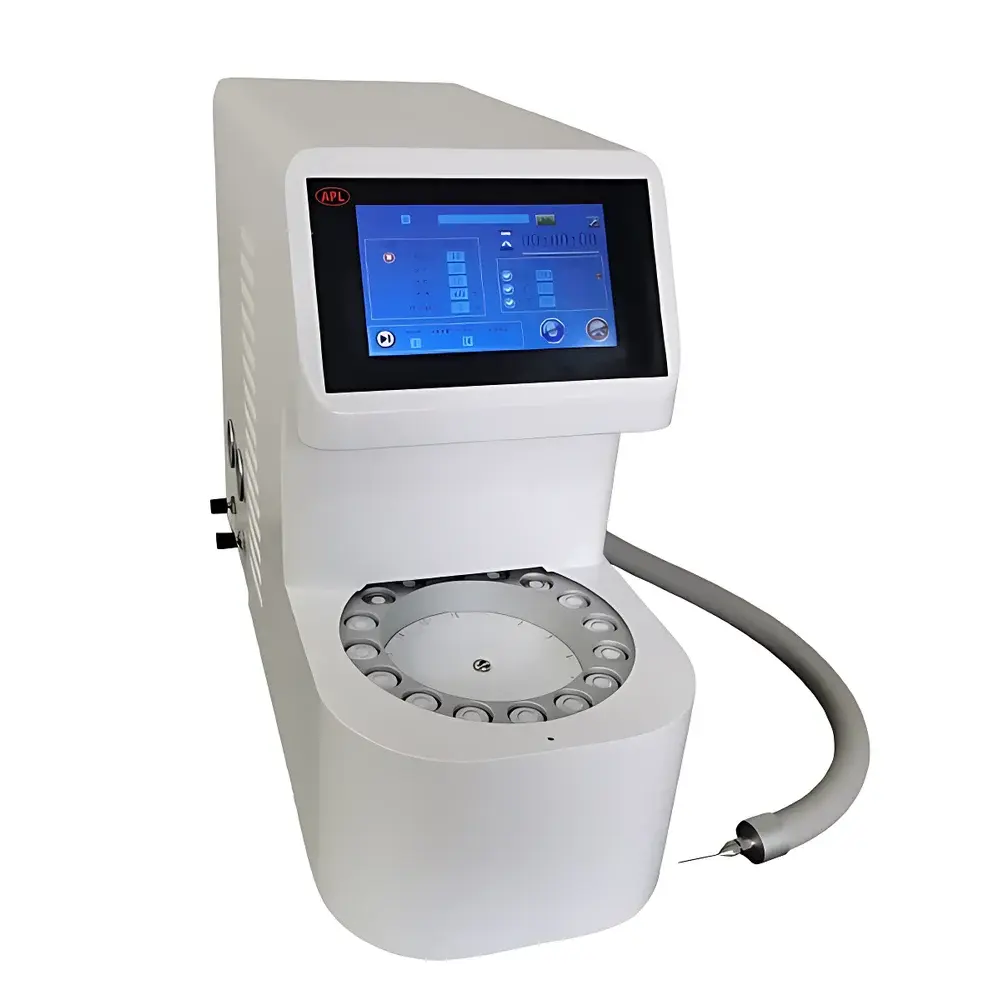
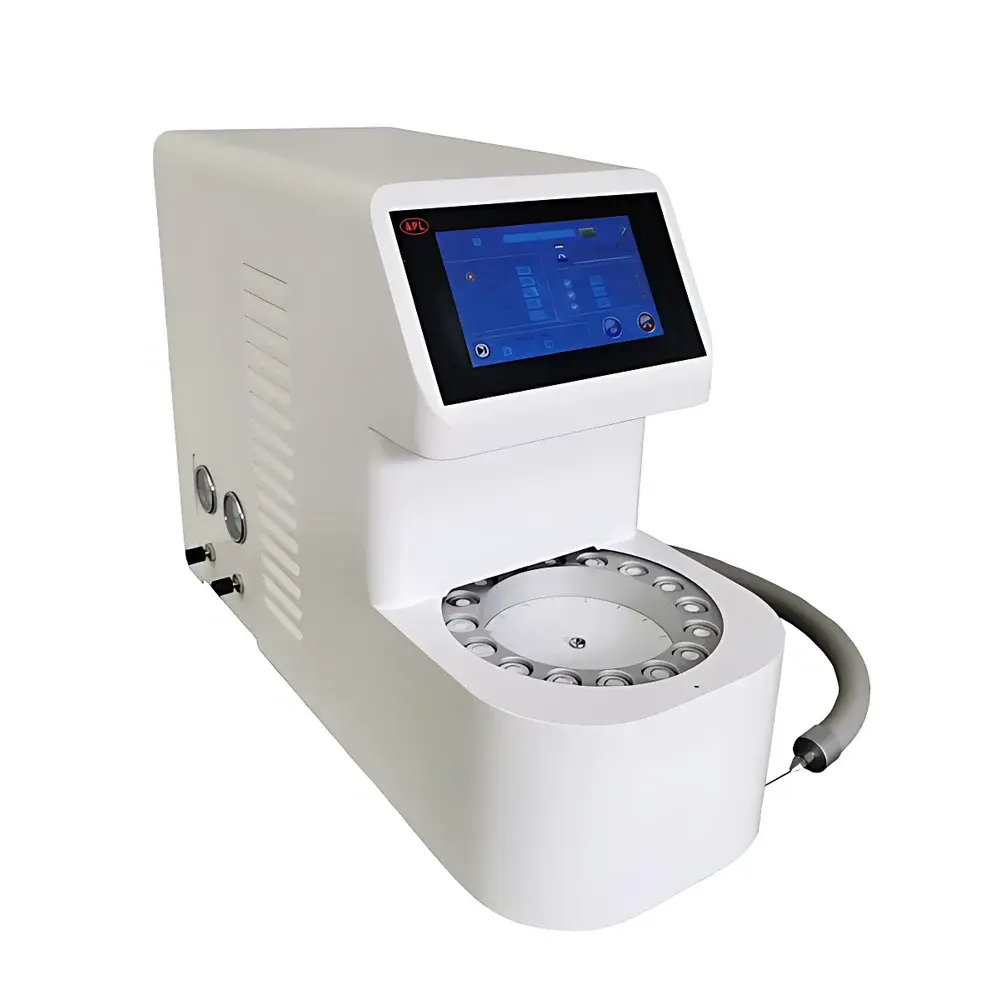
APL APL-HS-Auto16 Fully Automated Static Headspace Sampler
| Brand | APL |
|---|---|
| Origin | Sichuan, China |
| Manufacturer Type | Direct Manufacturer |
| Instrument Type | Static Headspace Sampler |
| Automation Level | Fully Automated |
| Sample Tray Capacity | 16 positions (all heated) |
| Vial Size Compatibility | 10 mL and 20 mL (20 mL standard) |
| Oven Temperature Range | Ambient to 260 °C |
| Valve & Transfer Line Temperature Range | Ambient to 220 °C |
| Temperature Control Accuracy | ±0.1 °C |
| Loop Volume | 1 mL |
| Pressurization Range | 0–0.4 MPa (continuously adjustable) |
| Purge Flow Rate | 0–400 mL/min (continuously adjustable) |
| Precision | RSD ≤1.5% (ethanol in water, 400 ppm, n=5) |
Overview
The APL APL-HS-Auto16 Fully Automated Static Headspace Sampler is an engineered solution for precise, reproducible volatile organic compound (VOC) analysis in gas chromatography (GC) workflows. Based on the static headspace principle—where analytes partition between a liquid or solid sample matrix and its equilibrated vapor phase—the instrument enables quantitative determination of volatile species without solvent extraction or derivatization. Designed for laboratories requiring high-throughput, unattended operation, the APL-HS-Auto16 integrates thermally isolated, independently controlled heating zones for sample vials, injection valve, and transfer lines—ensuring consistent vapor-phase composition and minimizing condensation or adsorption losses. Its architecture supports compliance with method validation requirements under ISO/IEC 17025, USP , and EPA Method 502.2, making it suitable for environmental testing, pharmaceutical residual solvents, food flavor profiling, and forensic toxicology applications.
Key Features
- Fully automated sequence execution: 1–16 samples per run with zero manual intervention—ideal for overnight or shift-unattended operation.
- Triple-zone independent temperature control: Sample oven (ambient to 260 °C), valve block (ambient to 220 °C), and transfer line (ambient to 220 °C), each with ±0.1 °C stability and 1 °C programmable resolution.
- Pressure-balanced headspace injection: Ensures narrow peak profiles, minimal band broadening, and high inter-run reproducibility (RSD ≤1.5% at 400 ppm ethanol in water, n=5).
- Programmable pressurization (0–0.4 MPa) and timed sampling: Enables precise control over mass transfer kinetics and analyte enrichment efficiency.
- Integrated post-injection purge: Adjustable reverse-flow cleaning (0–400 mL/min) of both the 1 mL sample loop and transfer path to eliminate carryover between samples.
- Universal GC interface compatibility: Standard 1/8″ or 1/4″ ferrule-ready needle assembly accommodates all major GC inlet types—including split/splitless, PTV, and cold-on-column—without adapter modification.
- Self-diagnostic startup: Automatic hardware initialization, positional calibration of the 16-position carousel, and real-time fault detection with audible/visual alerts.
Sample Compatibility & Compliance
The APL-HS-Auto16 accepts standard crimp-top or screw-cap headspace vials (10 mL and 20 mL formats; 20 mL supplied as default). Its inert, heated sample pathway—comprising silanized glass vials, electropolished stainless-steel valve internals, and fused-silica transfer tubing—minimizes active site interactions with polar or reactive VOCs (e.g., aldehydes, low-molecular-weight acids, amines). The system meets essential performance criteria outlined in ASTM D7699 (Standard Practice for Headspace Analysis), ISO 11843-3 (capability of detection for headspace methods), and ICH Q2(R2) guidelines for precision and robustness. For regulated environments, audit trails, user access levels, and electronic signature support can be implemented via optional integration with LIMS or chromatography data systems (CDS) compliant with FDA 21 CFR Part 11.
Software & Data Management
Control is managed through a dedicated Windows-based application featuring intuitive time-segmented method programming. Users define equilibration time, oven ramp rates, pressurization duration, loop fill time, injection dwell, and post-analysis purge parameters—all stored with full versioning and timestamped metadata. Raw method files are exportable in XML format for cross-platform interoperability. The software logs every hardware event—including temperature deviations, valve actuation cycles, pressure transients, and error codes—with retention configurable up to 12 months. Optional OPC UA connectivity enables bidirectional communication with third-party CDS platforms (e.g., Thermo Chromeleon, Agilent OpenLab, Shimadzu GCMSsolution), supporting automated start/stop triggers and result backfilling.
Applications
- Pharmaceutical quality control: Residual solvent analysis per ICH Q3C in APIs and drug products (e.g., acetone, dichloromethane, ethyl acetate).
- Environmental monitoring: Quantification of chlorinated hydrocarbons (e.g., chloroform, carbon tetrachloride) and BTEX compounds in groundwater and soil extracts.
- Food & beverage safety: Ethanol, acetaldehyde, and off-flavor volatiles in wines, dairy, and fermented products.
- Polymers & packaging: Migration testing of monomers (e.g., styrene, vinyl chloride) and additives from plastic containers into simulants.
- Clinical toxicology: Blood alcohol concentration (BAC) and volatile substance screening (e.g., isopropanol, methanol) using headspace-GC-FID.
FAQ
What vial sizes does the APL-HS-Auto16 support?
The system accommodates both 10 mL and 20 mL standard crimp-top headspace vials; 20 mL vials are supplied as standard equipment.
Is the instrument compatible with GC-MS systems?
Yes—the heated transfer line and pressure-controlled injection ensure compatibility with both GC-FID and GC-MS configurations, including those requiring low-dead-volume interfaces.
How is carryover prevented between analyses?
Dual-stage purging is applied: high-flow reverse gas flush of the sample loop and transfer line after each injection, combined with thermal desorption of the valve seat at elevated temperature.
Can method parameters be locked for GLP/GMP compliance?
While the base software provides full parameter editing, configuration lockdown, user role assignment, and electronic signature modules are available as validated add-ons for regulated laboratories.
Does the system require external gas supply for pressurization?
Yes—a regulated source of carrier-grade nitrogen or helium (minimum 0.6 MPa inlet pressure) is required for vial pressurization and purge functions.




