
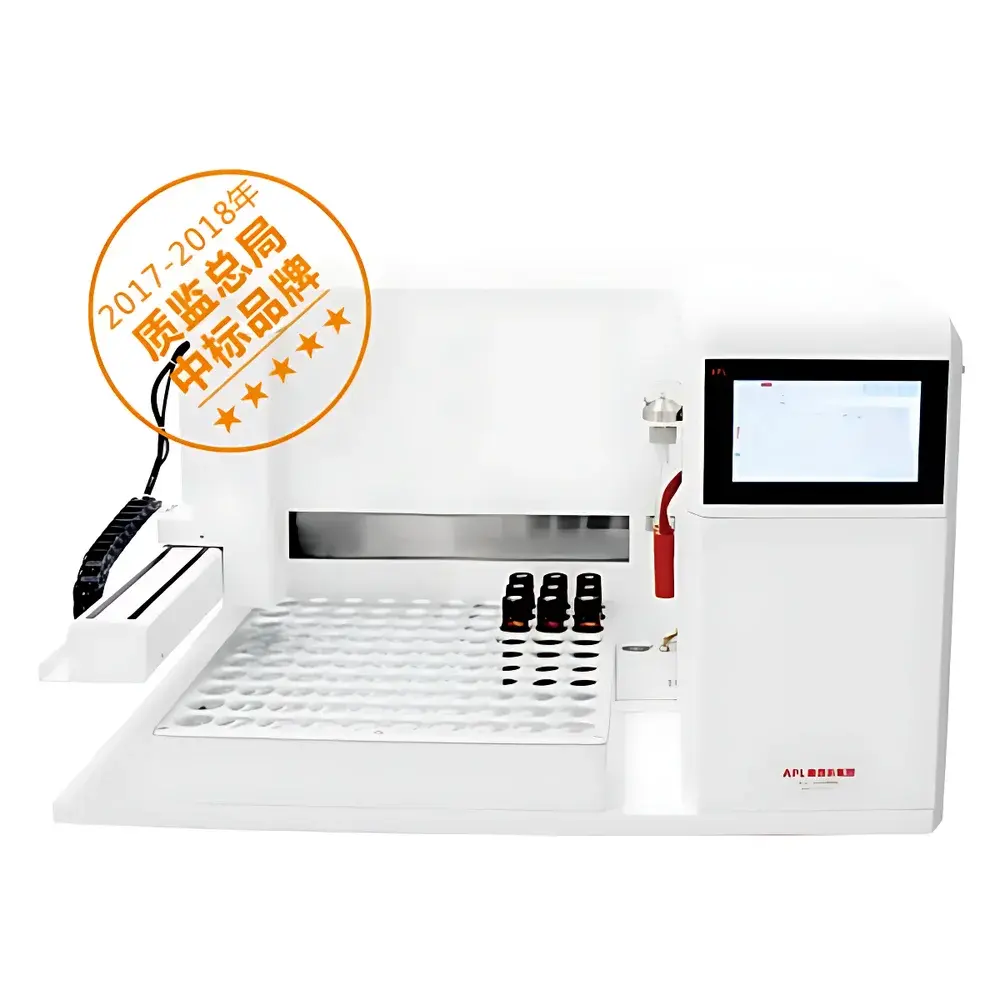
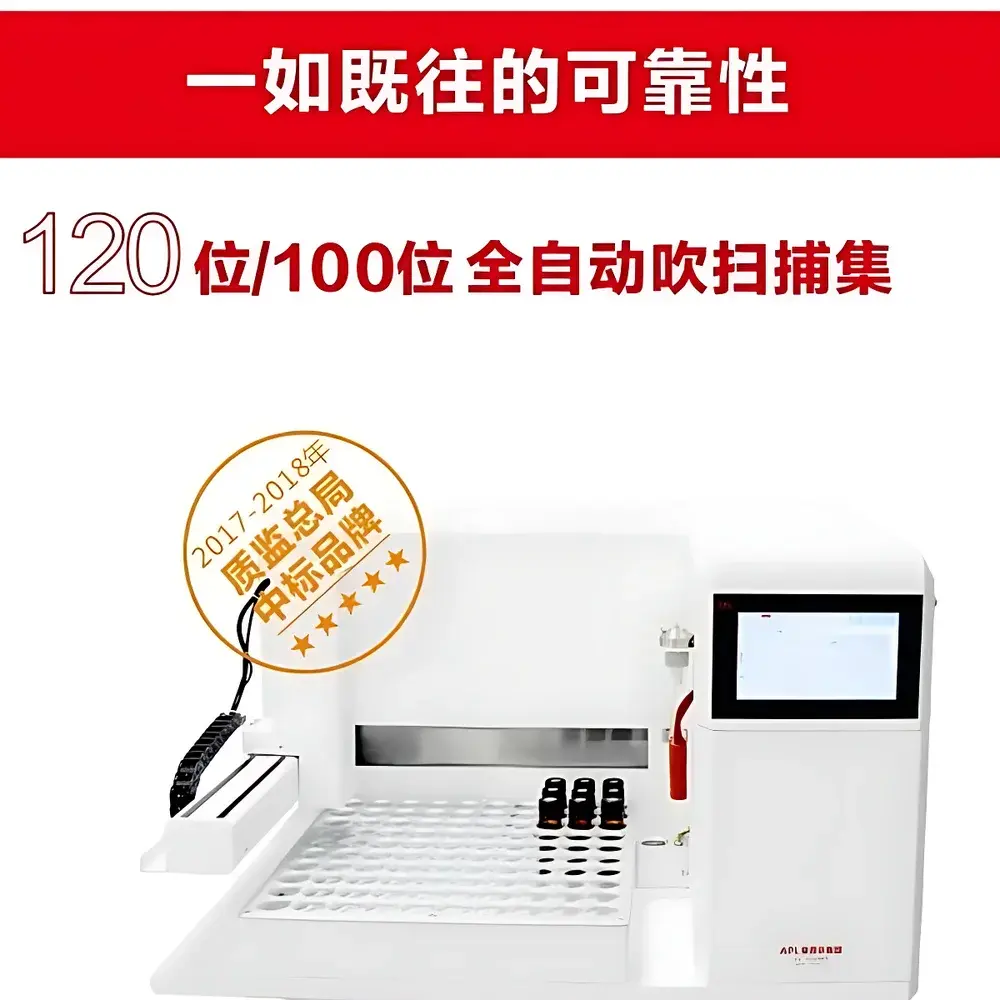
APL APL-PT-100 100-Position Fully Automated Purge and Trap System
| Brand | APL |
|---|---|
| Origin | Sichuan, China |
| Manufacturer Type | Manufacturer |
| Origin Category | Domestic |
| Model | APL-PT-100 |
| Sample Capacity | 100 positions |
| Injection Precision | RSD < 3% |
| Trap Temperature Range | −30 °C to 400 °C |
| Purge Sample Heating Temperature | Ambient to 120 °C |
| Sample Vial Cooling Temperature | −30 °C |
Overview
The APL APL-PT-100 is a fully automated, high-throughput purge and trap (P&T) sample introduction system engineered for trace-level volatile organic compound (VOC) analysis in aqueous, soil, and solid matrices. It operates on the principle of dynamic headspace extraction: inert gas purging volatilizes target analytes from the sample matrix into a carrier stream, which transports them onto a sorbent-packed trap where they are concentrated cryogenically. Subsequent thermal desorption injects the enriched analytes directly into a coupled gas chromatograph (GC) or GC–mass spectrometer (GC–MS) for separation and detection. Designed for unattended operation across full 100-sample batches, the APL-PT-100 integrates precise temperature control, leak-tight fluidic architecture, and inert sample pathways—ensuring high reproducibility, low carryover, and compliance with EPA Methods 502.2, 524.2, 624, 8260D, and ISO 15681-2.
Key Features
- Fully automated batch processing of 1–100 samples with real-time status animation, method parameter configuration, and integrated leak-check diagnostics with audible/visual fault alerts.
- Independent four-zone heating: purge valve, transfer line, water removal trap, and trap desorption zone—each controlled within ±1 °C for optimal analyte integrity and quantitative recovery.
- Dedicated trap bake-out program: enables standalone high-temperature conditioning (up to 400 °C) of the sorbent trap and associated lines to eliminate memory effects between runs.
- Programmable line cleaning protocol: targets residual organics in the transfer path using solvent-free thermal purging or optional inert gas flush sequences.
- Standalone trap desorption test mode: allows rapid verification of trap performance and contamination status without full purge cycle execution.
- Integrated 3-port solenoid valve module for precise, programmable internal standard addition—compatible with multi-component standard blends (e.g., fluorobenzene, bromofluorobenzene, t-butylbenzene).
- Magnetic stirring with adjustable speed (100–1200 rpm): ensures homogeneous mixing and enhanced mass transfer during aqueous purge, particularly for viscous or particulate-laden samples.
- Automatic back-flush of injection valve and transfer line post-desorption: minimizes cross-contamination between sequential samples by expelling residual vapors.
- Flexible purge modes: supports both in-situ (direct vial purge) and ex-situ (U-tube transfer) configurations for liquid samples—optimized for EPA-compliant matrix-specific protocols.
- Full-path thermal insulation and silanized surface treatment: all wetted components—including vial spindles, transfer tubing, and trap housing—are passivated to reduce adsorption, hydrolysis, and analyte degradation.
Sample Compatibility & Compliance
The APL-PT-100 accommodates 40-mL EPA vials (with septa), 22-mL soil vials, and custom solid-phase microextraction (SPME)-compatible formats. Its −30 °C vial cooling stabilizes thermally labile VOCs prior to purge initiation, while the integrated water removal trap (cooled to −30 °C) selectively condenses moisture before it reaches the sorbent trap—reducing GC column bleed, detector saturation, and retention time shifts. The system meets design requirements for GLP/GMP environments: audit-trail-capable method storage, user-access logs, and electronic signature support (when paired with compliant LIMS or chromatography data systems). It is compatible with 21 CFR Part 11–enabled GC and GC–MS platforms via configurable TTL/relay trigger outputs.
Software & Data Management
Controlled via Windows-based APL-PurgeSoft™ software, the system supports method cloning, sequence scheduling, real-time monitoring of temperature profiles and pressure curves, and automatic report generation (PDF/CSV). All method parameters—including purge time, desorption ramp rates, bake temperatures, and stir speed—are timestamped and stored with operator ID. Raw log files include diagnostic codes for leak events, temperature deviations >±2 °C, and valve actuation failures—facilitating root-cause analysis during regulatory audits. Export interfaces support ASTM E1381, ASTM E1461, and AnIML-compliant data exchange.
Applications
The APL-PT-100 is routinely deployed in environmental laboratories for drinking water, wastewater, groundwater, and leachate analysis per EPA SW-846; in food safety labs for residual solvents in beverages and packaged foods; and in pharmaceutical QC for genotoxic impurity screening (ICH Q3C). Its robustness supports high-volume contract testing labs performing >500 samples/week under ISO/IEC 17025 accreditation. Method validation data demonstrate ≤3% RSD for chlorinated ethenes, BTEX, and trihalomethanes across concentration ranges from 0.01–100 µg/L.
FAQ
Does the APL-PT-100 support remote monitoring and unattended overnight operation?
Yes—equipped with Ethernet connectivity and heartbeat polling, it enables remote status checks and sequence resumption after power recovery.
Can the system be validated for ISO/IEC 17025 or FDA-regulated workflows?
Yes—software logs, calibration records, and electronic signatures comply with documentation requirements when integrated with validated CDS platforms.
Is method transfer possible from legacy P&T systems (e.g., Tekmar, OI Analytical)?
Yes—parameter mapping tables and purge/desorb timing templates simplify migration; APL provides application notes for EPA 524.2 and 8260D equivalency testing.
What maintenance intervals are recommended for the water trap and sorbent trap?
Water trap regeneration every 200 injections; sorbent trap replacement or bake-out every 500–1000 injections depending on sample matrix cleanliness.
Does the system require external cryogens or liquid nitrogen?
No—all cooling functions (trap, vial, water trap) use closed-cycle Peltier thermoelectric modules—eliminating consumables and infrastructure dependencies.






