
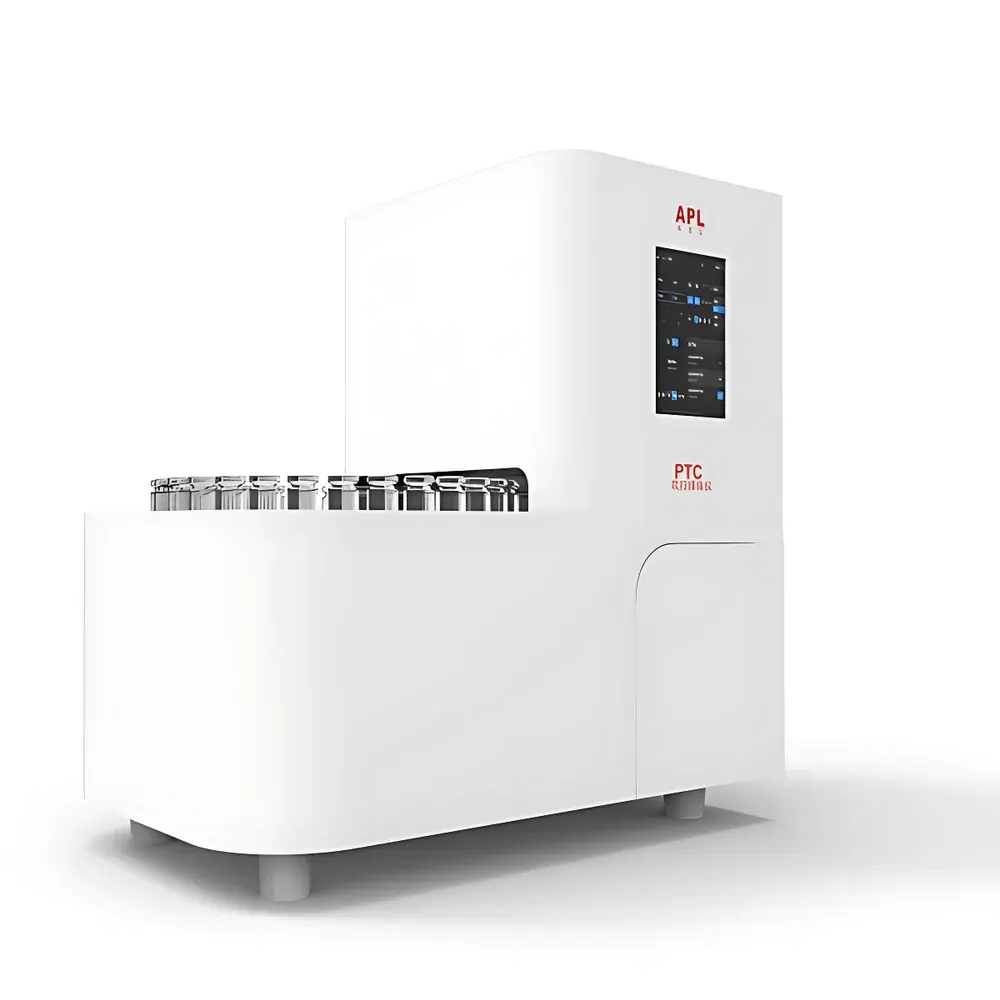
APL APL-PT-75 Fully Automated Purge and Trap System
| Brand | APL |
|---|---|
| Origin | Sichuan, China |
| Manufacturer Type | Direct Manufacturer |
| Instrument Category | Domestic (China-made) |
| Model | APL-PT-75 |
| Sample Tray Capacity | 75 positions |
| Injection Precision | RSD < 3% |
| Trap Temperature Range | –30 °C to 400 °C |
| Sample Heating Temperature | Ambient to 120 °C |
| Sample Vial Cooling Temperature | –30 °C |
| Purge Gas Flow Rate | 0–100 mL/min (adjustable) |
| Back-Flush Flow Rate | 0–100 mL/min (adjustable) |
| Water Removal Trap Temp | Ambient to 240 °C |
| Valve & Transfer Line Temp | Ambient to 220 °C |
| Sample Vial Size | 40 mL |
Overview
The APL APL-PT-75 Fully Automated Purge and Trap System is a high-throughput, laboratory-grade sample introduction platform engineered for the quantitative analysis of volatile organic compounds (VOCs) in aqueous, solid, and semi-solid matrices. It operates on the principle of dynamic headspace extraction: inert purge gas (typically helium or nitrogen) is passed through a heated, agitated sample to volatilize target analytes, which are then trapped onto a sorbent-packed trap at cryogenic temperatures. Following water removal and thermal desorption, the concentrated analytes are transferred directly into a gas chromatograph (GC) or GC-mass spectrometer (GC-MS) for separation and detection. Designed to meet stringent regulatory requirements for environmental monitoring, the system supports full compliance with U.S. EPA Method 502.2, 524.2, 624, and 8260, as well as Chinese national standards including HJ 605–2011, HJ 639–2012, HJ 686–2014, HJ 713–2014, HJ 735–2015, HJ 866–2017, HJ 893–2017, HJ 896–2017, and HJ 1020–2019.
Key Features
- 75-position autosampler tray with programmable sample sequencing and unattended operation from start to finish — including purge, trap, dry purge, desorption, injection, and bake-out.
- Independent four-zone temperature control: purge valve assembly, transfer line, water removal trap, and sorbent trap — each adjustable in 1 °C increments across defined operational ranges.
- Cryogenic trap cooling via Peltier-based electronic refrigeration, enabling precise adsorption at –30 °C and rapid, reproducible thermal desorption up to 400 °C.
- Integrated magnetic stirring with variable speed control (0–1200 rpm) for homogeneous sample agitation during purge, enhancing mass transfer efficiency and method robustness.
- Automated back-flush functionality for both transfer line and six-port valve, minimizing carryover between samples and extending maintenance intervals.
- Dedicated water removal trap (0–240 °C) with real-time moisture management, significantly reducing water vapor load on downstream GC columns and detectors.
- Universal GC/GC-MS trigger interface supporting TTL-level start signals compatible with Agilent, Thermo Fisher, Shimadzu, PerkinElmer, and other major chromatography platforms.
- Graphical user interface with animated status display, method library management, audit-ready event logging, and password-protected parameter editing.
Sample Compatibility & Compliance
The APL-PT-75 accommodates standard 40 mL EPA-compliant vials and accepts liquid, slurry, and homogenized solid samples (e.g., soil, sediment, wastewater, landfill leachate, food extracts). Its dual-mode capability—supporting both aqueous and soil/solid-phase VOC analysis—eliminates the need for separate instrumentation. All thermal zones maintain stability within ±0.5 °C over extended runs, ensuring inter-day repeatability required for GLP and ISO/IEC 17025-accredited laboratories. The system’s firmware records all temperature setpoints, flow rates, timing events, and operator actions with timestamped entries, satisfying data integrity expectations under FDA 21 CFR Part 11 when paired with validated LIMS integration.
Software & Data Management
Control software runs on Windows OS and provides intuitive method development tools, including stepwise time-programming for purge duration, dry purge, desorption ramp rate, and bake-out conditions. All methods are saved with version control and digital signatures. Raw event logs—including error codes, temperature deviations >1 °C, and flow calibration alerts—are exportable in CSV format. Audit trail functionality tracks user login/logout, parameter changes, and sequence modifications with immutable timestamps. Optional integration with third-party chromatography data systems (CDS) enables synchronized instrument control and result correlation.
Applications
- Regulatory environmental testing: VOCs in drinking water, surface water, groundwater, wastewater, and industrial effluents per EPA and HJ standards.
- Soil and sediment analysis for BTEX, chlorinated solvents (e.g., PCE, TCE), vinyl chloride, and petroleum hydrocarbons (C6–C9).
- Food safety screening: residual solvents, off-flavor compounds, and packaging migrants in beverages, dairy, and processed foods.
- Waste characterization: halogenated VOCs in solid waste leachates and landfill gas condensates.
- Method development labs requiring flexibility in trap chemistry selection (e.g., Tenax TA, Carbopack B/C, or custom multi-bed traps) and thermal desorption optimization.
FAQ
Does the APL-PT-75 support EPA Method 524.2 for drinking water analysis?
Yes — the system meets all instrumental requirements for purge gas flow control (±1 mL/min), trap temperature accuracy (±1 °C), and desorption transfer efficiency specified in Method 524.2.
Can it be integrated with an Agilent 8890 GC equipped with a split/splitless inlet?
Yes — the included TTL-compatible start cable and customizable inlet adapter bracket ensure seamless synchronization and carrier gas alignment.
Is the water removal trap replaceable in the field without tools?
Yes — the modular water trap assembly features quick-release fittings and standardized dimensions for on-site replacement in under two minutes.
What is the maximum allowable sample salinity for reliable performance?
The system has been validated for samples up to 35 g/L NaCl; higher salt concentrations require matrix-matched calibration or dilution to prevent trap clogging and valve corrosion.
How often does the cryogenic trap require maintenance or recalibration?
No routine recalibration is needed; Peltier-based cooling stability is verified during annual IQ/OQ protocols, and trap lifetime exceeds 10,000 cycles under normal use conditions.



