
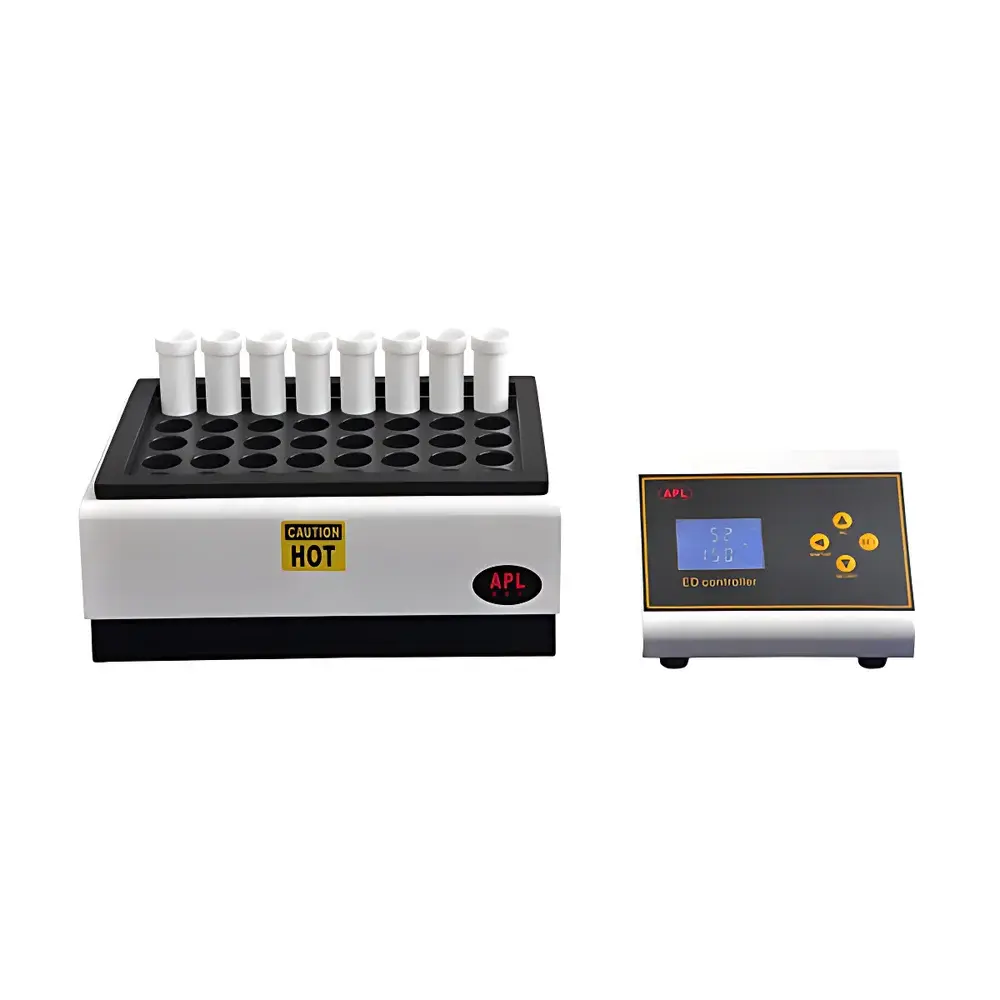
APL APL-TOC-30 Smart Graphite Digestion System for Soil Organic Carbon Analysis
| Brand | APL |
|---|---|
| Origin | Sichuan, China |
| Manufacturer Type | Direct Manufacturer |
| Regional Classification | Domestic (China) |
| Model | APL-TOC-30 |
| Instrument Category | Graphite Block Digestion System |
| Automation Level | Semi-Automatic |
| Digestion Positions | 30 |
| Temperature Range | Ambient to 350 °C |
| Temperature Control Accuracy | ±0.1 °C |
| Heating Principle | Electric Resistance Heating |
| Reagent Dispensing Channels | None |
| Power Supply | AC 220 V ±10%, 50 Hz |
| Rated Power | 1600 W |
| Well Dimensions | Ø30 mm × 55 mm depth |
| Inter-Well Temperature Uniformity | < ±1.0 °C (20–250 °C) |
| Control System | Detachable PID Controller with LCD Digital Display |
Overview
The APL APL-TOC-30 Smart Graphite Digestion System is a semi-automatic, high-precision thermal digestion platform engineered specifically for the quantitative determination of soil organic carbon (SOC) in accordance with standardized wet-oxidation protocols. It operates on the principle of controlled conductive heating via a monolithic, isostatically pressed high-purity graphite block — a material selected for its exceptional thermal homogeneity, chemical inertness against strong oxidants (e.g., potassium dichromate-sulfuric acid mixtures), and long-term dimensional stability under repeated thermal cycling. Unlike open-flame or ceramic-heated systems, the APL-TOC-30 delivers uniform thermal energy distribution across all 30 digestion positions, minimizing inter-sample temperature variance and ensuring reproducible oxidation kinetics essential for compliance with HJ 615–2011 (Chinese EPA standard equivalent to ISO 10694:1995 and ASTM D5088–17 for SOC quantification). The system is not designed for reagent addition or automated liquid handling; instead, it serves as a thermally regulated reaction platform where sample preparation, reagent dosing, and post-digestion analysis are performed manually by laboratory personnel.
Key Features
- Isostatically pressed ultra-high-purity graphite block ensures corrosion resistance to aggressive acidic digestants (e.g., H2SO4/K2Cr2O7) and maintains structural integrity at sustained temperatures up to 350 °C.
- 360° circumferential heating architecture minimizes radial thermal gradients, achieving inter-well temperature uniformity of < ±1.0 °C across the full operating range (20–250 °C), critical for batch consistency in multi-sample SOC workflows.
- PID-based digital temperature control with real-time feedback loop enables setpoint accuracy of ±0.1 °C, programmable ramp rates, hold-time scheduling, over-temperature/under-temperature alarms, and automatic power cutoff upon fault detection.
- Detachable controller with backlit LCD interface supports intuitive parameter entry, real-time temperature monitoring per zone group, and non-volatile storage of up to 10 user-defined digestion programs.
- Optimized well geometry (Ø30 mm × 55 mm depth) accommodates standard 100 mL borosilicate digestion tubes used in HJ 615–2011, supporting consistent meniscus height and vapor condensation dynamics during reflux.
Sample Compatibility & Compliance
The APL-TOC-30 is validated for use with mineral and organic soils, sediments, and composted matrices requiring quantification of total organic carbon via dichromate oxidation. It complies with the thermal requirements specified in HJ 615–2011, which mandates precise temperature control between 150–170 °C for 30 minutes during the primary digestion phase. While the instrument itself does not carry CE, UKCA, or FDA 510(k) certification, its design aligns with general laboratory safety principles outlined in ISO/IEC 17025:2017 (clause 6.4.1 on equipment suitability) and supports GLP-compliant documentation when integrated into validated SOPs. Users must implement independent verification of temperature uniformity (e.g., using NIST-traceable thermocouples) prior to routine use and document calibration history per internal quality management requirements.
Software & Data Management
The APL-TOC-30 employs embedded firmware without external PC connectivity or proprietary software. All operational parameters — including target temperature, ramp rate, dwell time, and alarm thresholds — are configured directly via the front-panel LCD interface. The controller logs no raw temperature data or timestamps; therefore, manual recording or integration with external data loggers is required for audit trails. For laboratories operating under 21 CFR Part 11 or ISO 17025, supplemental validation documentation (e.g., IQ/OQ protocols, temperature mapping reports, and preventive maintenance records) must be maintained separately. No electronic signature capability or user access control is provided.
Applications
- Determination of soil organic carbon content in agricultural, environmental, and geochemical surveys per HJ 615–2011 and comparable methods (e.g., Walkley–Black, modified Tyurin).
- Preparatory digestion step for subsequent spectrophotometric analysis (e.g., UV-Vis measurement of Cr3+ absorbance at 600 nm following reduction of excess dichromate).
- Method development and validation studies requiring tightly controlled thermal profiles for redox-based carbon oxidation kinetics.
- Batch processing of up to 30 soil samples under identical thermal conditions to reduce analytical variability in large-scale monitoring programs.
- Supporting QA/QC procedures such as matrix spike recovery, duplicate analysis, and certified reference material (CRM) verification in accredited environmental testing labs.
FAQ
Does the APL-TOC-30 support automated reagent addition?
No. This system provides only thermal regulation; all reagent dosing, tube capping, and post-digestion handling must be performed manually.
Can the instrument be used for heavy metal digestion (e.g., EPA Method 3050B)?
Not recommended. The well depth and thermal profile are optimized for SOC-specific reflux conditions, not for high-pressure acid digestion protocols requiring sealed vessels.
What calibration standards are required for routine operation?
Users must perform periodic temperature uniformity mapping using calibrated thermocouples traceable to national standards, especially before method validation or after maintenance.
Is the graphite block replaceable as a field-serviceable component?
Yes. The graphite block is mechanically secured and can be replaced without specialized tools; APL supplies OEM replacement blocks with documented thermal conductivity specifications.
Does the system meet electromagnetic compatibility (EMC) requirements for EU laboratories?
It has not been tested or certified to EN 61326-1. Laboratories in EU-regulated environments should conduct site-specific EMC evaluation prior to deployment.



