
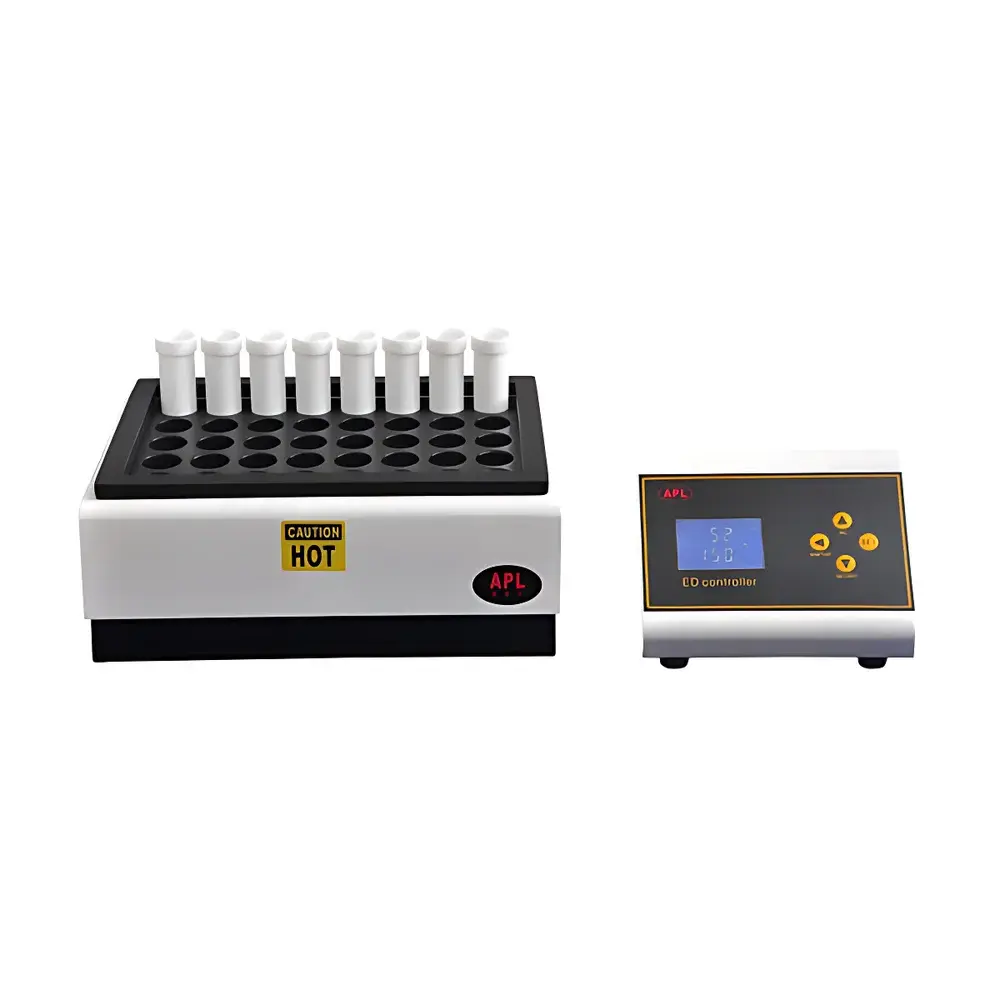
APL APL-TOC-60 60-Position Graphite Block Digestion System for Soil Organic Carbon Analysis
| Brand | APL |
|---|---|
| Origin | Sichuan, China |
| Manufacturer Type | Direct Manufacturer |
| Country of Origin | China |
| Model | APL-TOC-60 |
| Instrument Type | Graphite Block Digestion System |
| Automation Level | Semi-Automatic |
| Digestion Positions | 60 |
| Temperature Range | Ambient to 350 °C |
| Temperature Control Accuracy | ±0.1 °C |
| Heating Principle | Electric Resistance Heating with Isostatically Pressed High-Purity Graphite Block |
| Reagent Channels | None |
| Power Supply | AC 220 V ±10%, 50 Hz |
| Rated Power | 4000 W |
| Well Dimensions | Ø30 mm × 55 mm depth |
| Inter-Well Temperature Uniformity | < ±1.0 °C (25–250 °C) |
| Control System | Separated PID Controller with LCD Digital Display |
Overview
The APL APL-TOC-60 is a semi-automatic, high-capacity graphite block digestion system engineered specifically for standardized determination of soil organic carbon (SOC) according to HJ 615–2011 (Chinese EPA Method: Determination of Organic Carbon in Soils by Potassium Dichromate Oxidation–Spectrophotometry). Unlike conventional hot plates or open-flame digesters, this instrument employs an isostatically pressed, ultra-pure graphite heating block—selected for its exceptional thermal homogeneity, chemical inertness, and long-term stability under aggressive acidic conditions typical of dichromate-based oxidation protocols. The system operates on the principle of conductive, uniform resistive heating across all 60 digestion wells, ensuring reproducible thermal profiles critical for quantitative redox reactions. Its design eliminates convective heat loss and minimizes axial/radial temperature gradients, directly supporting method compliance where reaction kinetics and endpoint consistency are governed by precise, sustained temperature control.
Key Features
- Isostatically pressed high-purity graphite block: Resistant to corrosion from concentrated H2SO4, K2Cr2O7, and H3PO4 solutions; maintains structural integrity over >5,000 digestion cycles.
- 60-position digestion capacity with Ø30 mm × 55 mm well geometry: Optimized for standard 100 mL borosilicate digestion tubes used in HJ 615–2011; enables true parallel processing without cross-contamination risk.
- PID-controlled digital temperature regulation: Achieves ±0.1 °C setpoint accuracy across the full 25–350 °C range; supports programmable ramp-hold profiles including pre-heating, oxidation hold, and cooling phases.
- Inter-well temperature uniformity < ±1.0 °C (25–250 °C): Verified per ASTM E220 calibration protocol using NIST-traceable Pt100 probes; essential for inter-sample comparability in batch analysis.
- Separate controller unit with backlit LCD interface: Enables remote placement from the heating block to reduce ambient thermal interference; displays real-time temperature, setpoint, elapsed time, and alarm status.
- Robust electrical architecture: 4000 W rated power with dual-stage overtemperature protection (electronic cut-off + mechanical bimetal switch); complies with IEC 61010-1 safety standards for laboratory heating equipment.
Sample Compatibility & Compliance
The APL-TOC-60 accommodates standard 100 mL borosilicate digestion tubes (included) and is fully compatible with the reagent volumes, acid concentrations, and heating durations specified in HJ 615–2011. It also supports alternative SOC methodologies requiring comparable thermal profiles—including modified Walkley–Black procedures and ISO 14235:1998 (Soil quality — Determination of organic carbon content). While not a regulated analytical instrument under FDA 21 CFR Part 11, its PID logging capability (via optional RS232/USB output) allows integration into GLP-compliant workflows when paired with validated third-party data acquisition software. All materials contacting samples meet USP Class VI biocompatibility requirements for glass and graphite components.
Software & Data Management
The base configuration includes a standalone controller with non-volatile memory storing up to 10 user-defined temperature programs. Optional communication modules (RS232 or USB-to-serial) enable connection to LIMS or custom LabVIEW/Python scripts for automated parameter logging, timestamped event capture (e.g., start/stop, alarm triggers), and CSV export of temperature vs. time datasets. Audit trail functionality—including operator ID tagging and change history—is achievable through external software validation in accordance with ISO/IEC 17025:2017 Clause 7.7. No proprietary cloud platform or subscription service is required or embedded.
Applications
- Routine quantification of soil organic carbon in agricultural, environmental, and geochemical laboratories.
- Method validation and inter-laboratory comparison studies under CNAS or CMA accreditation frameworks.
- Preparation of digests for downstream UV-Vis spectrophotometric analysis at 585 nm (dichromate reduction assay).
- Supporting long-term soil health monitoring programs requiring high-throughput, low-variance sample preparation.
- Research applications involving comparative thermal stability studies of organic matter fractions under controlled oxidative stress.
FAQ
Does the APL-TOC-60 support fully automated reagent addition or timing sequences?
No. It is a semi-automatic digestion system: users manually add reagents and initiate heating cycles via the controller. No integrated liquid handling or timed dispensing is provided.
Can the instrument be used for heavy metal digestion (e.g., EPA 3050B)?
Not recommended. The well depth (55 mm) and absence of reflux condensers limit its suitability for prolonged nitric/hydrochloric acid digestions requiring vapor containment. It is optimized for closed-tube, short-duration dichromate oxidations only.
Is calibration certificate included with shipment?
A factory calibration report (traceable to national metrology institutes) is supplied. Full ISO/IEC 17025 calibration requires third-party service and is not bundled.
What maintenance is required for long-term performance?
Annual inspection of graphite block surface integrity and PID sensor drift verification using reference thermocouples is advised. No consumable parts beyond digestion tubes are specified.
Are replacement digestion tubes available in alternative materials (e.g., PTFE)?
Only borosilicate glass tubes meeting HJ 615–2011 specifications are supported. PTFE or quartz alternatives are incompatible due to dimensional and thermal expansion mismatches with the graphite block design.



