
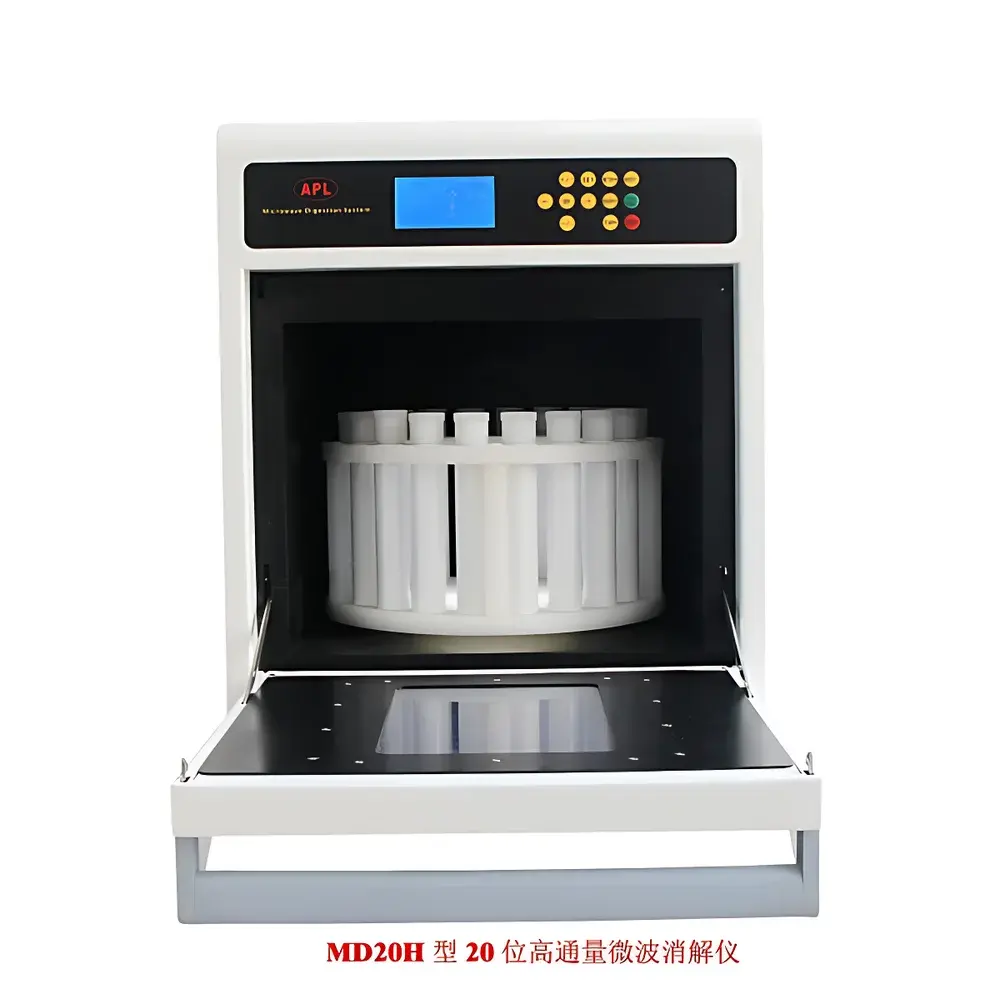
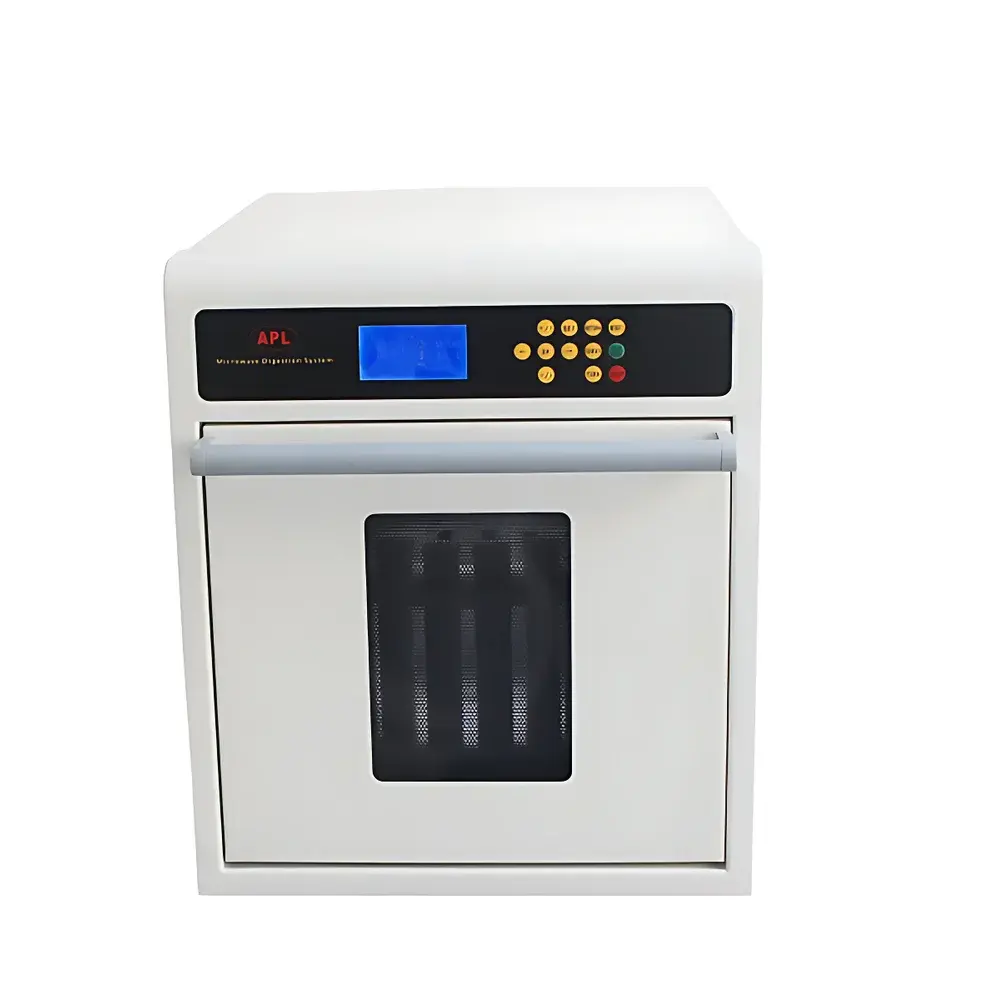
APL BUS High-Throughput Microwave Digestion System
| Brand | APL |
|---|---|
| Origin | Sichuan, China |
| Manufacturer Type | Original Equipment Manufacturer (OEM) |
| Product Origin | Domestic (China) |
| Model | BUS |
| Price Range | USD 56,000 – 70,000 |
| Cavity Class | Industrial Grade |
| Maximum Sample Capacity | 40 vessels |
| Microwave Source | Dual Magnetron |
| Max Temperature | 305 °C |
| Max Pressure | 22,000 psi |
| Input Power | 220 VAC, 50 Hz, 15 A |
| Total System Power | 3600 W |
| Microwave Output Power | 2200 W |
| Output Mode | Non-pulsed, continuous microwave (0–2200 W adjustable) |
| Cavity Volume | 66 L |
| Cavity Material | 316 stainless steel with multi-layer PTFE-based high-temp corrosion-resistant coating |
| Cooling | Integrated high-turbulence forced-air cooling system |
| Safety | Aerospace-grade composite fiber outer vessels with 3D vertical explosion containment, real-time pressure/temperature monitoring, electromagnetic leakage < 1 mW/cm² (per GB 10436 & IEC 61000-3-2) |
Overview
The APL BUS High-Throughput Microwave Digestion System is an industrial-grade sample preparation platform engineered for complete, reproducible, and trace-metal-clean decomposition of complex solid and semi-solid matrices prior to elemental analysis. It operates on the principle of controlled microwave dielectric heating—where polar molecules (e.g., HNO₃, HCl, HF, H₂O) absorb electromagnetic energy at 2.45 GHz, generating rapid, volumetric internal heating within sealed quartz or TFM-lined digestion vessels. Unlike open-vessel hotplate digestion or single-sample microwave systems, the BUS leverages dual magnetron architecture and bidirectional waveguide distribution to achieve uniform field distribution across its 66 L cavity—minimizing thermal gradients and ensuring parallel processing of up to 40 samples under identical thermobaric conditions. This capability directly supports regulatory compliance in environmental, geochemical, clinical, and food safety laboratories where batch integrity, low procedural blanks, and method traceability are non-negotiable.
Key Features
- Industrial dual-magnetron microwave source delivering 2200 W non-pulsed, continuously adjustable output for precise kinetic control over digestion ramping, hold, and cooling phases.
- 66 L cavity constructed from electropolished 316 stainless steel with multi-layer fluoropolymer (PTFE-based) high-temperature coating—resistant to aggressive acid mixtures (e.g., aqua regia, HF/HNO₃) and sustained operation up to 305 °C.
- 3D vertical explosion containment system using aerospace-grade composite fiber outer vessels—certified to withstand 22,000 psi burst pressure with zero rupture propagation; integrated passive pressure release and active real-time vessel monitoring (pressure ±0.5 bar, temperature ±0.5 °C).
- Optical-grade borosilicate anti-explosion viewing window with wireless HD video streaming capability—enabling remote visual verification of vessel integrity and reaction behavior via secure iOS/Android app without opening the cavity.
- High-turbulence forced-air cooling module with intelligent thermal load balancing—reducing post-digestion cooldown time by >60% versus conventional fan-assisted systems, while maintaining vessel seal integrity during depressurization.
- Electromagnetic shielding compliant with IEC 61000-3-2 and GB 10436: measured leakage <1 mW/cm² at 5 cm distance—ensuring operator safety and compatibility with adjacent sensitive instrumentation (e.g., ICP-MS).
Sample Compatibility & Compliance
The BUS accommodates standard 55 mL or 100 mL TFM, quartz, or reinforced PFA digestion vessels—compatible with EPA Methods 3015A, 3051A, 3052, and 3546; ASTM D5511, D5512; AOAC 999.10 and 2007.01; and ISO 11466 for trace metal analysis in soils, sediments, biological tissues, polymers, and foodstuffs. Its closed-vessel design eliminates volatile element loss (e.g., As, Se, Hg, Pb), enabling accurate quantification by GF-AAS, ICP-OES, and quadrupole/time-of-flight ICP-MS. All digestion protocols are fully auditable and support 21 CFR Part 11-compliant electronic signatures when paired with optional LIMS-integrated software modules.
Software & Data Management
The embedded control interface features a 10.1″ capacitive touchscreen running APL Digisafe OS v4.2—supporting method library management, real-time graphing of pressure/temperature/power curves, automatic method validation logging, and export of CSV/Excel-compatible audit trails. Optional APL LabLink Suite enables integration with laboratory information management systems (LIMS), GLP/GMP workflow enforcement, and remote diagnostics via TLS 1.3-secured cloud gateway. All data—including raw sensor streams, user actions, calibration logs, and error events—are timestamped, immutable, and stored locally with RAID-1 redundancy.
Applications
- Environmental testing: heavy metal extraction from soil, sludge, fly ash, and airborne particulates per EPA SW-846.
- Clinical & pharmaceutical: digestion of tissue biopsies, dietary supplements, and excipient matrices for USP / elemental impurity screening.
- Geochemical research: complete dissolution of silicate rocks, ores, and refractory minerals using HF-inclusive protocols.
- Food safety: determination of toxic elements (Cd, Pb, As, Sn) in infant formula, seafood, and fortified cereals under ISO 17294-2 and EN 13805.
- Materials science: liberation of dopants and contaminants from catalysts, batteries, and electronic waste for recycling analytics.
FAQ
What safety certifications does the BUS system meet?
It complies with IEC 61010-1 (electrical safety), IEC 61000-3-2 (EMC), GB 10436 (microwave leakage), and incorporates mechanical safety interlocks certified to ISO 13857. Vessel burst testing follows ASTM E2913-13 protocols.
Can the BUS be integrated into an automated sample prep line?
Yes—via optional RS-485/Modbus TCP and dry-contact I/O interfaces, it supports handshake protocols with robotic autosamplers and liquid handlers for unattended 24/7 operation.
Is method transfer from legacy microwave systems supported?
Pre-validated method conversion tables (including ramp rates, hold times, and acid volumes) are provided for common instruments (CEM MARS 6, Anton Paar Multiwave PRO, Milestone ETHOS UP).
What maintenance is required for long-term reliability?
Annual calibration of pressure/temperature sensors and magnetron output verification are recommended; cavity coating inspection every 500 cycles; no routine magnetron replacement needed below 10,000 operating hours.
Does the system support custom vessel geometries or third-party consumables?
Only APL-certified vessels with integrated RFID tags are recognized by the control system—ensuring pressure rating validation, thermal history tracking, and automatic protocol lockout for incompatible configurations.



