
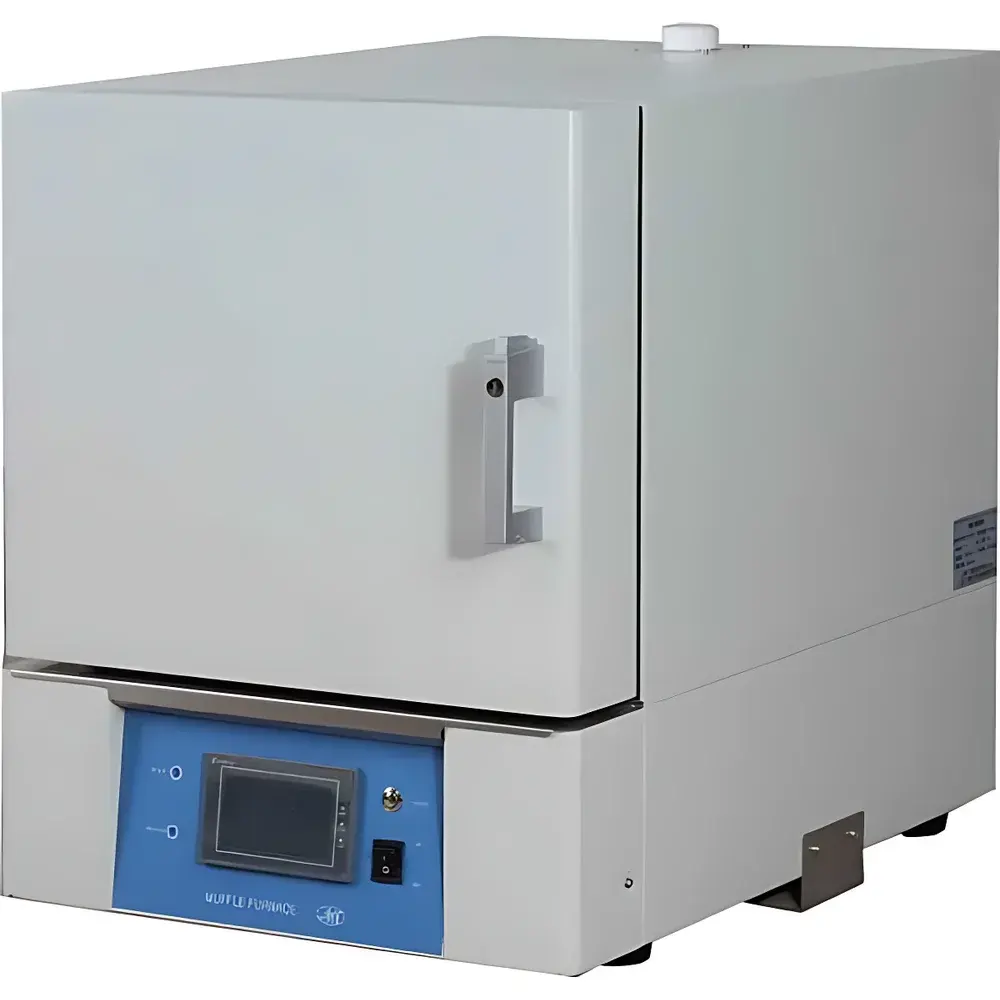
APL CFF-2.5-12T Integrated Ceramic Fiber Muffle Furnace
| Brand | APL |
|---|---|
| Origin | Sichuan, China |
| Manufacturer Type | Direct Manufacturer |
| Product Category | Domestic |
| Model | CFF-2.5-12T |
| Instrument Type | Box-Type Muffle Furnace |
| Maximum Temperature | 1200 °C |
| Temperature Control Accuracy | ±1 °C |
| Rated Power | 2500 W |
| Time to Reach 1000 °C | ≤20 min |
| Heating Element | Fe-Cr-Al Alloy Wire |
| Internal Chamber Dimensions | 200 × 120 × 80 mm |
| Chamber Volume | 2 L |
| Operating Voltage | AC 220 V, 50 Hz |
| Control System | PID Temperature Controller |
| Insulation Material | High-Purity Alumina-Silica Ceramic Fiber |
Overview
The APL CFF-2.5-12T Integrated Ceramic Fiber Muffle Furnace is an engineered solution for high-temperature laboratory thermal processing, designed to meet the stringent demands of materials synthesis, ash content analysis, calcination, sintering, and heat treatment protocols in academic, industrial, and quality control laboratories. Unlike conventional refractory brick muffle furnaces, this unit employs a monolithic alumina-silica ceramic fiber insulation system—sourced from U.S.-specification raw materials—providing exceptional thermal efficiency and structural lightness. The furnace operates on the principle of resistive heating via high-stability Fe-Cr-Al alloy wire elements embedded within a low-thermal-mass cavity, enabling rapid thermal equilibration and minimizing energy dissipation. Its maximum operating temperature of 1200 °C (with continuous use recommended up to 1100 °C) complies with ASTM E1142 and ISO 8573-1 thermal classification standards for Class B laboratory ovens. The integrated chassis design eliminates external insulation cladding, reducing footprint while maintaining surface temperatures below 60 °C at 1000 °C internal setpoint—well under the ISO 13732-1 safety threshold of 100 °C for accessible surfaces.
Key Features
- Monolithic high-purity ceramic fiber chamber (alumina-silica composition, ≥96% Al₂O₃ equivalent) offering thermal conductivity <0.08 W/m·K at 1000 °C, resulting in ~60% energy reduction versus traditional brick-lined furnaces.
- Double-wall structural housing with forced-air cooling ducts and axial fans, maintaining external cabinet temperature within 10 °C of ambient during extended operation at 1100 °C.
- PID-based digital temperature controller with auto-tuning capability, delivering ±1 °C stability over full range (room temperature to 1200 °C) and supporting ramp-hold programming with up to 30 segments.
- Integrated safety architecture including dual independent over-temperature cutoffs (mechanical and electronic), real-time thermocouple fault detection, audible/visual alarm activation, and automatic power cutoff upon sensor failure or deviation >±5 °C from setpoint.
- Seamless one-piece furnace chamber construction—no joints or seams—to eliminate fiber shedding, particulate contamination, or thermal bridging; validated per USP for non-shedding performance in GMP-compliant sample preparation.
Sample Compatibility & Compliance
The CFF-2.5-12T accommodates crucibles, boats, and sample holders made from alumina, quartz, silicon carbide, or platinum-group metals—compatible with ASTM C71, ISO 562, and EN 15407 ashing procedures. Its uniformity profile (<±3 °C across the 2 L chamber at 1000 °C, per ASTM E220 calibration methodology) ensures reproducible thermal exposure for gravimetric analysis, LOI (Loss on Ignition), and catalyst activation. The unit conforms to IEC 61000-6-3 (EMC emissions), IEC 61000-6-2 (immunity), and UL 61010-1 / CSA C22.2 No. 61010-1 for electrical safety. Optional NIST-traceable calibration certificate and IQ/OQ documentation packages are available to support GLP, GMP, and ISO/IEC 17025 laboratory accreditation requirements.
Software & Data Management
While the standard configuration features a front-panel PID controller with LED display and manual program entry, optional RS485 Modbus RTU interface enables integration with LabVIEW™, MATLAB®, or LIMS platforms for automated data logging. When paired with APL’s optional TC-Link™ software (v3.2+), users gain access to time-stamped temperature profiles, audit trails compliant with FDA 21 CFR Part 11 (electronic signatures, user-level permissions, and immutable record storage), and export to CSV/PDF formats. All firmware updates preserve calibration coefficients and historical setpoint logs without reset.
Applications
- Quantitative ash determination in food, pharmaceuticals, and environmental samples per AOAC 942.05 and EPA Method 2540E.
- Thermal decomposition studies of polymers, battery cathode precursors, and metal-organic frameworks (MOFs).
- Rapid pre-firing of ceramic green bodies and sintering trials under controlled oxidative atmospheres.
- Residue analysis in QC labs performing USP , Ph. Eur. 2.2.34, or JP 17 thermal residue tests.
- Calibration of thermocouples and reference materials using fixed-point cells (e.g., Ag, Cu, Al freezing points) in metrology workflows.
FAQ
What is the recommended maintenance interval for the ceramic fiber chamber?
Ceramic fiber integrity should be visually inspected before each high-temperature cycle; no scheduled replacement is required under normal operation (≤1100 °C, <5 h/day). Avoid mechanical abrasion or exposure to halogens, alkalis, or phosphoric acid vapors.
Can this furnace operate under inert or reducing atmospheres?
The standard configuration is rated for air atmosphere only. For nitrogen, argon, or forming gas applications, optional quartz tube inserts with flanged sealing and gas inlet/outlet ports must be specified at time of order.
Is the temperature controller compliant with FDA 21 CFR Part 11 for electronic records?
The base PID controller does not include Part 11 functionality; however, the optional TC-Link™ software package provides full compliance—including role-based access, electronic signatures, and audit trail generation—when deployed on validated Windows OS environments.
What thermocouple type is used for internal sensing?
A grounded K-type (Chromel-Alumel) thermocouple with mineral-insulated sheath is factory-installed and calibrated against NIST-traceable references.
Does the unit include a validation protocol for IQ/OQ qualification?
Yes—APL provides a customizable IQ/OQ template aligned with Annex 15 and ASTM E2500, including test scripts for temperature uniformity mapping, alarm verification, and ramp-rate validation. On-site qualification support is available upon request.
Related Products



