
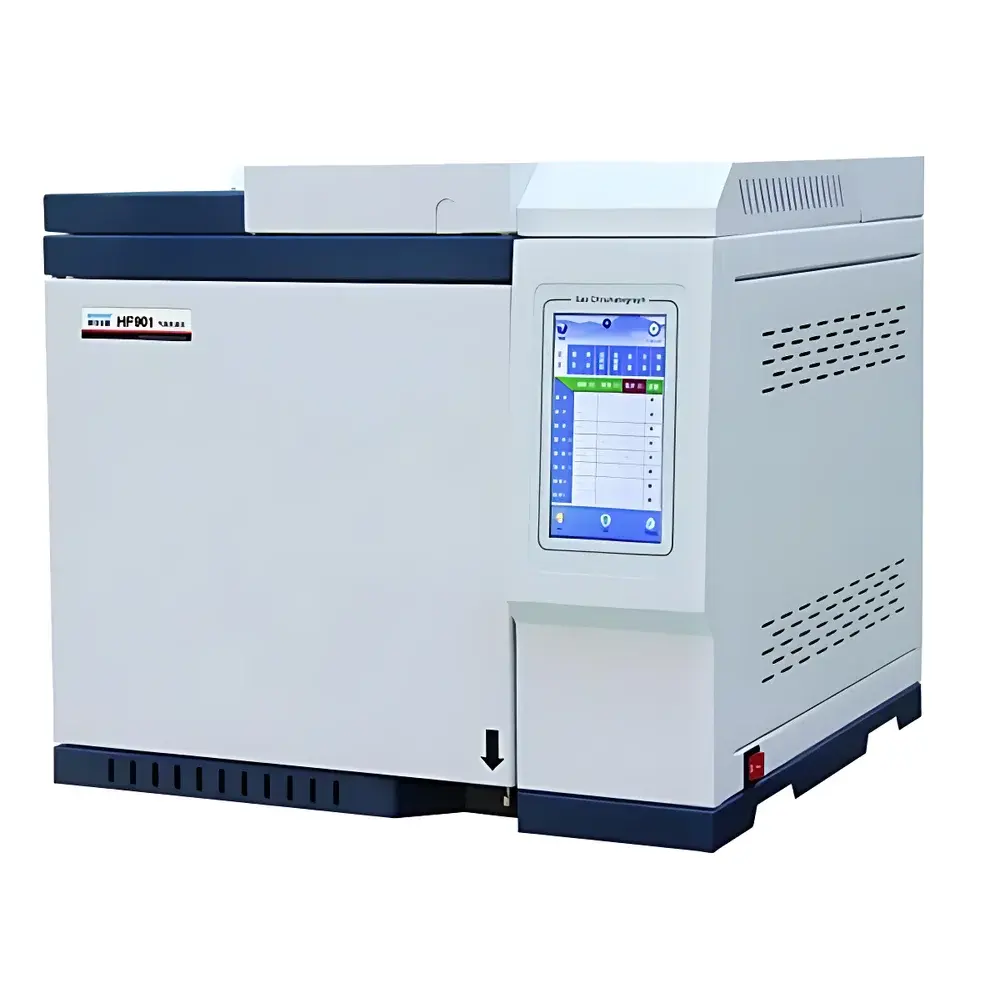
APL GC-901 Gas Chromatograph
| Brand | APL |
|---|---|
| Origin | Sichuan, China |
| Manufacturer Type | Direct Manufacturer |
| Regional Classification | Domestic (China) |
| Model | APL-GC-901 |
| Instrument Type | Laboratory Gas Chromatograph |
| Application Scope | General-Purpose |
| Oven Temperature Range | Ambient to 450 °C |
| Oven Ramp Rate | 0.1–80 °C/min |
| Oven Cool-Down Rate | 0.1–80 °C/min |
| Carrier Gas Flow Range & Control | 0–100 mL/min |
| Carrier Gas Pressure Range & Control | 0–0.6 MPa |
| Injector Maximum Operating Temperature | Ambient to 450 °C |
| Injector Pressure Setpoint Range | 0–0.6 MPa |
| Injector Total Flow Setpoint Range | 0–100 mL/min |
| Temperature Zones | 8 independently controlled zones |
| Programmable Temperature Steps | 16 stages |
| External Event Inputs | 6 channels |
| Auxiliary Outputs | 2 channels |
| Detector Capacity | Up to 3 detectors (FID, TCD, ECD, FPD, NPD selectable) |
| Injection Modes | Packed column, capillary column, valve injection, headspace (with optional autosampler), thermal desorption |
| EPC/EFC Modes | Constant-flow and constant-pressure |
| Supported Gases | N₂, H₂, Air, He, Ar |
| EPC Pressure Resolution | 0.01 psi |
| EPC Flow Resolution | 0.01 mL/min |
| Communication Interface | 10/100 M adaptive Ethernet with embedded TCP/IP stack |
| Software | iBrainChrom workstation supporting up to 253 concurrent GC systems, 21 CFR Part 11 compliance (audit trail, role-based user permissions, electronic signatures), Modbus RTU protocol for DCS integration |
Overview
The APL GC-901 is a high-performance, laboratory-grade gas chromatograph engineered for precision, reproducibility, and operational robustness in routine and regulated analytical environments. Based on the fundamental principle of differential partitioning of volatile and semi-volatile analytes between a mobile phase (carrier gas) and a stationary phase (capillary or packed column), the GC-901 delivers reliable separation, detection, and quantification across a broad chemical space—including organic compounds, inorganic volatiles, and permanent gases. Its modular architecture supports dual-oven configurations, multi-detector deployment, and seamless integration with sample introduction systems such as headspace autosamplers, thermal desorbers, and purge-and-trap modules. Designed and manufactured in Sichuan, China, the instrument meets GB/T 30431–2021 (Chinese National Standard for Gas Chromatographs) and incorporates design elements aligned with ISO/IEC 17025 method validation requirements.
Key Features
- Full Electronic Pressure and Flow Control (EPC/EFC): Digital regulation of carrier, makeup, and detector gases with resolution of 0.01 psi (pressure) and 0.01 mL/min (flow), minimizing retention time drift and enhancing inter-run reproducibility.
- Eight Independent Temperature Zones: Includes oven, up to three detectors, and up to four inlet modules—each programmable from ambient to 450 °C in 0.1 °C increments, with temperature stability ±0.01 °C.
- High-Speed Thermal Management: Programmable ramp rates from 0.1 to 80 °C/min and active cool-down control enable rapid cycle times without compromising column integrity or baseline stability.
- 7-Inch Industrial TFT Color Touchscreen: Dual-language interface (English/Chinese), intuitive navigation, real-time parameter monitoring, and local method execution—no PC required for basic operation.
- Embedded Ethernet Connectivity: Integrated 10/100 M MAC controller with static/DHCP IP assignment, enabling remote instrument control, firmware updates, and centralized data aggregation within LAN or LIMS environments.
- Intelligent Safety Protocols: Automatic flame-out detection and re-ignition for FID; pressure-loss fault detection with pneumatic shutdown; leak-tolerant startup sequences; and hardware-enforced interlocks for detector and inlet safety.
Sample Compatibility & Compliance
The GC-901 accommodates diverse sample matrices via configurable inlet systems: split/splitless injectors for liquid samples, gas-tight valves for permanent gas analysis, programmable temperature vaporizing (PTV) inlets for thermally labile compounds, and dedicated interfaces for headspace, thermal desorption, and purge-and-trap modules. It supports all major detector types—including Flame Ionization (FID), Thermal Conductivity (TCD), Electron Capture (ECD), Flame Photometric (FPD), and Nitrogen-Phosphorus (NPD)—enabling trace-level detection (sub-pg for ECD, low-pg for FID) across environmental, petrochemical, food safety, pharmaceutical, and public health applications. The system complies with ASTM D3612 (oil analysis), EPA Method 8260/8270 (volatile/semi-volatile organics), ISO 11843-2 (detection limit estimation), and supports GLP/GMP workflows through full 21 CFR Part 11–compliant audit trails, electronic signatures, and hierarchical user access control.
Software & Data Management
The iBrainChrom workstation serves as the central analytical platform, offering native support for up to 253 GC instruments on a single network segment. It provides full bidirectional instrument control, real-time chromatogram visualization, peak integration using ISO 14155–aligned algorithms, calibration curve generation (linear, quadratic, weighted), and customizable report templates compliant with ISO/IEC 17025 reporting clauses. Audit trail records include operator ID, timestamp, parameter changes, method modifications, and raw data export events—with immutable storage and configurable retention policies. Role-based permissions enforce separation of duties (e.g., analyst, reviewer, administrator), while Modbus RTU integration allows direct forwarding of quantitative results to distributed control systems (DCS) or MES platforms without middleware.
Applications
The GC-901 is routinely deployed in accredited testing laboratories for residual solvent analysis in pharmaceuticals (ICH Q3C), pesticide screening in food commodities (GB 23200 series), hydrocarbon speciation in gasoline and diesel (GB/T 30519), VOC profiling in indoor air (HJ 644–2013), and monomer quantification in polymer manufacturing. Its flexibility extends to academic research in metabolomics (headspace-GC-MS coupling), environmental forensics (petroleum fingerprinting), and quality control in fine chemical synthesis—where precise retention time locking, method transferability, and long-term baseline stability are critical success factors.
FAQ
Does the GC-901 support regulatory-compliant data handling per FDA 21 CFR Part 11?
Yes—the iBrainChrom workstation implements full electronic signature enforcement, audit trail logging with tamper-evident hashing, and role-based access controls required for GxP environments.
Can the instrument operate without a connected PC after method loading?
Yes—local method storage and touchscreen execution allow standalone operation; the PC is required only for advanced data processing, method development, or network administration.
What carrier gases are supported under EPC mode?
Nitrogen, hydrogen, helium, argon, and compressed air—all with independent pressure and flow control calibrated per ISO 6145.
Is remote diagnostics available via Ethernet?
Yes—embedded web server enables live status monitoring, error log retrieval, and secure firmware updates over standard HTTP/HTTPS with TLS 1.2 encryption.
How many external devices can be synchronized via the 6-event input interface?
Up to six TTL-compatible triggers (e.g., autosampler start, fraction collector activation, or modulator reset) can be precisely timed relative to oven or detector events.





