
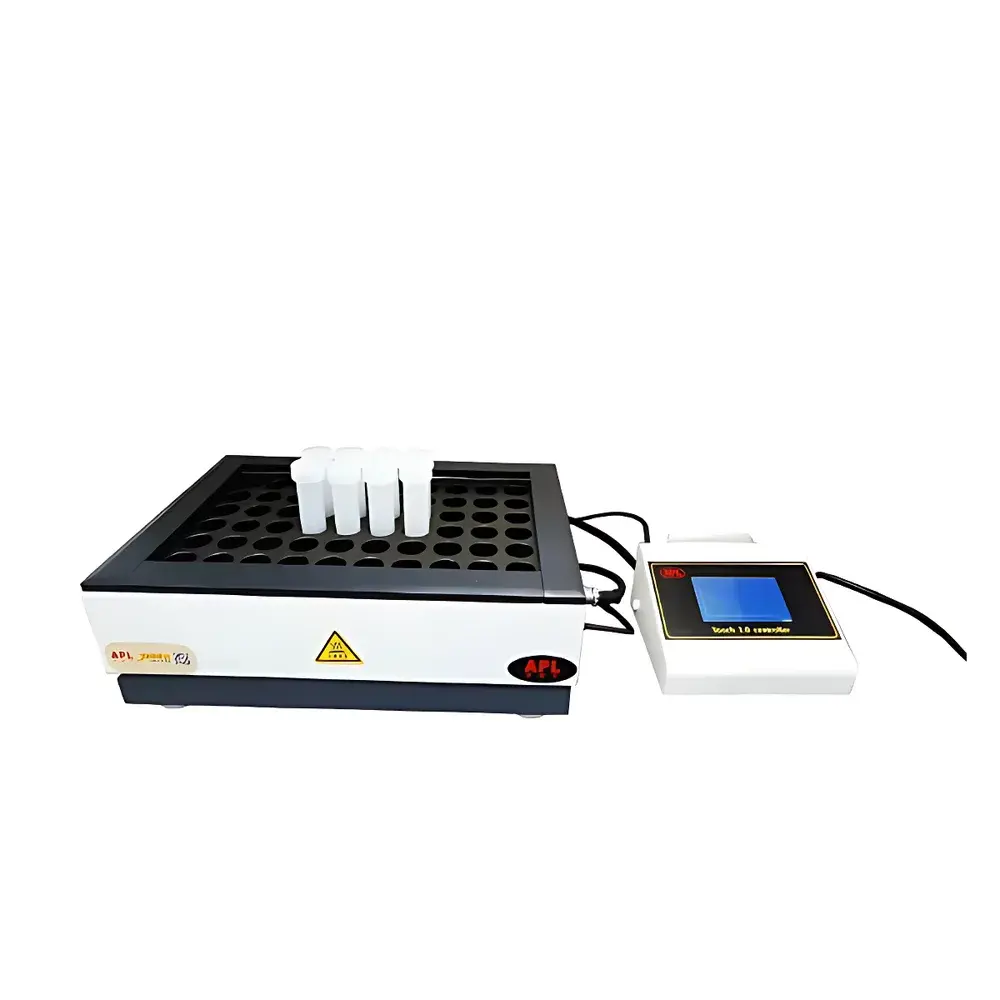
APL GD104 Graphite Block Digestion System
| Brand | APL |
|---|---|
| Origin | Sichuan, China |
| Manufacturer Type | Direct Manufacturer |
| Instrument Type | Graphite Block Digestion System |
| Automation Level | Semi-Automatic |
| Digestion Positions | 104 |
| Max. Heating Temperature | 350 °C |
| Temperature Control Accuracy | ±0.1 °C |
| Heating Medium | Isostatically Pressed High-Purity Graphite |
| Power Supply | AC 220 V ±10%, 50 Hz |
| Rated Power | 4000 W |
| Heating Block Dimensions | 104 × Ø30 mm × 55 mm (D × H) |
| Inter-Well Temperature Uniformity | ≤ ±1.5 °C (RT–250 °C) |
| Control System | Detached PID Controller with LCD Digital Display |
| Heating Method | Full Perimeter Surround Heating |
Overview
The APL GD104 Graphite Block Digestion System is a high-capacity, semi-automated sample preparation instrument engineered for precise, reproducible, and scalable acid digestion of solid and semi-solid matrices. It operates on the principle of conductive heating via an isostatically pressed high-purity graphite block — a material selected for its exceptional thermal homogeneity, chemical inertness against aggressive mineral acids (including HNO3, HCl, HF, and H2SO4), and long-term dimensional stability under repeated thermal cycling. Unlike ceramic or metal-heated blocks, graphite delivers uniform volumetric heat transfer with minimal thermal lag, enabling tightly controlled ramp-and-hold temperature profiles across all 104 digestion wells. This architecture supports standardized digestion protocols required for trace elemental analysis by ICP-OES, ICP-MS, AAS, and HG-AFS, particularly where batch consistency, low blank levels, and compliance with ISO 17294-2, EPA Method 3050B/3052, and ASTM D5681 are critical.
Key Features
- Isostatically Pressed Graphite Block: Manufactured to ≥99.99% purity and density >1.85 g/cm³, ensuring resistance to acid corrosion, negligible metal leaching, and structural integrity up to 350 °C.
- Full-Perimeter Surround Heating: Dual-zone resistive heating elements envelop the entire lateral surface of the block, minimizing radial thermal gradients and eliminating cold spots—critical for inter-well comparability in regulatory batch testing.
- PID-Controlled Thermal Management: Real-time feedback loop maintains setpoint accuracy within ±0.1 °C over full range (RT–350 °C); programmable ramp rates (0.1–10 °C/min), hold durations (0–999 min), and dual-stage overtemperature cutoff (audible + automatic power cut-off).
- Inter-Well Uniformity: Verified at ≤±1.5 °C across all 104 positions (RT–250 °C), meeting CLSI EP21-A and USP <851> requirements for parallel digestion reproducibility.
- Detached Control Interface: Dedicated LCD controller with membrane keypad, independent from the heating block—reducing electromagnetic interference, simplifying cleaning, and supporting integration into fume hood workflows.
Sample Compatibility & Compliance
The GD104 accommodates standard 50 mL quartz, PTFE, or PFA digestion tubes (Ø30 mm × 55 mm depth) and is validated for use with soils, sediments, biological tissues, food composites, pharmaceutical excipients, and polymer ash residues. Its design conforms to GLP documentation standards: all temperature setpoints, ramp profiles, hold times, and fault logs are timestamped and exportable via RS232 interface. The system supports audit-ready operation under FDA 21 CFR Part 11 when paired with compliant LIMS or ELN software (user-configurable electronic signature and change tracking). It meets CE safety directives (2014/35/EU, 2014/30/EU) and carries RoHS-compliant material declarations.
Software & Data Management
While the base GD104 operates via standalone PID controller, optional firmware upgrade enables RS232 serial communication for remote parameter setting and real-time temperature logging (up to 10 Hz sampling). Exported .csv files include column headers: “Timestamp”, “Setpoint (°C)”, “Actual Avg. Temp (°C)”, “Max Deviation (°C)”, “Status Code”. These datasets integrate natively with LabWare LIMS, Thermo Fisher SampleManager, and custom Python/MATLAB automation scripts. No proprietary software installation is required; configuration remains accessible through ASCII command protocol documented in the IEC 61158-compliant communication manual.
Applications
- Pre-digestion conditioning and post-microwave acid removal (‘dry-down’ or ‘acid evaporation’) for ICP-MS multi-element analysis.
- Batch digestion of environmental samples per EPA 3052 for heavy metals (Pb, Cd, As, Cr) in soil and sludge.
- Pharmaceutical residual catalyst quantification (e.g., Pd, Pt, Rh) in API intermediates per ICH Q2(R2) validation guidelines.
- Food safety testing of total arsenic and inorganic arsenic speciation after HNO3/H2O2 digestion (AOAC 999.10).
- GMP-aligned dissolution matrix preparation for biopharmaceuticals prior to SEC-ICP-MS size-exclusion metal profiling.
FAQ
What types of digestion vessels are compatible with the GD104?
Standard 50 mL tall-form digestion tubes with outer diameter ≤30 mm and height ≤55 mm—commonly quartz, PTFE, PFA, or borosilicate glass. Custom inserts for smaller vials (e.g., 15 mL) are available upon request.
Can the GD104 be used for hydrofluoric acid (HF) digestion?
Yes—provided HF-compatible vessels (e.g., PFA or quartz) are used. The graphite block itself exhibits no measurable etching or mass loss after repeated exposure to 40% HF at 200 °C for 2 h, as verified by SEM/EDS post-test analysis.
Is temperature calibration traceable to NIST standards?
Each unit ships with a factory calibration certificate referencing Pt100 reference probes calibrated per ISO/IEC 17025:2017 by an ILAC-MRA signatory lab. On-site recalibration kits (dual-junction thermocouple + digital readout) are available.
How is maintenance performed on the heating block?
No routine servicing is required. Graphite surfaces may be cleaned with dilute nitric acid (5%) followed by deionized water rinse and air drying. Avoid abrasive tools or organic solvents that may degrade binder integrity.
Does the GD104 support method programming for unattended overnight runs?
Yes—up to 10 multi-step methods (ramp → hold → ramp → hold) can be stored in non-volatile memory, with automatic shutdown and cooling confirmation output via relay contact.



