
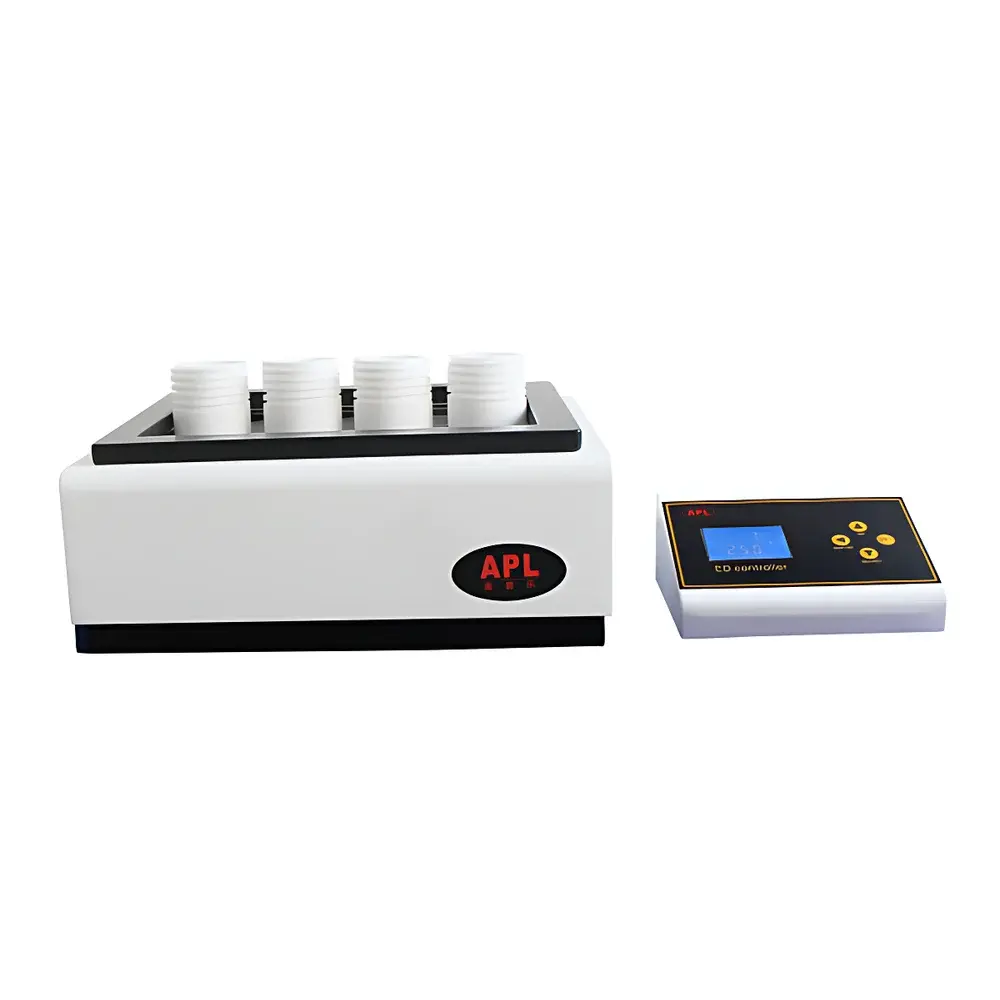
APL GD12 Graphite Block Digestion System
| Brand | APL |
|---|---|
| Origin | Sichuan, China |
| Manufacturer Type | Direct Manufacturer |
| Regional Classification | Domestic (China) |
| Model | GD12 |
| Instrument Type | Graphite Block Digestion System |
| Temperature Range | Ambient to 250 °C |
| Heating Method | High-Purity Graphite Block with PFA Coating |
| Temperature Accuracy | ±1 °C |
| Max Power | 1.6 kW |
| Standard Sample Configuration | 12 × Ø55 mm holes (depth: 110 mm) |
| Uniformity | ±1.5 °C across all positions (20–210 °C) |
| Control System | PID-based Digital Temperature Controller with Programmable Ramp/Soak Profiles |
| Remote Interface | RS-232 Serial Communication Port |
Overview
The APL GD12 Graphite Block Digestion System is a precision-engineered laboratory instrument designed for reproducible, high-throughput sample digestion in analytical chemistry workflows. It operates on the principle of conductive heating via a monolithic high-purity graphite block, uniformly coated with chemically inert perfluoroalkoxy (PFA) polymer. Unlike open-heating systems such as hot plates or ceramic heaters, the GD12 employs an integrated circumferential heating architecture that ensures minimal thermal gradient across the entire digestion surface. This design enables consistent energy transfer to all sample vessels simultaneously—critical for multi-sample batch processing where inter-vial temperature deviation must remain below ±1.5 °C across the operational range (20–210 °C). The system supports both standalone operation and remote integration via RS-232 serial interface, facilitating synchronization with LIMS environments and automated lab workflows. Its thermal stability, corrosion resistance, and programmable PID control make it suitable for regulatory-compliant sample preparation in environmental, food safety, pharmaceutical, and materials testing laboratories.
Key Features
- Monolithic graphite heating block with uniform PFA coating—resistant to concentrated HNO₃, HCl, HF, and aqua regia at elevated temperatures; eliminates metal leaching and cross-contamination.
- PID-controlled digital temperature regulation with ramp-and-soak programming capability; setpoint accuracy ±0.2 °C under stable conditions; real-time over-temperature and low-temperature alarm outputs.
- 12-position digestion configuration (Ø55 mm × 110 mm depth), optimized for standard 50 mL Teflon®-lined digestion tubes and quartz vials used in EPA and GB method protocols.
- Energy-efficient design: achieves target temperatures up to 75% faster than conventional electric mantle systems, reducing average digestion cycle time from hours to minutes while lowering power consumption to ≤1.6 kW.
- Corrosion-resistant front-panel controls and sealed membrane switches rated for continuous exposure to acidic fumes; housing meets IP54 ingress protection standards for benchtop chemical environments.
Sample Compatibility & Compliance
The GD12 is validated for use with borosilicate glass, quartz, PTFE, and PFA digestion vessels—compatible with closed-vessel microwave pre-digestion and post-digestion acid evaporation (“赶酸”, or acid removal). It adheres to critical method requirements across multiple international and national regulatory frameworks: EPA Methods 3010a, 3050b, 3060 (soil/sediment), 200.7, 200.8, 245.1 (water), and SJ/T 11365-2006 (electronic waste); Chinese National Standards GB/T 22105.1–2008 (soil heavy metals), GB/T 17138–1997 (soil total Cu/Pb/Zn), and GB/T 5009.11–2003 (food As determination). While not certified to ISO/IEC 17025 or GLP audit requirements out-of-the-box, its programmable temperature logging (via optional RS-232 data capture) supports traceable record-keeping aligned with FDA 21 CFR Part 11 Annex 11 principles when integrated into validated SOPs.
Software & Data Management
The GD12 includes a built-in microprocessor-based controller with non-volatile memory for storing up to 10 user-defined digestion programs—including multi-step ramp rates, dwell times, and cooling profiles. Temperature setpoints, actual readings, and alarm status are displayed on a high-contrast LCD screen with backlighting. For laboratory informatics integration, the RS-232 port supports ASCII command protocol for bidirectional communication with external PCs or PLCs. Optional terminal software (provided separately) enables real-time graphing, CSV export of time-temperature logs, and batch ID tagging—facilitating audit-ready documentation for QA/QC reporting and method validation packages.
Applications
- Preparation of environmental matrices (soil, sludge, sediment, water filters) prior to analysis by ICP-OES, ICP-MS, AAS, or HG-AFS.
- Digestion of biological tissues, seafood, and plant materials for total elemental quantification under GB/T 5009 series food safety standards.
- Decomposition of polymer composites, printed circuit boards, and cathode materials in battery recycling R&D.
- Acid evaporation (“acid removal”) following microwave-assisted digestion to reduce residual matrix effects before instrumental analysis.
- Standardized reference material (SRM) homogenization and calibration standard preparation under controlled thermal conditions.
FAQ
Is the GD12 compatible with hydrofluoric acid (HF) digestion?
Yes—the PFA-coated graphite block and PTFE/PFA vessel support allow safe use with ≤5% HF at temperatures up to 180 °C. Always verify vessel compatibility and perform risk assessment per institutional EH&S policy.
Can the GD12 be connected to a laboratory information management system (LIMS)?
Yes—via its RS-232 interface using standard Modbus RTU or custom ASCII commands; integration requires middleware or script-based parsing for ingestion into LIMS audit trails.
What is the recommended maintenance schedule for long-term accuracy?
Calibrate annually using NIST-traceable thermocouple probes; inspect PFA coating integrity every 6 months under magnification; clean graphite surface with 10% nitric acid followed by deionized water rinse and air drying.
Does the GD12 meet CE or UL safety certification requirements?
The unit complies with IEC 61010-1:2010 for electrical safety in laboratory equipment; CE marking is available upon request for EU-distributed units with full technical file submission.
How does the GD12 compare to ceramic heater-based digestion blocks in terms of thermal uniformity?
Graphite’s thermal conductivity (~120 W/m·K) exceeds that of alumina ceramics (~30 W/m·K), enabling faster equilibration and lower spatial variance—validated at ±1.5 °C across all 12 positions versus typical ±5–8 °C for ceramic alternatives.



