
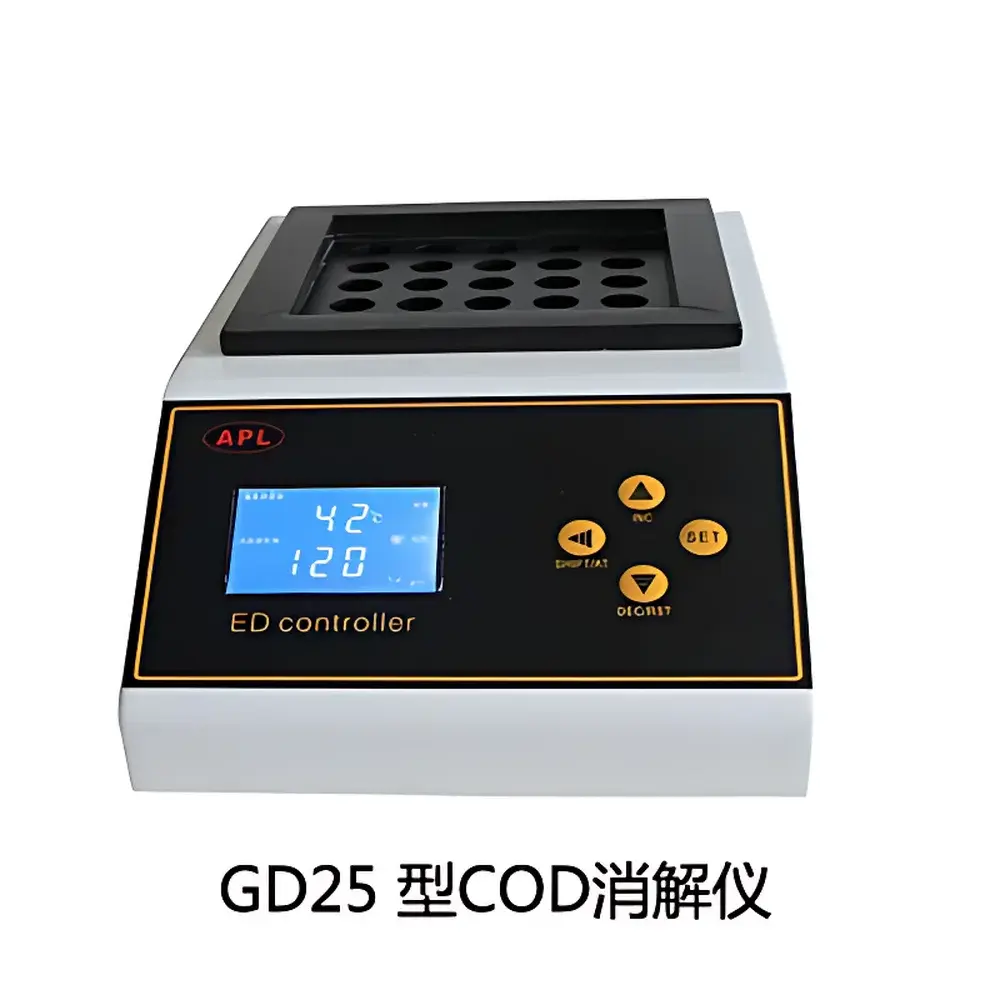
APL GD25-COD Graphite Block Digestion System for COD, Total Phosphorus, and Total Nitrogen Analysis
| Brand | APL |
|---|---|
| Origin | Sichuan, China |
| Manufacturer Type | Direct Manufacturer |
| Origin Category | Domestic (China) |
| Model | GD25-COD |
| Price | USD 980 (FOB China) |
| Display | Full Chinese LCD Interface |
| Temperature Range | Ambient to 250 °C |
| Temperature Control Accuracy | ±1 °C |
| Heating Time | ≤10 min to Setpoint |
| Digestion Programs | COD, Total Phosphorus, Total Nitrogen, Total Copper, Hexavalent Chromium |
| Timer Range | 1–199 min |
| Timer Accuracy | ±0.1 s at 10 min |
| Sample Capacity | 25 samples per batch |
| Digestion Method | Sealed-Tube Digestion |
Overview
The APL GD25-COD Graphite Block Digestion System is a benchtop, programmable thermal digestion unit engineered for standardized wet-chemical oxidation of water and wastewater samples prior to spectrophotometric or titrimetric determination of chemical oxygen demand (COD), total phosphorus (TP), total nitrogen (TN), total copper, and hexavalent chromium. It operates on the principle of controlled conductive heating via high-purity graphite blocks, ensuring uniform thermal distribution across all 25 sample positions. Unlike ceramic or aluminum heating modules, graphite delivers superior thermal stability, low thermal inertia, and resistance to acid corrosion—critical for repeated exposure to sulfuric acid–potassium dichromate (for COD), persulfate–acid (for TN), or ammonium molybdate–antimony potassium tartrate (for TP) digestion reagents. The system complies with core method requirements outlined in ISO 6060 (COD), ISO 11908 (TP), ISO 11905-1 (TN), and EPA Method 410.4, supporting laboratories pursuing ISO/IEC 17025 accreditation.
Key Features
- High-purity graphite heating block with optimized thermal mass for rapid, repeatable ramping (≤10 min to 250 °C) and minimal temperature overshoot
- Precision PID temperature control with real-time feedback loop, maintaining ±1 °C accuracy across full operating range (ambient to 250 °C)
- Dedicated digestion protocols preloaded for COD (50–150 °C, 2–4 h), TP (120–150 °C, 30–60 min), TN (100–120 °C, 60 min), and Cr(VI) (95 °C, 15–30 min)
- Sealed-tube digestion configuration compatible with standard 16 mm × 100 mm or 16 mm × 150 mm borosilicate glass digestion tubes (e.g., Hach TNTplus vials or equivalent)
- Independent digital timer with resolution of 1 second and long-term stability (±0.1 s over 10 min), meeting traceability requirements for GLP-compliant workflows
- Full Chinese LCD interface with intuitive menu navigation, parameter lockout, and error-code diagnostics (e.g., overtemperature, open-circuit heater)
- Robust stainless-steel housing with integrated ventilation channeling and acid-resistant surface coating for extended service life in corrosive lab environments
Sample Compatibility & Compliance
The GD25-COD accommodates aqueous matrices including municipal wastewater, industrial effluents, surface water, and digested sludge filtrates. Its sealed-tube design minimizes reagent loss and prevents cross-contamination during high-temperature oxidation. All digestion programs align with reference methods requiring closed-vessel digestion under reflux or pressurized conditions—specifically supporting ISO 6060 Annex A (closed reflux, colorimetric), ISO 11908 (alkaline persulfate UV digestion), and ASTM D5176 (COD by dichromate oxidation). The instrument’s temperature and timing reproducibility meets internal QC criteria for method validation per ISO/IEC 17025 Clause 7.2.2, and its operational logs (when paired with external data capture) support audit readiness for environmental regulatory submissions.
Software & Data Management
While the GD25-COD operates as a standalone hardware platform with embedded firmware, it supports seamless integration into laboratory data management systems via RS-232 serial output (optional USB-to-serial adapter). Timestamped event logs—including start time, setpoint, actual temperature profile, and completion signal—can be exported for inclusion in LIMS or ELN entries. For labs operating under FDA 21 CFR Part 11 or EU Annex 11, the device may be validated as a “non-configurable instrument” when used with documented SOPs, calibration records, and periodic performance verification (e.g., NIST-traceable thermometer checks every 6 months). Audit trails are maintained externally through instrument log files or LIMS transaction history.
Applications
- Routine COD analysis in municipal wastewater treatment plants (WWTPs) per ISO 6060 or national equivalents (e.g., HJ 828–2017 in China)
- Total phosphorus quantification in eutrophication monitoring programs using molybdenum blue spectrophotometry
- Total nitrogen determination in drinking water source assessment via alkaline persulfate digestion followed by UV absorption at 220/275 nm
- Heavy metal speciation workflows, including hexavalent chromium digestion prior to diphenylcarbazide colorimetry (ISO 11084)
- Method development and inter-laboratory comparison studies requiring tightly controlled thermal profiles and batch-wise throughput
FAQ
Is the GD25-COD compatible with Hach TNTplus vials?
Yes—it accepts standard 16 mm OD digestion tubes up to 150 mm in length, including Hach TNTplus, Lovibond, and Thermo Scientific vials.
Does the system include temperature calibration certificates?
No factory-issued certificate is included; however, the unit features a dedicated calibration port for third-party verification using NIST-traceable thermometers.
Can digestion programs be customized or edited?
The interface supports manual temperature and timer entry but does not allow user-defined program storage beyond the five preset methods.
What maintenance is required for long-term reliability?
Annual inspection of graphite block integrity, cleaning of acid residue from tube wells with dilute sodium bicarbonate solution, and verification of thermal sensor response are recommended.
Is the GD25-COD suitable for GLP-regulated environmental testing labs?
Yes—when operated within a documented validation framework including IQ/OQ/PQ, routine calibration, and defined change control procedures, it meets GLP infrastructure requirements for sample preparation instrumentation.
Related Products







