
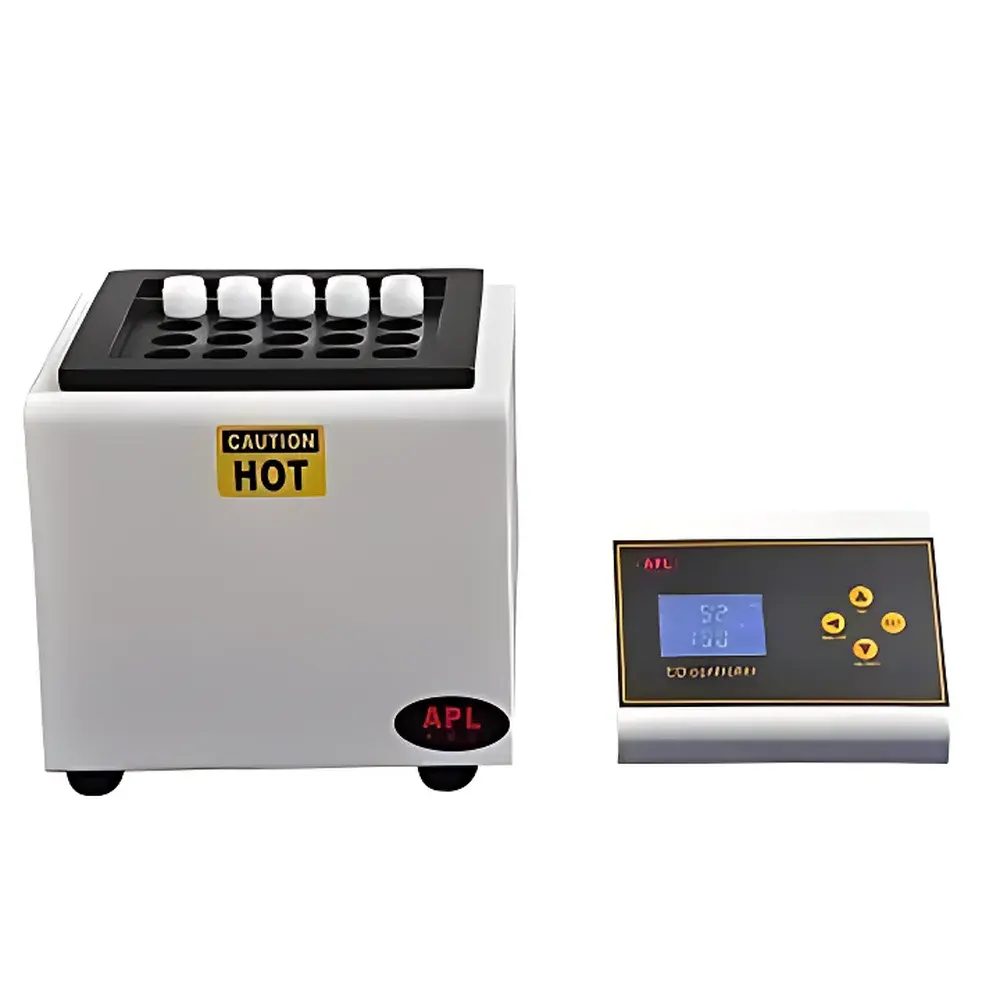
APL GD25 Graphite Block Digestion System (Acid Evaporation Unit)
| Brand | APL |
|---|---|
| Origin | Sichuan, China |
| Manufacturer Type | Direct Manufacturer |
| Instrument Type | Graphite Digestion System |
| Number of Digestion Positions | 25 |
| Max. Heating Temperature | 250 °C |
| Temperature Control Accuracy | ±1 °C |
| Heating Medium | Highly Uniform Graphite Block with PTFE Coating |
| Power Supply | AC 220 V, 50 Hz |
| Rated Power | 1600 W |
| Temperature Setting Range | Ambient to 250 °C (1 °C increments) |
| Timer Range | 0–60 min (1 min increments) |
| Preheating Time | ≤10 min |
| Standard Sample Well Configuration | Ø28 mm × 25 positions |
| Compliance | Designed for ISO/IEC 17025-compliant sample preparation workflows |
Overview
The APL GD25 Graphite Block Digestion System is a precision-engineered, benchtop electric heating platform designed for controlled open-vessel sample digestion and post-digestion acid evaporation (commonly referred to as “acid removal” or “acid fuming”). It operates on the principle of uniform conductive heating via a high-density, thermally stable graphite block coated with chemically inert polytetrafluoroethylene (PTFE), ensuring consistent thermal distribution across all 25 sample positions. Unlike ceramic or aluminum heating blocks, graphite delivers superior thermal mass, minimal temperature gradient (<±1.5 °C across the block surface at 220 °C), and rapid heat recovery after sample loading—critical for reproducible trace-metal analysis. The system is not a microwave replacement but a complementary tool engineered for pre-digestion stabilization, post-microwave acid volume reduction, and standalone hot-block digestion of environmental, biological, pharmaceutical, and industrial matrices prior to elemental quantification by ICP-OES, ICP-MS, AAS, or HG-AFS.
Key Features
- 25-position graphite digestion block with precisely machined Ø28 mm wells—optimized for standard borosilicate or quartz digestion tubes (e.g., SCP Science, CEM, Anton Paar) and compatible with most commercial microwave digestion vessel racks.
- Digital PID temperature controller with real-time LED display, ±1 °C accuracy over full range (ambient to 250 °C), and 1 °C programmable resolution.
- Independent 0–60 min countdown timer with audible end-of-cycle alert—enabling unattended operation while maintaining GLP traceability for time-critical digestion steps.
- PTFE-coated graphite construction resists corrosion from HNO₃, HCl, HF (dilute), and H₂O₂—eliminating metal leaching risks that compromise low-level elemental analysis.
- No reagent delivery system (reagent-free design): eliminates tubing, pumps, and fluidic complexity—reducing maintenance, cross-contamination risk, and validation burden in regulated labs.
- Integrated safety features: over-temperature cutoff, auto-shutdown on timer expiration, and grounded chassis compliant with IEC 61010-1 for laboratory electrical safety.
Sample Compatibility & Compliance
The GD25 accommodates a broad spectrum of solid and semi-solid samples—including soil, sediment, sludge, plant tissue, food homogenates, and polymer ash—when paired with appropriate digestion vessels and acid mixtures (e.g., HNO₃/H₂O₂ for organics; HNO₃/HF for silicates). Its thermal profile satisfies key regulatory digestion methods: EPA 3050B (acid digestion of sediments and soils), EPA 3051A (microwave-assisted extraction followed by open-vessel evaporation), and ASTM D5511/D5512 (anaerobic biodegradation testing requiring acid-stable residue preparation). The instrument’s mechanical and thermal stability supports audit-ready documentation under ISO/IEC 17025:2017 Clause 6.4.3 (equipment verification) and aligns with FDA 21 CFR Part 11 data integrity expectations when paired with validated lab notebooks or LIMS-integrated logging.
Software & Data Management
The GD25 operates via embedded firmware—no PC connection or proprietary software required. All operational parameters (set temperature, elapsed time, target time) are retained in non-volatile memory and displayed in real time. For laboratories requiring electronic records, optional RS-232 or USB-to-serial interface modules (sold separately) enable integration with custom LabVIEW or Python-based acquisition scripts. Audit trails—including operator ID, start/stop timestamps, and temperature logs—can be exported as CSV for inclusion in analytical batch records. No cloud connectivity or remote access functionality is included, preserving data sovereignty and simplifying 21 CFR Part 11 compliance for on-premise deployments.
Applications
- Pre-microwave thermal conditioning of high-fat or high-sugar samples to mitigate violent reactions during closed-vessel digestion.
- Controlled evaporation of nitric/hydrochloric acid supernatants following microwave digestion—reducing final volume to ≤1 mL without analyte loss or precipitation.
- Standardized hot-block digestion per AOAC 999.10 for heavy metals in dietary supplements and herbal products.
- Acid fuming of digested wastewater sludge prior to ICP-MS analysis to remove residual chlorine interferences.
- Stabilization of mercury-containing samples using HNO₃ + K₂Cr₂O₇ before cold vapor AAS determination.
- Routine QA/QC of certified reference materials (CRMs) such as NIST SRM 2710a or GBW 07401 in environmental testing labs.
FAQ
Is the GD25 suitable for hydrofluoric acid (HF) digestion?
Yes—when used with HF-compatible vessels (e.g., PFA or quartz) and operated below 200 °C. The PTFE-coated graphite block provides robust resistance to diluted HF (<5%), though concentrated HF requires additional containment precautions.
Can I use the GD25 for method validation under ISO/IEC 17025?
Yes—the instrument’s documented temperature uniformity, calibration traceability (via external NIST-traceable probe), and repeatable timing functionality meet ISO/IEC 17025:2017 requirements for equipment verification and method-specific performance checks.
Does the system support multi-step temperature ramping?
No—the GD25 implements single-setpoint control only. For ramped protocols (e.g., 95 °C → 120 °C → 150 °C), manual intervention or external programmable controllers are required.
What maintenance is required for long-term accuracy?
Annual verification using a calibrated reference thermometer (e.g., Fluke 1523) inserted into an empty well is recommended. Visual inspection of PTFE coating integrity and cleaning of graphite surface with dilute NaOH followed by DI water rinse ensures sustained thermal performance.
Is technical support available outside China?
APL provides English-language documentation, application notes, and remote troubleshooting via email. Distributor networks in EU, North America, and Southeast Asia offer local calibration and service contracts upon request.



