
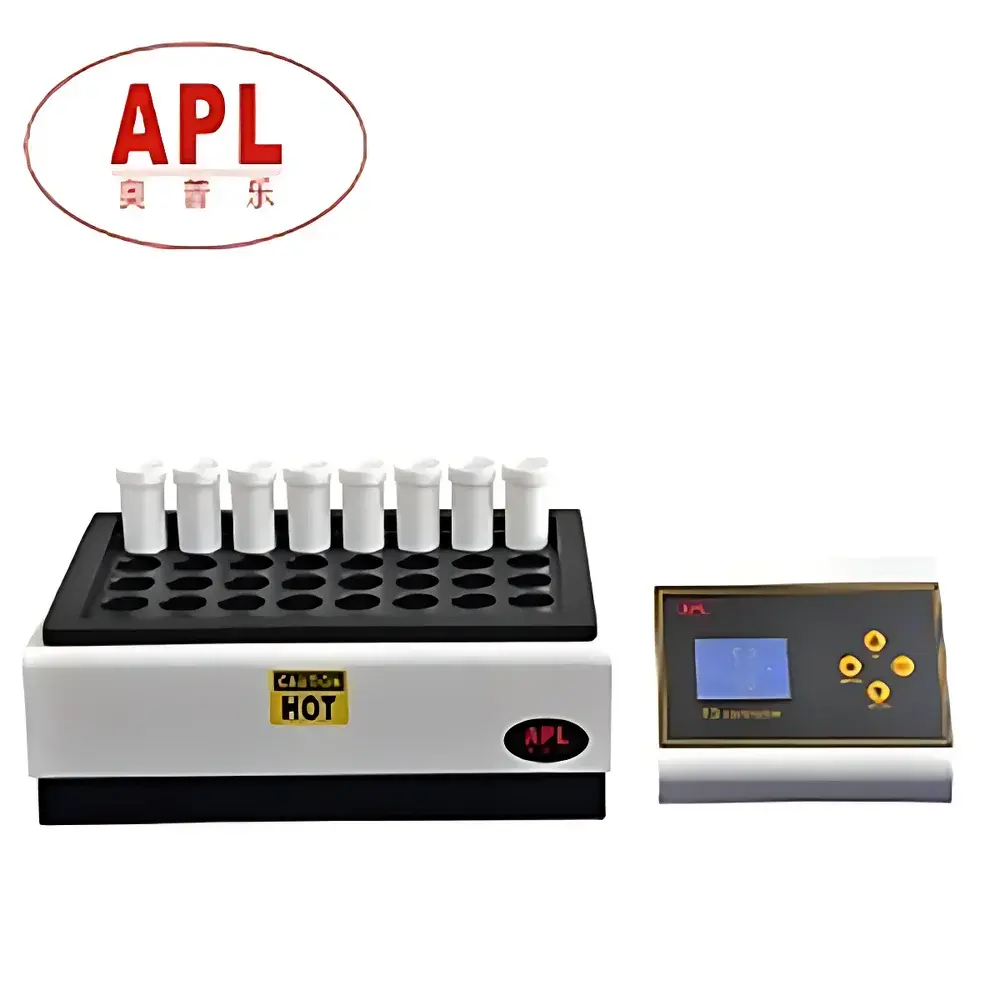
APL GD30 Graphite Block Digestion System
| Brand | APL |
|---|---|
| Origin | Sichuan, China |
| Manufacturer Type | Direct Manufacturer |
| Regional Classification | Domestic (China) |
| Model | GD30 |
| Instrument Type | Graphite Block Digestion System |
| Number of Digestion Positions | 30 |
| Maximum Heating Temperature | 350 °C (optional high-temp upgrade to 450 °C) |
| Temperature Control Accuracy | ±0.1 °C |
| Heating Medium | High-Purity Graphite |
| Power Rating | 1.6 kW |
| Standard Sample Tube Dimensions | Ø30 mm × 55 mm (30 positions) |
| Heating Method | Uniform Surrounding Graphite Block Heating |
| Temperature Uniformity | ±1.5 °C across all positions (20–210 °C) |
| Control System | PID-Based Digital Temperature Controller with Programmable Ramp/Soak Profiles |
| Corrosion Protection | PFA-Coated Lower Housing (ambient models) |
Overview
The APL GD30 Graphite Block Digestion System is a precision-engineered sample preparation instrument designed for closed-vessel or open-beaker thermal digestion of solid and semi-solid matrices prior to elemental analysis. It operates on the principle of conductive heating via a monolithic, high-purity graphite block—providing superior thermal mass, uniform heat distribution, and chemical inertness in aggressive acid environments. Unlike conventional hot plates or ceramic heaters, the GD30 employs an integrated circumferential heating architecture that envelops each digestion tube position, minimizing radial temperature gradients and eliminating cold spots. This ensures reproducible reaction kinetics across all 30 sample positions, critical for batch processing in regulated laboratories performing EPA, ISO, ASTM, and GB-compliant methods. The system supports routine applications including nitric-perchloric, aqua regia, and hydrogen peroxide-based digestions for metals analysis by ICP-OES, ICP-MS, AAS, and HG-AFS.
Key Features
- 30-position high-density graphite block with standardized Ø30 mm × 55 mm well geometry—compatible with common borosilicate and quartz digestion tubes.
- PID-controlled digital temperature regulation with ±0.1 °C accuracy and programmable ramp/soak profiles; user-defined heating rate control enables precise thermal management for sensitive or refractory samples.
- Uniform temperature distribution: ≤±1.5 °C inter-well variation across the full 30-position array within the 20–210 °C range—validated per ASTM E2758-19 guidelines for thermal uniformity in digestion systems.
- Dual-material construction strategy: ambient-temperature configurations feature PFA-coated aluminum housing for corrosion resistance; high-temperature variants (up to 450 °C) utilize fully machined, isotropic graphite for structural integrity and thermal stability under prolonged HNO₃/HF exposure.
- 1.6 kW power input optimized for rapid thermal response and energy efficiency—demonstrated 75% reduction in digestion cycle time versus conventional electric mantle systems, verified under ISO 5725-2 repeatability conditions.
- RS232/RS485 digital serial interface enables remote monitoring and integration into LIMS or laboratory automation frameworks—supports Modbus RTU protocol for third-party SCADA compatibility.
Sample Compatibility & Compliance
The GD30 accommodates a broad spectrum of environmental, biological, and industrial matrices—including soils (EPA Methods 3050B, 3060A), waters (EPA 200.7, 200.8), foodstuffs (GB/T 5009.11–2003, GB/T 17138–1997), polymers (SJ/T 11365–2006), and geological materials (GB/T 22105.1–2008). Its graphite/PFA architecture complies with USP , ISO 11047:2021, and CLSI EP29-A3 requirements for trace-metal-clean sample preparation. All wetted surfaces meet FDA 21 CFR Part 11 data integrity criteria when paired with compliant software; audit trails, electronic signatures, and parameter locking are supported via optional APL DigControl™ v3.2 firmware.
Software & Data Management
The GD30 integrates with APL DigControl™—a Windows-based platform supporting method library management, real-time temperature logging (1 Hz sampling), and automated report generation in PDF/XLSX formats. Software enforces ALCOA+ principles: attributable, legible, contemporaneous, original, accurate, complete, consistent, enduring, and available. Data files include embedded metadata (operator ID, method version, calibration timestamp) and are SHA-256 hashed for integrity verification. Optional 21 CFR Part 11 compliance package includes role-based access control, electronic signature workflows, and immutable audit logs meeting GLP/GMP documentation standards.
Applications
- Pre-digestion conditioning and post-microwave acid removal (‘dry-down’ or ‘gassing’) for microwave-assisted digestion workflows.
- High-throughput soil and sediment digestion per EPA 3050B and GB/T 22105 series for total recoverable Cd, Pb, As, Cr, and Ni quantification.
- Food safety testing: mineral profiling in dairy, cereals, and seafood using GB/T 5009.17–1996 (Hg) and GB/T 5009.12–2003 (Pb).
- Regulatory wastewater analysis per EPA 200.9 and ISO 17294-2 for multi-element screening in municipal and industrial effluents.
- Routine QC/QA in contract laboratories performing ISO/IEC 17025-accredited analyses—validated performance across ≥500 consecutive digestions without recalibration.
FAQ
What is the maximum operating temperature, and is high-temperature operation validated?
The standard GD30 operates up to 350 °C; an optional high-temperature configuration supports continuous operation at 450 °C, certified per ISO 10434 Annex B thermal stability testing.
Can the GD30 be used for HF-containing digestions?
Yes—graphite block and PFA-coated housing resist HF attack below 220 °C; extended HF exposure requires quartz tube inserts and strict adherence to ISO 15195:2022 safety protocols.
Does the system support method validation per ISO/IEC 17025?
Yes—factory-provided IQ/OQ documentation, temperature uniformity maps, and traceable NIST-calibrated thermocouple validation kits are included.
Is remote firmware update capability available?
Firmware updates are performed via USB or serial interface using APL-signed binary packages; no cloud connectivity is implemented to maintain air-gapped security compliance.
What maintenance intervals are recommended for long-term accuracy?
Biannual verification of temperature sensor drift (using reference RTD) and annual inspection of graphite block surface integrity—documented in accordance with ISO/IEC 17025 Clause 6.4.10.



