
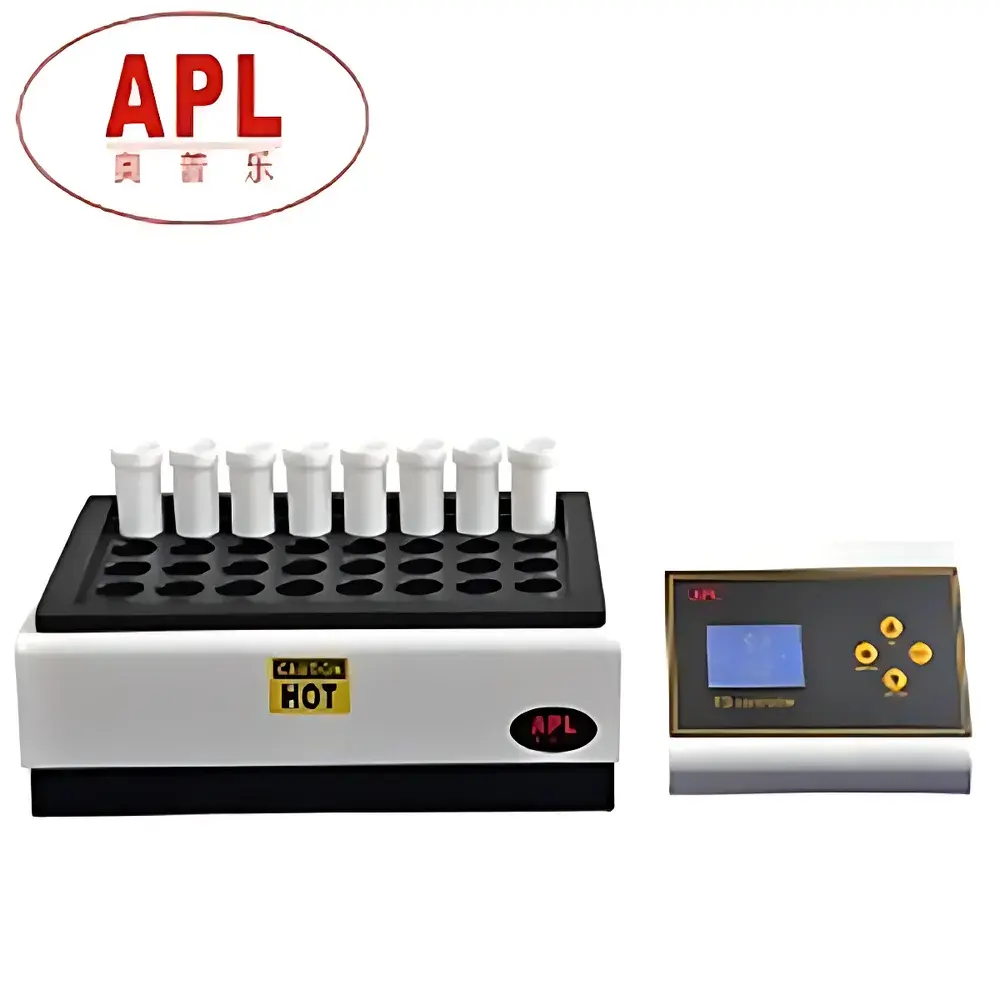
APL GD60 Programmable Graphite Block Digestion System
| Brand | APL |
|---|---|
| Origin | Sichuan, China |
| Manufacturer Type | Direct Manufacturer |
| Instrument Type | Graphite Block Digestion System |
| Automation Level | Semi-Automatic |
| Digestion Positions | 60 |
| Max Heating Temperature | 450 °C |
| Temperature Control Accuracy | ±0.1 °C |
| Heating Material | Isostatically Pressed High-Purity Graphite |
| Reagent Addition Channels | 2 |
| Power Supply | AC 220 V ±10%, 50 Hz |
| Rated Power | 4000 W |
| Temperature Range | Ambient to 350 °C |
| Inter-Well Temperature Uniformity | ±1.0 °C (ambient–250 °C) |
| Well Dimensions | Ø40 mm × 55 mm depth |
| Control Interface | Detachable LCD Digital Display |
| Control Algorithm | PID-Based Closed-Loop Temperature Regulation |
| Overall Dimensions | 500 mm × 350 mm × 180 mm |
| Net Weight | 35 kg |
Overview
The APL GD60 Programmable Graphite Block Digestion System is a semi-automated, high-capacity sample preparation instrument engineered for reproducible, trace-metal-clean acid digestion of solid and liquid matrices. It operates on the principle of conductive heating via an isostatically pressed high-purity graphite block—providing uniform thermal distribution across all 60 digestion wells without reliance on convective air or radiant heating elements. This architecture ensures consistent reaction kinetics across parallel samples, minimizing inter-sample variability critical for quantitative elemental analysis by ICP-OES, ICP-MS, AAS, and HG-AFS. Designed for routine compliance with ISO 11885, EPA Method 3050B/3051A, and ASTM D3682, the GD60 supports both open-vessel hotplate-style digestion and post-microwave acid removal (i.e., “acid evaporation” or “赶酸”), serving as a robust, cost-effective alternative or complement to microwave-assisted systems in regulated and research laboratories.
Key Features
- Isostatically pressed high-purity graphite block delivering exceptional thermal conductivity, chemical inertness, and long-term stability under aggressive HNO₃/HCl/HF/H₂O₂ environments.
- 60-position digestion array with standardized well geometry (Ø40 mm × 55 mm depth), compatible with common PTFE, quartz, and borosilicate digestion tubes (e.g., SCP Science, Milestone, or custom OEM formats).
- PID-based closed-loop temperature control system enabling precise setpoint regulation from ambient to 350 °C, with real-time deviation monitoring and ±0.1 °C accuracy at steady state.
- Integrated dual reagent addition channels supporting timed, sequential, or manual acid dosing—facilitating multi-step digestion protocols (e.g., initial oxidation followed by HF-assisted silicate dissolution).
- Modular control unit with backlit LCD interface, programmable ramp-hold profiles (up to 10 segments), over-temperature cut-off, and audible/visual alarm triggers.
- Optimized thermal isolation design achieving ≤±1.0 °C inter-well temperature uniformity across the full working range (ambient–250 °C), verified per ASTM E220 calibration practice.
Sample Compatibility & Compliance
The GD60 accommodates a broad spectrum of environmental, biological, pharmaceutical, and industrial samples—including soils, sediments, plant tissues, food composites, polymers, catalysts, and geological digests. Its corrosion-resistant graphite surface and sealed heating cavity minimize cross-contamination risks during high-acid throughput. The system meets mechanical and electrical safety requirements per IEC 61010-1 and supports GLP/GMP-aligned workflows through configurable audit trails (when integrated with optional data logging software). While not inherently 21 CFR Part 11 compliant, its deterministic temperature programming and hardware-level safety interlocks provide foundational traceability required for method validation under USP , ISO/IEC 17025, and CNAS accreditation frameworks.
Software & Data Management
The GD60 operates via a standalone front-panel controller; however, it features RS-232 and optional USB/RS-485 interfaces for external data acquisition. When paired with APL’s optional DigControl™ PC software (v3.2+), users gain access to full protocol archiving, real-time temperature graphing, event-triggered logging, and CSV export for LIMS integration. All temperature setpoints, ramp rates, hold durations, and alarm thresholds are stored with timestamped metadata—enabling retrospective review and electronic signature support where local SOPs permit. Software-generated reports comply with minimum ALCOA+ principles (Attributable, Legible, Contemporaneous, Original, Accurate) when deployed on validated computing infrastructure.
Applications
- Preparation of certified reference materials (CRMs) for trace metal certification (e.g., NIST SRM 2710a, GBW standards).
- Digestion of wastewater sludge and airborne particulate filters prior to ICP-MS quantification of As, Cd, Pb, and Hg.
- Decomposition of herbal matrices for heavy metal screening under Chinese Pharmacopoeia (ChP) General Chapter 0412.
- Routine digestion of polymer ash residues for catalyst residue analysis in petrochemical QA/QC labs.
- Acid evaporation step following microwave digestion to reduce final volume to ≤1 mL while preserving volatile analytes (e.g., Se, Sb).
FAQ
What types of digestion vessels are compatible with the GD60?
Standard 40 mm OD × 55 mm deep vessels made from PTFE (Teflon®), quartz, or high-borosilicate glass are fully supported. Custom vessel adapters are available upon request.
Can the GD60 be used for hydrofluoric acid (HF) digestion?
Yes—provided HF-compatible vessels (e.g., PFA or quartz) are used and appropriate fume hood containment and PPE protocols are enforced per OSHA 1910.1200 guidelines.
Is remote monitoring or network connectivity supported?
The base model includes RS-232; Ethernet or Wi-Fi modules are available as factory-installed options for centralized lab management systems.
How is temperature calibration performed?
Calibration follows ASTM E220 using NIST-traceable Pt100 reference probes inserted into designated wells; APL provides a certificate of conformance with each unit.
Does the system include safety interlocks for unattended operation?
Yes—hardware-based over-temperature cutoff, door-open detection (if equipped with optional safety shield), and power-fail recovery mode ensure safe overnight runs.



