
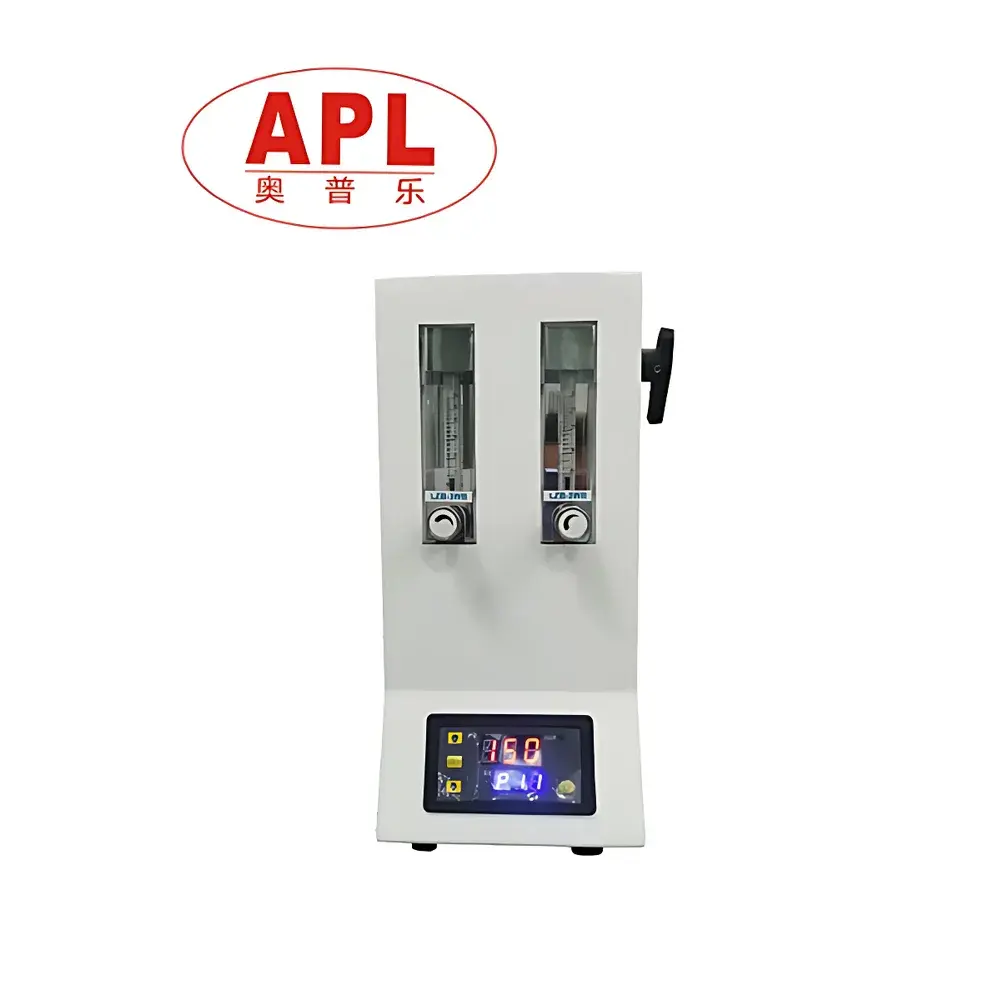
APL-GDS-100 Automated Gas Dilution System
| Brand | APL |
|---|---|
| Origin | Sichuan, China |
| Manufacturer Type | Original Equipment Manufacturer (OEM) |
| Country of Origin | China |
| Model | APL-GDS-100 |
| Price Range | USD 1,400 – 2,800 |
Overview
The APL-GDS-100 Automated Gas Dilution System is a precision-engineered instrument designed for the accurate, repeatable preparation of low-concentration calibration and reference gas standards from high-concentration source gases. It operates on the principle of dynamic volumetric dilution—using two independently controlled mass flow paths (stock gas and diluent gas) to achieve programmable dilution ratios ranging from 1:10 to 1:1000. Engineered specifically for compliance with Chinese environmental standard HJ 1261–2022 (“Determination of Benzene Homologues in Exhaust Gas from Stationary Sources — Gas Bag Sampling/Direct Injection–Gas Chromatography”), the system supports direct integration into GC-based emissions monitoring workflows, including stack testing, ambient air quality verification, and laboratory method validation. Its architecture prioritizes chemical inertness, flow stability, and traceability—critical requirements for regulatory-grade gas standard generation.
Key Features
- Dynamic dual-channel flow control using calibrated rotameters with ≤3% full-scale accuracy across the operational range
- Adjustable stock gas flow: 0–100 mL/min; diluent gas flow: 0–200 mL/min—enabling fine-tuned ratio selection without hardware reconfiguration
- Chemically passivated stainless-steel gas pathways (electropolished 316L tubing) to minimize adsorption, memory effects, and cross-contamination
- Dedicated push-button interface with intuitive status indicators—designed for glove-compatible operation in field or lab environments
- Modular pneumatic layout facilitating rapid maintenance, leak-checking, and ISO 554-compliant humidity/temperature stabilization (when paired with optional environmental enclosures)
- No external PC or software driver required for basic operation—supports standalone calibration gas delivery within <5 seconds of activation
Sample Compatibility & Compliance
The APL-GDS-100 is compatible with non-corrosive, non-condensable gases including N₂, O₂, CO, CO₂, CH₄, C₂H₆, benzene, toluene, ethylbenzene, and xylene (BTEX) in certified cylinder matrices. It is not rated for use with halogenated compounds (e.g., CFCs, SF₆), hydrogen sulfide, ammonia, or reactive nitrogen oxides without prior compatibility assessment and optional chemically resistant wetted materials. The system meets structural and performance criteria referenced in HJ 1261–2022 for dynamic dilution systems used in fixed-source emission testing. While not CE-marked or UL-listed, its mechanical design adheres to ISO 8573-1:2010 Class 4 purity requirements for compressed air interfaces, and its flow path geometry conforms to ASTM D6159–20 for inert gas handling in analytical calibration applications.
Software & Data Management
The base configuration operates via embedded firmware with real-time LED feedback for flow status, error codes (e.g., over-pressure, zero-flow timeout), and dilution ratio confirmation. Optional RS-232 or USB-to-serial interface enables logging of timestamped flow setpoints and duration to external acquisition software (e.g., LabVIEW, MATLAB, or custom Python scripts). Audit-trail functionality—including operator ID input, session start/stop timestamps, and manual override logs—is available in the upgraded firmware version (v2.3+), supporting GLP-aligned documentation per CNAS-CL01:2018 and internal QA/QC protocols. Raw data exports are provided in CSV format with ISO 8601 timestamps and SI-unit annotations (mL/min, s, ratio).
Applications
- Preparation of multi-level calibration standards for GC-FID, GC-PID, and GC-MS analysis of volatile organic compounds (VOCs) in stack emissions
- Generation of challenge gases for sensor response testing and drift verification of fixed continuous emission monitoring systems (CEMS)
- Method development and validation under HJ 1261–2022, HJ 732–2014 (TVOC determination), and ISO 16000-6:2011 (indoor air VOC sampling)
- Field-deployable dilution for mobile lab campaigns requiring on-site standard generation without reliance on pre-mixed cylinders
- Supporting ISO/IEC 17025 accredited laboratories in maintaining traceability to national gas standards (e.g., NIM, China National Institute of Metrology)
FAQ
Does the APL-GDS-100 support automated ratio sequencing across multiple target concentrations?
Yes—when connected to optional serial control, users can define up to 12 sequential dilution steps with independent dwell times and flow profiles.
Is third-party calibration certification available?
APL provides factory calibration certificates traceable to NIM standards; ISO/IEC 17025-accredited calibration services are available through authorized regional partners.
Can the system be integrated with gas chromatographs from Agilent, Thermo Fisher, or Shimadzu?
Direct analog/digital triggering is supported via TTL pulse output; inlet pressure matching must be verified per GC manufacturer’s carrier gas specifications (typically 30–100 kPa backpressure tolerance).
What maintenance intervals are recommended for long-term flow accuracy?
Rotameter recalibration is advised every 12 months or after 2,000 operating hours; stainless-steel tubing should be inspected quarterly for particulate accumulation using helium leak detection.
Does the unit comply with FDA 21 CFR Part 11 requirements?
The base model does not include electronic signature or audit-trail features required for Part 11; however, the v2.3+ firmware upgrade package adds role-based access control and immutable log export—meeting key technical controls for regulated pharmaceutical or environmental QA labs.
Related Products







