
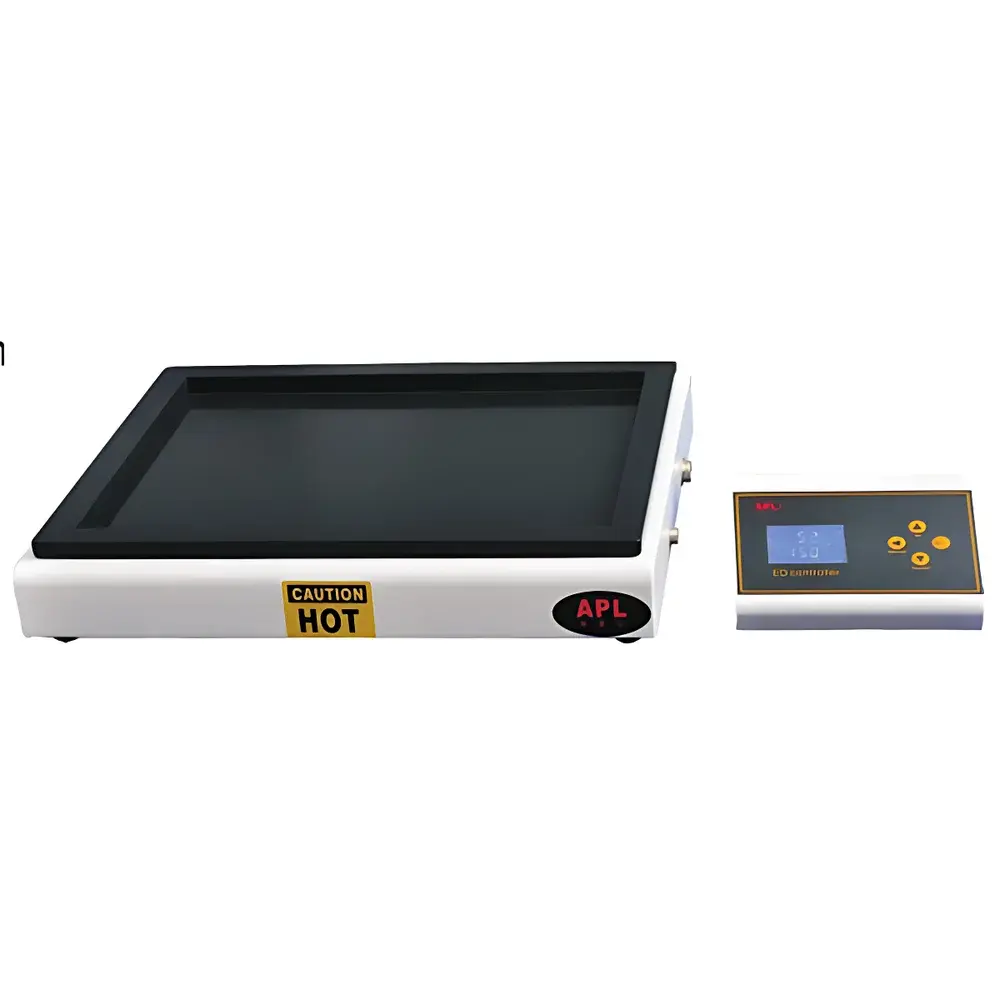
APL GHP400P Graphite Electric Heating Plate
| Brand | APL |
|---|---|
| Origin | Sichuan, China |
| Manufacturer Type | Direct Manufacturer |
| Country of Origin | China |
| Model | GHP400P |
| Price | USD 850 (FOB) |
| Heating Surface Material | High-Purity Graphite |
| Surface Coating | Optional PFA Coating |
| Max. Temperature (PFA-coated) | 250 °C |
| Max. Temperature (Uncoated) | 450 °C |
| Temperature Control | PID with Digital LCD Controller |
| Uniformity | ±1.5 °C across surface |
| Power Rating | 1600 W |
| Dimensions (W×D×H) | 400 mm × 320 mm × 120 mm |
| Weight | 12.5 kg |
Overview
The APL GHP400P Graphite Electric Heating Plate is an engineered solution for high-stability, corrosion-resistant sample heating in analytical laboratories performing acid digestion, evaporation, concentration, and thermal pretreatment of environmental, geological, food, and pharmaceutical samples. Unlike conventional ceramic or stainless-steel hotplates, the GHP400P utilizes a monolithic high-purity graphite heating block—machined from isotropic, low-ash, high-density graphite—to deliver exceptional thermal conductivity (≥120 W/m·K), chemical inertness against concentrated HNO₃, HCl, HF, and aqua regia, and long-term dimensional stability at elevated temperatures. Its design adheres to fundamental thermodynamic principles: uniform resistive heating distributed across the entire graphite mass minimizes thermal gradients, while the integrated PID feedback loop continuously modulates power output based on real-time surface thermistor readings to maintain setpoint accuracy within ±0.5 °C under steady-state conditions. The unit operates without moving parts or forced convection, eliminating airflow-induced contamination—a critical requirement for trace-metal analysis workflows compliant with EPA Method 3050B, ISO 11466, and ASTM D5762.
Key Features
- Monolithic high-purity graphite heating surface (99.997% carbon, ash content <50 ppm) ensuring resistance to aggressive mineral acids and molten alkalis
- Dual temperature configuration: 250 °C maximum with chemically inert PFA fluoropolymer coating; 450 °C maximum in uncoated mode for high-temperature ashing applications
- PID-controlled digital LCD interface with programmable ramp-soak profiles, auto-tuning capability, and over-temperature safety cutoff (adjustable up to 480 °C)
- Large 400 mm × 320 mm active heating area enabling simultaneous processing of up to 12 × 50-mL digestion vessels or 6 × 100-mL beakers with ≤±1.5 °C spatial uniformity
- Robust industrial-grade housing with IP20-rated enclosure, reinforced aluminum alloy chassis, and silicone-insulated heating elements rated for >10,000 hours MTBF
- Low electromagnetic interference (EMI) design compatible with adjacent instrumentation including ICP-MS, AAS, and ion chromatographs
Sample Compatibility & Compliance
The GHP400P supports standard borosilicate glass, quartz, PTFE, and PFA digestion vessels—including EPA-approved 50-mL and 100-mL Teflon®-lined microwave digestion bombs used in closed-vessel protocols. Its non-reactive graphite surface eliminates metal leaching risks associated with metal-plated hotplates, making it suitable for ultratrace elemental analysis where blank levels must meet sub-ppt detection limits. The instrument complies with IEC 61010-1:2010 for laboratory electrical equipment safety and incorporates dual redundant thermal protection circuits. While not certified to UL/CSA standards out-of-the-box, its architecture supports third-party validation for GLP and ISO/IEC 17025-accredited laboratories when deployed with documented calibration procedures per ISO/IEC 17025 Clause 6.4.2.
Software & Data Management
The GHP400P operates as a standalone analog-digital hybrid controller with no embedded firmware or network connectivity. All operational parameters—including setpoint, actual temperature, ramp rate, soak duration, and fault codes—are displayed in real time on the front-panel LCD. For regulated environments requiring audit trails, optional RS-485 Modbus RTU output (available via accessory module) enables integration with LabVantage, STARLIMS, or custom SCADA systems. When paired with calibrated NIST-traceable PT100 surface probes and validated data acquisition software, the system supports 21 CFR Part 11-compliant electronic records—including user authentication, change history, and electronic signatures—provided the host software implements appropriate security controls.
Applications
- Open-vessel acid digestion of soils, sediments, and biological tissues prior to ICP-OES/ICP-MS analysis
- Controlled evaporation of digestates to near-dryness without bumping or splattering
- Pre-concentration of aqueous extracts for pesticide residue testing (AOAC 2007.01)
- Thermal stabilization of catalysts and reference materials in material science labs
- Heating baths for reflux condensation setups in organic synthesis QA/QC
- Calibration verification of thermocouples and RTDs using fixed-point references (e.g., gallium melt at 29.7646 °C)
FAQ
Is the GHP400P suitable for HF-based digestions?
Yes—the uncoated graphite surface is fully resistant to hydrofluoric acid up to 450 °C; however, PFA-coated units must not exceed 250 °C and are not recommended for prolonged HF exposure.
What calibration documentation is provided?
Each unit ships with a factory calibration certificate referencing NIST-traceable standards, covering temperature accuracy at 100 °C, 200 °C, and 400 °C (uncoated mode).
Can the heating plate be used inside a fume hood?
Yes—its sealed graphite block and absence of exposed heating wires make it safe for continuous operation in Class I or II laminar flow hoods, provided adequate clearance (≥150 mm) is maintained around all sides.
Does it support external temperature probe input?
Not natively; however, the optional RS-485 interface allows connection to external PT100 or thermocouple transmitters for cascade control loops.
What maintenance is required?
No routine maintenance beyond periodic surface cleaning with dilute nitric acid and deionized water; graphite does not oxidize below 500 °C in air, ensuring >5-year service life under normal lab use.



