
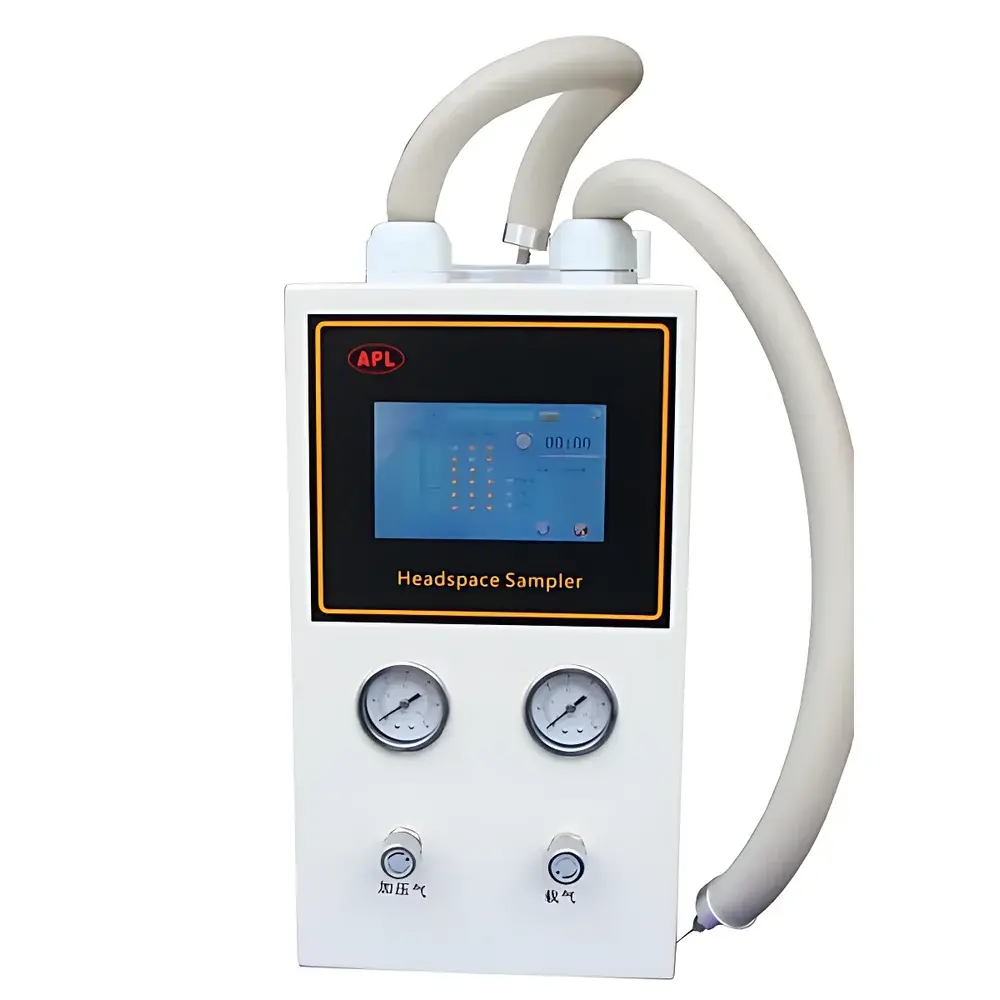
APL HS-9 Semi-Automatic Headspace Sampler
| Brand | APL |
|---|---|
| Origin | Sichuan, China |
| Manufacturer Type | Direct Manufacturer |
| Instrument Type | Static Headspace Sampler |
| Automation Level | Semi-Automatic |
| Sample Vial Heating Range | Ambient to 250 °C |
| Valve Temperature Control Range | Ambient to 220 °C |
| Loop Volume | 2 mL |
| Vial Positions | 9 |
| Vial Capacity | 20 mL |
| Temperature Setting Increment | 1 °C |
| Temperature Stability | < ±0.1 °C |
| RSD (Repeatability) | < 1.5% |
| Pressurization Range | 0–0.4 MPa (adjustable) |
| Purge Flow Rate | 0–20 mL/min (adjustable) |
| Interface | Touchscreen with Time-Programmed Sequence Control |
| GC Synchronization | Supported via TTL or external trigger |
Overview
The APL HS-9 Semi-Automatic Headspace Sampler is a precision-engineered static headspace sampling device designed for reliable integration with gas chromatography (GC) systems. It operates on the fundamental principle of phase equilibrium partitioning: volatile analytes in liquid or solid samples are thermally equilibrated in the sealed headspace above the sample matrix, and the vapor-phase concentration—governed by temperature, time, and partition coefficients—is then transferred quantitatively to the GC inlet via a heated six-port switching valve and inert transfer line. Engineered for laboratories requiring cost-effective, high-reproducibility headspace analysis without full automation overhead, the HS-9 delivers robust thermal control, minimal carryover, and seamless method synchronization with legacy and modern GC platforms.
Key Features
- Integrated thermal architecture: Independent PID-controlled heating zones for sample vials (ambient to 250 °C), six-port valve (ambient to 220 °C), and transfer line (ambient to 220 °C), each adjustable in 1 °C increments with stability better than ±0.1 °C.
- Low-adsorption fluidic path: Entire sample pathway—from vial septum piercer through stainless-steel valve loop (2 mL fixed volume) and fused-silica transfer line—is constructed from passivated, inert materials and actively heated to prevent condensation and analyte adsorption.
- Semi-automated workflow: Touchscreen interface enables intuitive programming of pressurization, equilibration, sampling, injection, and post-injection purge sequences; supports time-based triggering of GC start signals via TTL or external relay input.
- Nine-position heated carousel: Accommodates standard 20 mL crimp-top headspace vials (custom vial sizes available upon request); each position features individual thermal isolation and uniform heat distribution.
- Controlled pressurization and purge: Adjustable headspace pressurization (0–0.4 MPa) ensures consistent vial-to-loop transfer efficiency; programmable backflush (0–20 mL/min) minimizes cross-contamination between runs.
- Repeatable performance: Demonstrated relative standard deviation (RSD) < 1.5% for target VOCs under standardized conditions—validated per ASTM D7693 and ISO 15686-3 protocols for headspace method reproducibility.
Sample Compatibility & Compliance
The HS-9 accommodates aqueous, viscous, heterogeneous, and semi-solid matrices—including environmental water, pharmaceutical suspensions, food extracts, polymer leachates, and forensic biological fluids—without derivatization or solvent extraction. Its design conforms to core regulatory expectations for headspace analysis workflows: all thermal zones support GLP-compliant calibration logging; method parameters are stored with timestamped audit trails; and hardware-level temperature validation aligns with USP , EP 2.2.46, and ICH Q2(R2) guidelines for analytical instrument qualification. While not FDA 21 CFR Part 11–certified out-of-the-box, the system’s deterministic timing, non-volatile parameter storage, and external trigger capability enable straightforward integration into validated, Part 11–compliant laboratory informatics environments.
Software & Data Management
Operation is managed via an embedded industrial-grade touchscreen HMI running real-time Linux OS. All method parameters—including equilibration time, oven ramp profiles, valve actuation timing, and purge duration—are configured via graphical time-sequence editor. No proprietary PC software is required; however, ASCII-formatted log files (CSV export) record run metadata, temperature setpoints, and event timestamps for traceability. The unit provides dual communication interfaces: isolated digital I/O for GC synchronization and RS-232 serial port for remote status polling and firmware updates. Data integrity is preserved through write-protected internal flash memory and automatic power-fail recovery.
Applications
- Petrochemical QA/QC: Quantification of residual monomers (e.g., styrene, vinyl chloride), solvents (e.g., toluene, xylene), and catalyst residues in polymers and coatings.
- Environmental monitoring: Analysis of volatile halogenated hydrocarbons (e.g., chloroform, carbon tetrachloride) in drinking water per EPA Method 502.2 and industrial wastewater per ISO 15686-2.
- Pharmaceutical development: Residual solvent testing in APIs and final drug products per ICH Q3C guidelines (Classes 1–3 solvents).
- Food safety & packaging: Ethanal migration from PET bottles, hexanal oxidation markers in edible oils, and ethanol/biogenic amine profiling in fermented beverages.
- Clinical toxicology: Forensic quantification of ethanol, acetone, and isopropanol in blood and urine specimens using headspace-GC-FID.
- Materials science: VOC emission profiling from adhesives, sealants, and composite laminates per ASTM D6886 and EN 16516.
FAQ
What sample vial formats are supported?
Standard 20 mL crimp-top headspace vials (with PTFE/silicone septa) are fully compatible; 10 mL vials may be used with optional adapter inserts.
Can the HS-9 be integrated with third-party GC data systems?
Yes—via TTL-level start/stop signals or external relay closure; no driver installation required.
Is method validation documentation provided?
A comprehensive Instrument Qualification Protocol (IQ/OQ) template aligned with ISO/IEC 17025 and ASTM E2655 is included with shipment.
What maintenance is required for long-term reliability?
Quarterly verification of thermal accuracy using NIST-traceable RTDs; annual replacement of septa and O-rings in the valve manifold.
Does the system support dynamic headspace or purge-and-trap modes?
No—the HS-9 is optimized exclusively for static headspace sampling; dynamic modes require dedicated purge-and-trap instrumentation.






