
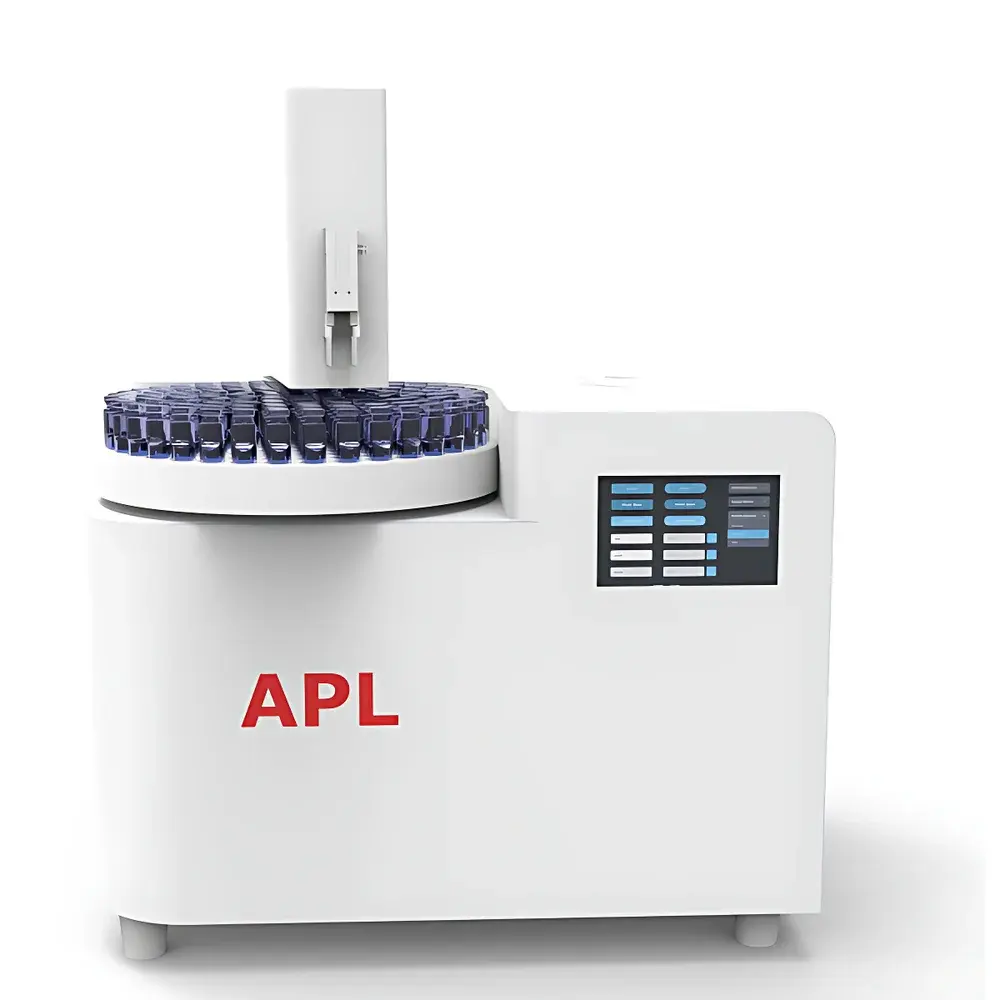
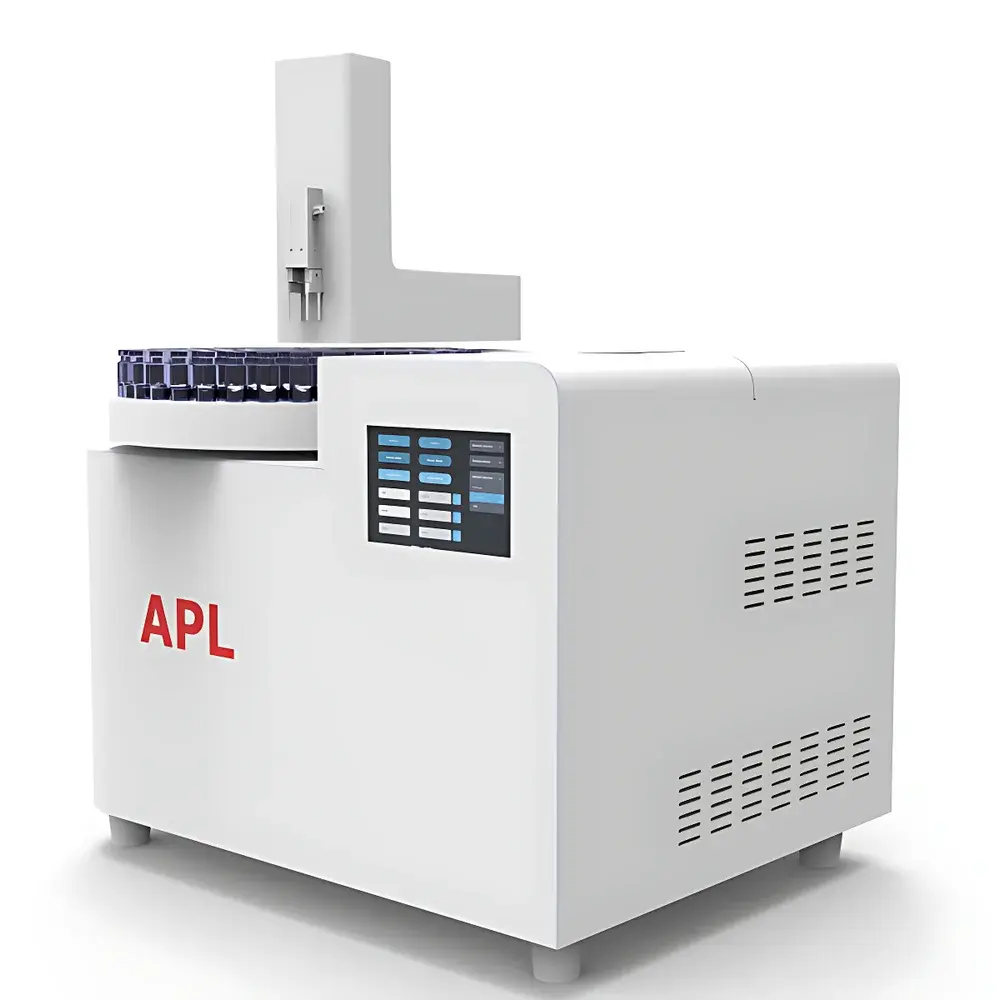
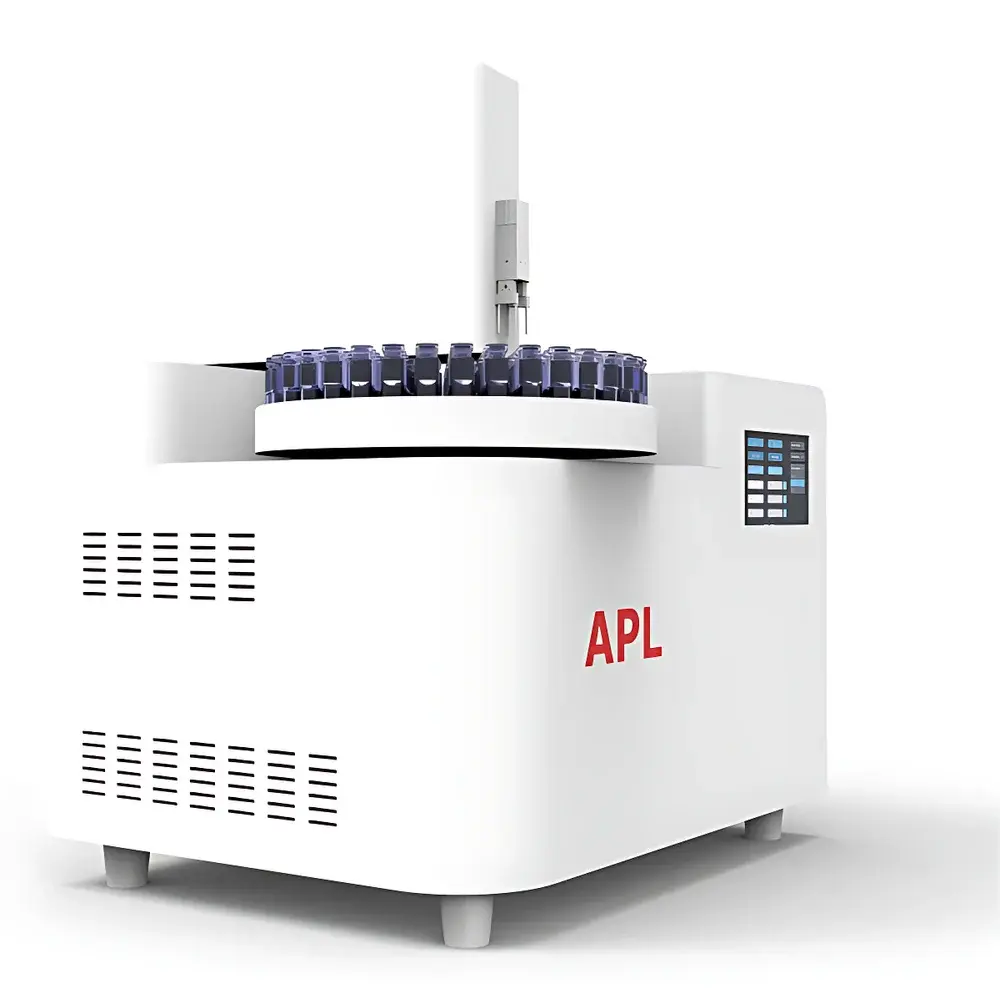
APL HS-Auto126 Fully Automated Static Headspace Sampler
| Brand | APL |
|---|---|
| Origin | Sichuan, China |
| Manufacturer Type | Direct Manufacturer |
| Regional Classification | Domestic (China) |
| Model | HS-Auto126 |
| Instrument Type | Static Headspace Sampler |
| Automation Level | Fully Automatic |
| Sample Vial Heating Range | Ambient to 280 °C |
| Valve Temperature Control Range | Ambient to 280 °C |
| Sample Loop Volume | 1 mL / 2 mL |
| Temperature Control Accuracy | ±0.1 °C |
| Sample Capacity | 126 positions |
| Vial Format | 20 mL standard (10 mL optional) |
| Sample Zone Heating Range | Ambient to 260 °C |
| Valve & Transfer Line Heating Range | Ambient to 220 °C |
| Precision | RSD ≤1% (200 ppm ethanol in water, n=5) |
| Pressurization Range | 0–0.4 MPa (adjustable) |
| Purge Flow Rate | 0–100 mL/min (adjustable) |
| Vial Heating Positions | 15 |
| Oscillation Mode | Vertical wave-like agitation during equilibration |
| Display | 7-inch capacitive touchscreen |
| Method Storage | Preloaded compliance methods (e.g., EPA 502.2, USP <467>, ISO 11843-3) |
Overview
The APL HS-Auto126 Fully Automated Static Headspace Sampler is an engineered solution for high-throughput, trace-level volatile organic compound (VOC) analysis in regulated and research laboratories. Based on the static headspace principle—where analytes partition between a liquid/solid sample matrix and its overlying vapor phase at thermal equilibrium—the instrument enables reproducible, contamination-free transfer of headspace gas into a gas chromatograph (GC). Designed for unattended operation across extended shifts, it supports rigorous analytical workflows in environmental testing, pharmaceutical residual solvent analysis (per USP and ICH Q3C), food flavor profiling, forensic toxicology, and polymer extractables studies. Its triple-zone independent temperature control (sample vial oven, injection valve, and transfer line), combined with real-time pressure monitoring and automated leak verification, ensures thermodynamic fidelity and method robustness across diverse sample matrices.
Key Features
- Fully automated batch processing of up to 126 standard 20 mL headspace vials—no manual intervention required from equilibration to GC injection.
- Independent thermal control of three critical zones: sample incubation zone (ambient to 260 °C), valve manifold (ambient to 220 °C), and heated transfer line (ambient to 220 °C), each with ±0.1 °C stability.
- Integrated vertical wave-like oscillation during vial heating—enhances mass transfer kinetics and reduces equilibration time by up to 35% compared to static heating alone.
- Automated system self-check at startup: mechanical position validation, pressure integrity test, valve actuation verification, and vial detection confirmation.
- Chemically inert, thermally insulated sample pathway—including electropolished stainless-steel loop (1 or 2 mL selectable), PFA-lined transfer lines, and passivated internal surfaces—to minimize adsorption and carryover.
- Programmable pressurization (0–0.4 MPa) and precise pressure-balanced sampling, enabling accurate quantitation across wide concentration ranges without loop saturation.
- Post-injection automatic purge: inert gas (N₂ or He) flushes the loop, needle, and transfer line at user-defined flow rates (0–100 mL/min), eliminating cross-contamination between samples.
- 7-inch industrial-grade capacitive touchscreen interface with intuitive icon-driven navigation, real-time status visualization (vial position, temperature, pressure, cycle progress), and embedded method library supporting ASTM D3699, EPA 502.2, and pharmacopeial standards.
Sample Compatibility & Compliance
The HS-Auto126 accommodates standard 10 mL and 20 mL crimp-top or screw-cap headspace vials, compatible with widely adopted septa materials (PTFE/silicone, butyl rubber). Its hardware architecture and firmware logic support audit-ready data integrity requirements: full electronic logs capture method parameters, run timestamps, temperature/pressure setpoints, error events, and operator actions. When integrated with compliant GC systems and LIMS, the platform meets GLP and GMP documentation expectations per FDA 21 CFR Part 11 (with optional electronic signature module), ISO/IEC 17025 clause 7.7 (method validation traceability), and EU Annex 11 principles for computerized system validation. Routine performance verification includes RSD ≤1% for ethanol in aqueous matrix (200 ppm, n=5), confirming precision under routine operating conditions.
Software & Data Management
The embedded firmware provides local method creation, storage, and execution without external PC dependency. Methods include multi-step time programming for vial pressurization, equilibration delay, loop fill duration, injection timing, and post-run purging—all adjustable in 1-second increments. Exportable CSV logs contain per-vial metadata (actual temperature, measured pressure, cycle duration, fault flags). For enterprise integration, optional Ethernet/RS-232 communication enables remote start/stop commands and status polling via ASCII protocol. All calibration and maintenance records—including heater verification, pressure sensor drift checks, and leak test history—are stored internally with date/time stamps and user ID tagging.
Applications
- Pharmaceutical QC: Residual solvents in APIs and drug products (USP , Ph. Eur. 2.4.24).
- Environmental labs: VOCs in groundwater, wastewater, and soil extracts (EPA Methods 502.2, 624, 8260).
- Food & beverage: Ethanol quantification, off-flavor compound screening (e.g., acetaldehyde in PET-bottled beverages), and packaging migration studies.
- Forensics: Blood alcohol content (BAC) determination and ignitable liquid residue (ILR) analysis per SWGTOX guidelines.
- Polymers & chemicals: Monomer residuals, catalyst traces, and degradation product profiling in synthetic resins and elastomers.
FAQ
What GC models is the HS-Auto126 compatible with?
It interfaces seamlessly with all major GC manufacturers (Agilent, Thermo Fisher, Shimadzu, PerkinElmer, Bruker) via standard pneumatic and electrical connections; no proprietary adapters required.
Can the instrument perform multiple injections from a single vial?
Yes—programmable multi-injection mode allows up to 9 repeated headspace draws from one vial, supporting method development, linearity assessment, and precision testing.
How is system leak integrity verified?
An automated pressure-decay test is executed before each sequence: the vial and loop are pressurized, isolated, and monitored for 60 seconds; deviation >0.01 MPa triggers an alert and halts the run.
Is method validation support included?
Preconfigured validation templates (accuracy, precision, LOD/LOQ, robustness) align with ICH Q2(R2); raw data export enables third-party statistical analysis in JMP or R.
What maintenance is required for long-term reliability?
Quarterly verification of temperature uniformity (ASTM E220), annual pressure sensor calibration, and routine septum replacement every 100–200 injections—documented via built-in service log.






