
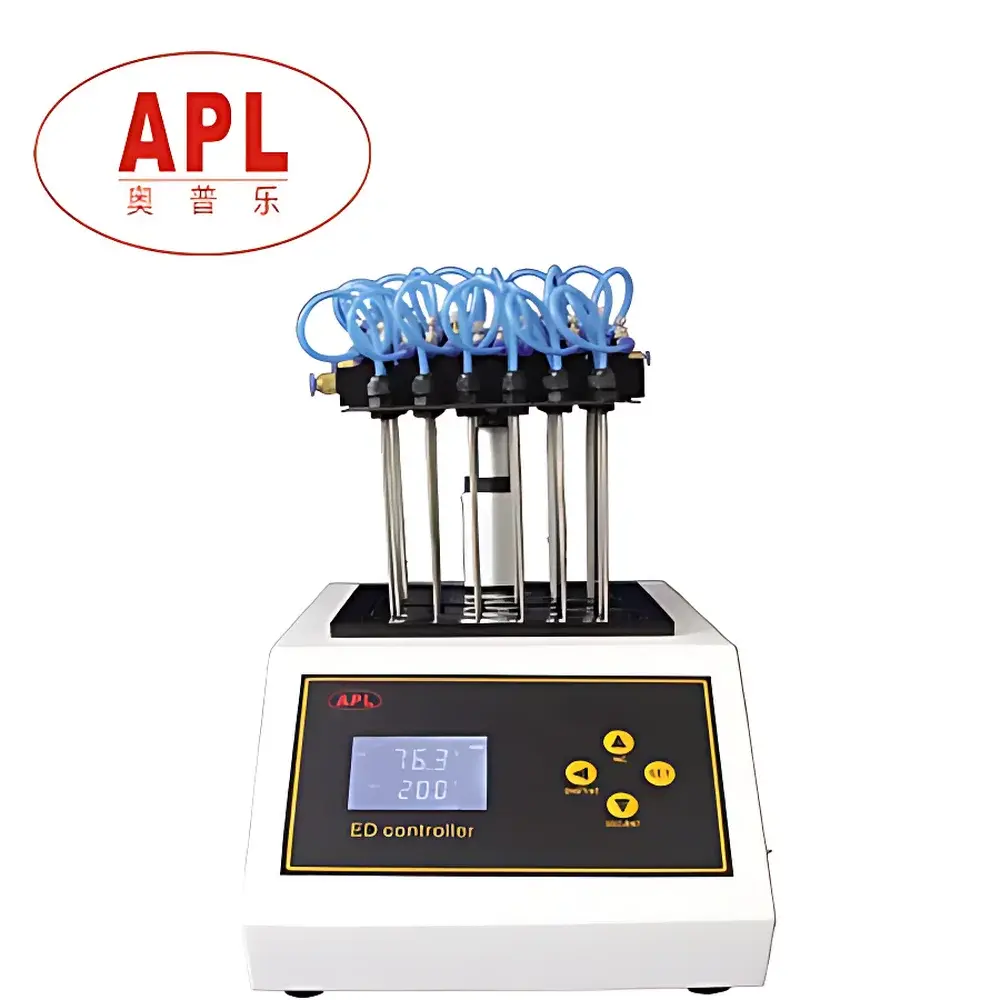
APL NC12 Dry-Block Nitrogen Evaporator
| Brand | APL |
|---|---|
| Origin | Sichuan, China |
| Manufacturer Type | Direct Manufacturer |
| Region of Origin | Domestic (China) |
| Model | NC12 |
| Price | USD 920 (est.) |
| Heating Method | Dry-block heating |
| Temperature Range | Ambient +5°C to 150°C |
| Temperature Stability | ±0.3°C |
| Sample Tube Diameter | φ15 mm |
| Gas Flow Rate | 0–5 L/min |
| Sample Capacity | 12 positions |
| Heating Power | 150 W |
| Temperature Control Accuracy | ±0.1°C |
| Timer Range | 0–99 h 59 min (countdown mode with audible alert) |
| Housing Material | Anodized aluminum housing with plastic-coated exterior |
| Dimensions (L×W×H) | 200 × 290 × 430 mm |
| Weight | 4.0 kg |
| Input Power | 220 V ±22 V / 50 Hz ±1 Hz |
| Gas Inlet Port | Ø6 mm |
| Max Operating Pressure | 200 kPa |
Overview
The APL NC12 Dry-Block Nitrogen Evaporator is a precision-engineered sample concentration system designed for controlled, gentle removal of volatile solvents from multiple liquid samples under inert nitrogen gas flow. It operates on the principle of regulated convective heat transfer combined with directed nitrogen gas shearing across sample surfaces—enabling efficient solvent evaporation while minimizing analyte degradation, oxidation, or cross-contamination. Unlike water bath-based evaporators, the NC12 employs a solid aluminum heating block with uniform thermal mass distribution and active PID feedback control, ensuring high spatial and temporal temperature reproducibility across all 12 sample positions. Its dry-block architecture eliminates risks associated with water contamination, condensation, or inconsistent immersion depth—making it especially suitable for trace-level analysis in environmental testing, pharmaceutical QC, food safety laboratories, and forensic toxicology workflows where batch integrity and method robustness are critical.
Key Features
- Intelligent PID temperature control with LCD interface, real-time display, and adjustable upper-limit temperature alarm—ensuring operational safety and protocol compliance.
- Precise thermal regulation: ±0.1°C setpoint accuracy and ±0.3°C stability over full operating range (ambient +5°C to 150°C), verified per ASTM E2234 calibration guidelines.
- Independent gas flow control per channel (0–5 L/min total, digitally balanced across 12 ports), enabling method-specific optimization for diverse analytes and solvent volatilities.
- Modular gas distribution manifold: individual stainless-steel needles can be removed or repositioned; height-adjustable manifold accommodates varying tube lengths (e.g., 10–150 mm).
- Anodized aluminum heating block surface—enhanced corrosion resistance, non-reactive to common organic solvents, and easy to decontaminate between batches per GLP cleaning validation protocols.
- Ergonomic 15° inclined control panel with tactile buttons and backlit LCD—improves visibility and reduces operator fatigue during extended run times.
- Extended countdown timer (0–99 h 59 min) with audible end-of-cycle alert and auto-shutdown option—supports unattended overnight concentration without manual intervention.
Sample Compatibility & Compliance
The NC12 accommodates standard 12 × φ15 mm test tubes, with optional interchangeable heating blocks available for φ17 mm and φ21 mm formats (custom bore configurations available upon request). Its open-block design allows direct visual monitoring of sample volume reduction and foam formation—critical for methods requiring endpoint determination by eye (e.g., EPA Method 525.3, ISO 17070:2018). The unit complies with IEC 61010-1 safety standards for laboratory electrical equipment and meets electromagnetic compatibility (EMC) requirements per EN 61326-1. While not inherently 21 CFR Part 11 compliant, its analog controls and non-networked architecture support audit-ready documentation when integrated into validated SOPs under ISO/IEC 17025 or GMP environments.
Software & Data Management
The NC12 operates as a standalone instrument with no embedded software or data logging capability. All operational parameters—including set temperature, elapsed time, and timer status—are displayed locally on the LCD screen. For laboratories requiring electronic record retention, external USB data loggers (e.g., Omega OM-DAQPRO-5300 series) may be connected via optional analog output modules (available separately). Temperature calibration certificates traceable to NIM (National Institute of Metrology, China) are provided with each unit, supporting metrological traceability in accredited testing labs.
Applications
- Routine concentration of pesticide residues in water extracts (e.g., following EPA 508/525 series methods)
- Pre-concentration of pharmaceutical impurities prior to LC-MS/MS analysis
- Removal of hexane, dichloromethane, or ethyl acetate from lipid extracts in nutritional analysis
- Sample preparation for GC-ECD analysis of PCB congeners in sediment matrices
- High-throughput cleanup steps in clinical toxicology workflows (e.g., benzodiazepine screening in urine)
- Stabilization of thermolabile compounds (e.g., prostaglandins, cannabinoids) during derivatization protocols
FAQ
Is the NC12 compatible with glass culture tubes and conical-bottom vials?
Yes—provided outer diameter does not exceed φ15 mm and wall thickness permits efficient conductive heating. For thicker-walled or low-thermal-conductivity vessels, users should validate recovery rates and thermal lag empirically.
Can the unit be operated inside a fume hood?
Yes—the NC12 has no internal fans or moving parts that would interfere with hood airflow; however, ensure nitrogen supply lines are secured and exhaust-rated tubing is used if venting concentrated solvent vapors externally.
What maintenance is required for long-term reliability?
Monthly inspection of gas needle tips for clogging, quarterly cleaning of heating block grooves with lint-free ethanol wipes, and annual verification of temperature uniformity across all 12 positions using a calibrated NIST-traceable probe.
Does APL provide IQ/OQ documentation support?
Standard units ship with Factory Acceptance Test (FAT) reports. Custom IQ/OQ protocols—including installation checks, operational boundary mapping, and temperature mapping studies—can be commissioned through APL’s Application Support Division.



