
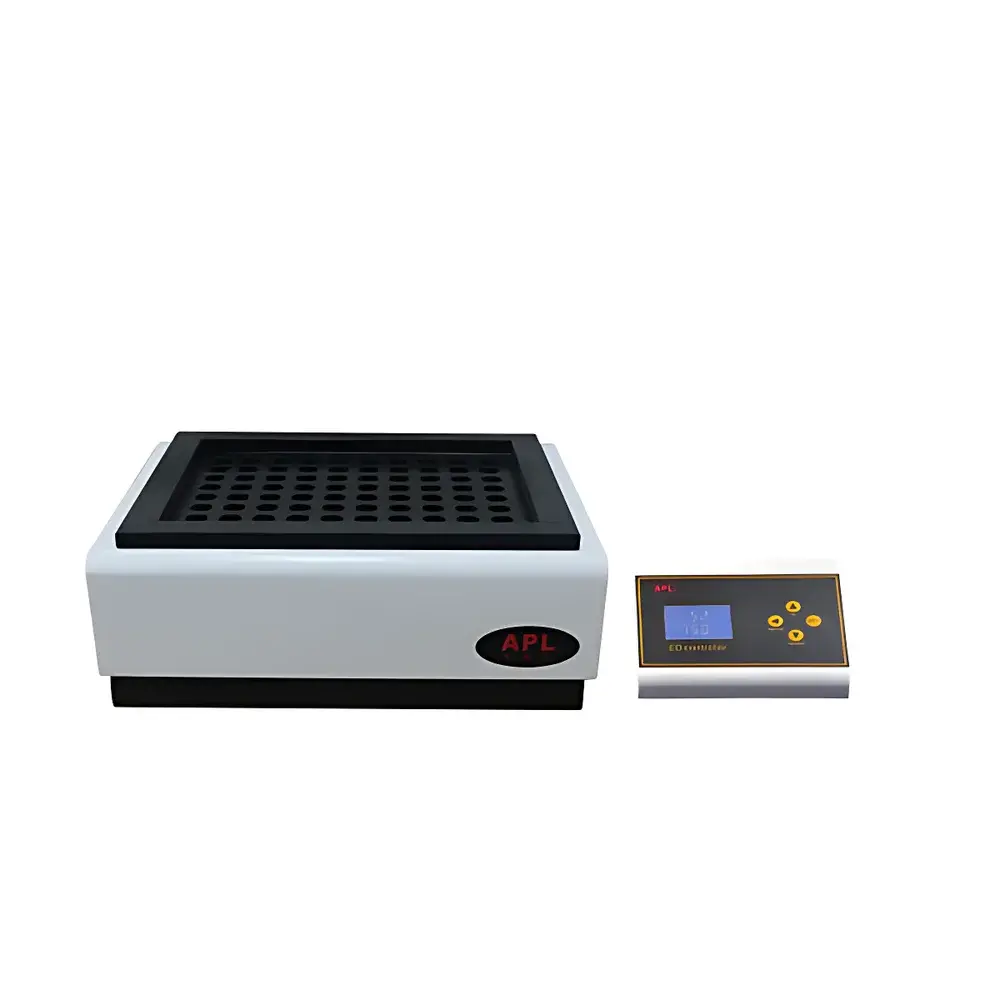
APL ND76 Constant-Temperature Urinary Iodine Digestion System
| Brand | APL |
|---|---|
| Origin | Sichuan, China |
| Manufacturer Type | Direct Manufacturer |
| Region of Origin | Domestic (China) |
| Model | ND76 |
| Instrument Type | Graphite Block Digestion System |
| Automation Level | Semi-Automatic |
| Digestion Positions | 76 |
| Max. Heating Temperature | 250 °C |
| Temperature Control Accuracy | ±0.1 °C |
| Heating Principle | Uniform Graphite Block Heating |
| Reagent Dispensing Channels | None |
Overview
The APL ND76 Constant-Temperature Urinary Iodine Digestion System is a purpose-built graphite block digestion instrument engineered for precise, reproducible sample preparation in compliance with Chinese health industry standards WS/T 107–2006 and WS/T 107–1999 — both specifying the arsenic-cerium catalytic spectrophotometric method for urinary iodine quantification. Unlike general-purpose hot blocks or microwave-assisted systems, the ND76 is thermally optimized for low-volume, high-acid (e.g., HNO₃/H₂SO₄/H₃PO₄) urine matrix digestion at controlled ramp-and-hold profiles. Its core architecture employs a monolithic high-purity graphite heating block with integrated PFA coating, delivering exceptional thermal mass stability and chemical inertness under prolonged exposure to aggressive mineral acids. The system operates on conductive heat transfer principles — eliminating convective variability — and maintains spatial temperature uniformity across all 76 digestion wells without forced air or external circulation, making it suitable for batched clinical epidemiology workflows requiring inter-sample comparability.
Key Features
- 76-position digestion capacity with standardized well geometry: 16 mm diameter × 50 mm depth — compatible with standard 15 mL borosilicate or PFA digestion tubes used in iodine assay protocols.
- Graphite block construction with electropolished PFA (perfluoroalkoxy alkane) surface coating ensures long-term resistance to HF-free strong acid environments (e.g., 1–5 mol/L HNO₃, 1–3 mol/L H₂SO₄), minimizing contamination risk and extending service life.
- PID-based digital temperature control with real-time feedback loop enables programmable ramp rates (°C/min), hold durations, and dual-stage alarms (high/low temperature deviation). Control resolution: 0.1 °C; accuracy: ±0.1 °C over full 30–250 °C range.
- Uniform thermal distribution: ≤ ±1.0 °C inter-well variation across the entire block (measured per ASTM E220-18 calibration methodology at 100 °C and 200 °C), critical for parallel processing of population-level urine specimens where coefficient of variation (CV) must remain <5% in final iodine recovery.
- Corrosion-resistant control enclosure with IP54-rated housing and chemically inert front-panel materials permits safe operation in fume hoods or shared analytical labs handling halogenated and oxidizing reagents.
Sample Compatibility & Compliance
The ND76 is validated for use with human urine samples (0.5–2.0 mL volume) processed via open-vessel wet digestion using sulfuric–nitric–phosphoric acid mixtures, as specified in WS/T 107–2006. It supports GLP-aligned documentation when paired with external electronic lab notebooks (ELNs) or LIMS interfaces via RS-232 output. While not FDA 21 CFR Part 11–certified out-of-the-box, its deterministic temperature logging (timestamped setpoint/actual values stored internally for ≥100 cycles) meets minimum audit-trail requirements for ISO/IEC 17025 accredited laboratories performing iodine testing in public health surveillance programs. No regulatory claims are made for clinical diagnostic use under IVDR or CLIA.
Software & Data Management
The ND76 features an embedded microcontroller interface with LED display and tactile membrane keypad — no proprietary software installation required. All thermal programs (up to 10 user-defined methods) are stored locally with non-volatile memory retention. Temperature data (setpoint, actual, time stamp) can be exported via serial interface (RS-232) for integration into laboratory information management systems (LIMS) or statistical process control (SPC) platforms. Export format is ASCII-delimited (.csv-compatible), enabling direct import into JMP, Minitab, or Python-based QA/QC pipelines. No cloud connectivity, remote access, or firmware update capability is provided — consistent with IEC 61326-1 Class A EMC compliance for industrial laboratory environments.
Applications
- Urinary iodine monitoring in national nutrition surveys and maternal-child health programs.
- Quality control of iodized salt distribution efficacy through population biomarker validation.
- Method validation studies comparing digestion efficiency across acid systems (e.g., HNO₃-only vs. HNO₃/H₂SO₄ blends).
- Reference material digestion for certified iodine concentration standards (e.g., NIST SRM 2670a).
- Pre-analytical sample stabilization prior to Ce⁴⁺/As³⁺ redox reaction in UV-Vis spectrophotometry (λ = 400 nm).
FAQ
Does the ND76 support programmable multi-step temperature ramps?
Yes — up to three independent ramp-and-hold segments per method, with adjustable rate (0.1–10.0 °C/min) and dwell time (1–999 min).
Is PFA coating resistant to hydrofluoric acid (HF)?
No — the PFA layer is not HF-resistant. The ND76 is intended for HF-free digestion protocols only, per WS/T 107 specifications.
Can the instrument be calibrated traceably to national standards?
Yes — users may perform in-situ verification using NIST-traceable PT100 probe assemblies (e.g., Fluke 720A) inserted into designated calibration wells; procedure documented in Appendix B of the operator manual.
What maintenance is required for long-term thermal accuracy?
Annual verification of block emissivity and PID gain parameters is recommended; graphite surface cleaning with 70% ethanol and lint-free wipes after each acid run prevents residue buildup affecting thermal contact.



