
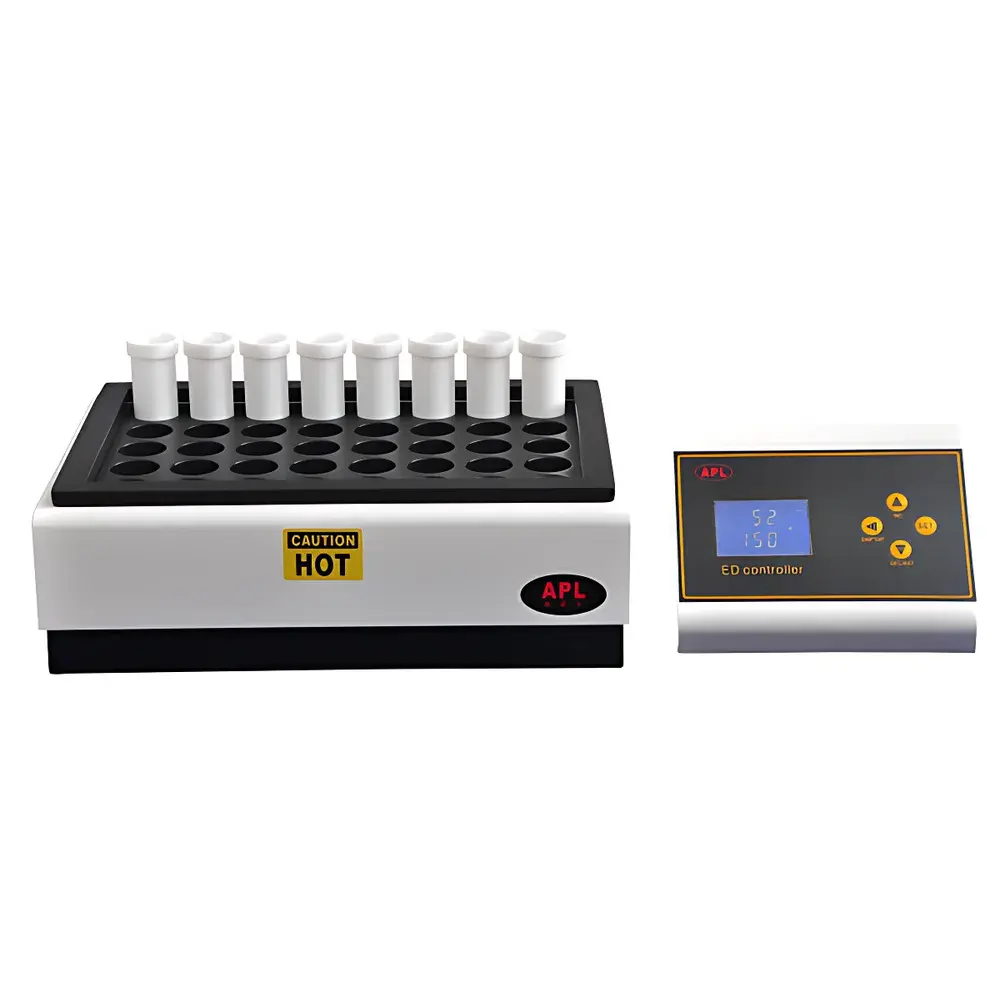
APL Optol GD40 Graphite Block Digestion System
| Brand | APL Optol |
|---|---|
| Model | GD40 |
| Digestion Capacity | 40 positions |
| Max Temperature | 450 °C |
| Temperature Control Accuracy | ±0.1 °C |
| Heating Medium | High-Purity Graphite |
| Heating Method | Integrated Omnidirectional Graphite Block Heating |
| Reagent Addition Channels | 2 |
| Automation Level | Semi-Automatic |
| Power Rating | 3.6 kW |
| Compliance | Designed to meet EPA Methods 200.2, 200.7, 200.8, 3050B, 3051A, 3052 |
Overview
The APL Optol GD40 Graphite Block Digestion System is an engineered solution for high-throughput, temperature-precise acid digestion of solid and semi-solid samples in environmental, geological, food safety, and regulatory testing laboratories. It operates on the principle of conductive heating via a monolithic high-purity graphite block—providing uniform thermal transfer across all 40 digestion wells without hotspots or radial gradients. Unlike conventional ceramic or metal-block heaters, the GD40’s graphite architecture delivers exceptional thermal stability, corrosion resistance, and long-term calibration retention under aggressive HNO₃/HF/HClO₄ matrices. Its operational range spans ambient to 450 °C (optional extended configuration), with real-time PID-controlled regulation ensuring compliance with method-defined ramp-and-hold profiles required by U.S. EPA, ISO 11466, and ASTM D3682.
Key Features
- Monolithic high-density graphite heating block engineered for thermal homogeneity: inter-well temperature variation ≤ ±1.5 °C across 40 positions (20–210 °C), verified per ASTM E220 calibration protocol.
- True omnidirectional heating geometry—surrounding each vessel laterally and from below—eliminates axial thermal stratification and accelerates complete matrix decomposition versus open-heater or coil-based systems.
- Dual independent reagent addition channels enable sequential or simultaneous delivery of oxidizing acids (e.g., HNO₃ followed by H₂O₂), supporting multi-step digestion protocols without manual intervention.
- Corrosion-resistant front panel with chemically inert toggle switches rated for continuous exposure to fuming nitric and hydrofluoric acid vapors; housing meets IP54 ingress protection standards.
- Integrated digital serial interface (RS-232/USB) supports bidirectional communication with laboratory information management systems (LIMS) and external PCs for audit-trail-compliant data logging, including time-stamped temperature ramps, hold durations, and alarm events.
- Energy-optimized thermal design reduces power consumption by up to 75% relative to conventional hotplate-digestion workflows—validated against IEC 62304 energy efficiency benchmarks for lab instrumentation.
Sample Compatibility & Compliance
The GD40 accommodates standard 50 mL and 100 mL PTFE, quartz, or borosilicate digestion tubes (diameter ≤ 32 mm). It is validated for use with EPA Methods 3050B (sediments/sludges), 3051A (microwave-assisted alternative validation), 3052 (high-pressure ashing), and 200.7/200.8 (metals in wastewater). All temperature setpoints, ramp rates, and dwell times are programmable and traceable—supporting GLP/GMP documentation requirements under 21 CFR Part 11 when paired with compliant LIMS software. The graphite surface coating is certified non-leaching per USP for extractables testing.
Software & Data Management
The GD40 includes factory-calibrated firmware with embedded temperature profiling logic. When connected to a host PC via serial interface, users can deploy Optol DigControl™ v3.x (Windows-compatible) to define multi-stage digestion programs—including up to 8 ramp segments, variable slope control (0.1–10 °C/min), and conditional triggers (e.g., pause on reaching 120 °C for reflux stabilization). All session logs are timestamped, digitally signed, and exportable in CSV/Excel format. Audit trail functionality records operator ID, parameter changes, system errors, and thermal deviations—fully compliant with FDA 21 CFR Part 11 Annex 11 requirements for electronic records.
Applications
- Environmental analysis: Total recoverable metals (As, Cd, Cr, Pb, Hg, Ni, Zn) in soils, sediments, sludges, and airborne particulates (PM₁₀/PM₂.₅ filters).
- Food and agricultural testing: Digestion of plant tissues, animal feed, and dairy products prior to ICP-OES or ICP-MS quantification.
- Geochemical exploration: Preparation of rock powders and mineral concentrates for rare earth element (REE) and platinum group metal (PGM) assays.
- Regulatory compliance labs: Routine execution of ISO 17294-2:2016 (water analysis) and EN 13346:2000 (soil extraction) sample prep workflows.
- Academic research: Controlled oxidative degradation of polymers, carbon nanomaterials, and biological matrices under reproducible thermal-chemical conditions.
FAQ
Does the GD40 support method validation according to ISO/IEC 17025?
Yes—the instrument’s temperature uniformity, repeatability (±0.1 °C over 24 h), and programmability are documented in its Factory Calibration Certificate, which includes traceability to NIST SRM 1967 thermocouple standards.
Can the dual reagent channels be used for automated HF addition?
HF delivery requires optional PTFE-lined peristaltic tubing and a dedicated HF-rated pump module (sold separately); standard channels are compatible with HNO₃, HCl, and H₂O₂ only.
Is remote monitoring possible without direct PC connection?
No native Ethernet/Wi-Fi module is integrated; however, third-party RS-232-to-Ethernet gateways (e.g., Moxa NPort) enable networked access when deployed within institutional IT infrastructure.
What maintenance is required for long-term graphite block integrity?
Annual visual inspection for micro-cracking and coating integrity is recommended; cleaning must use only deionized water and soft lint-free cloths—no abrasive solvents or steel wool.
How does the GD40 compare to microwave digestion systems in throughput?
While microwave systems offer faster single-batch kinetics, the GD40 enables unattended overnight processing of 40 samples with identical thermal history—ideal for routine QA/QC where inter-batch comparability outweighs absolute speed.
Related Products



