
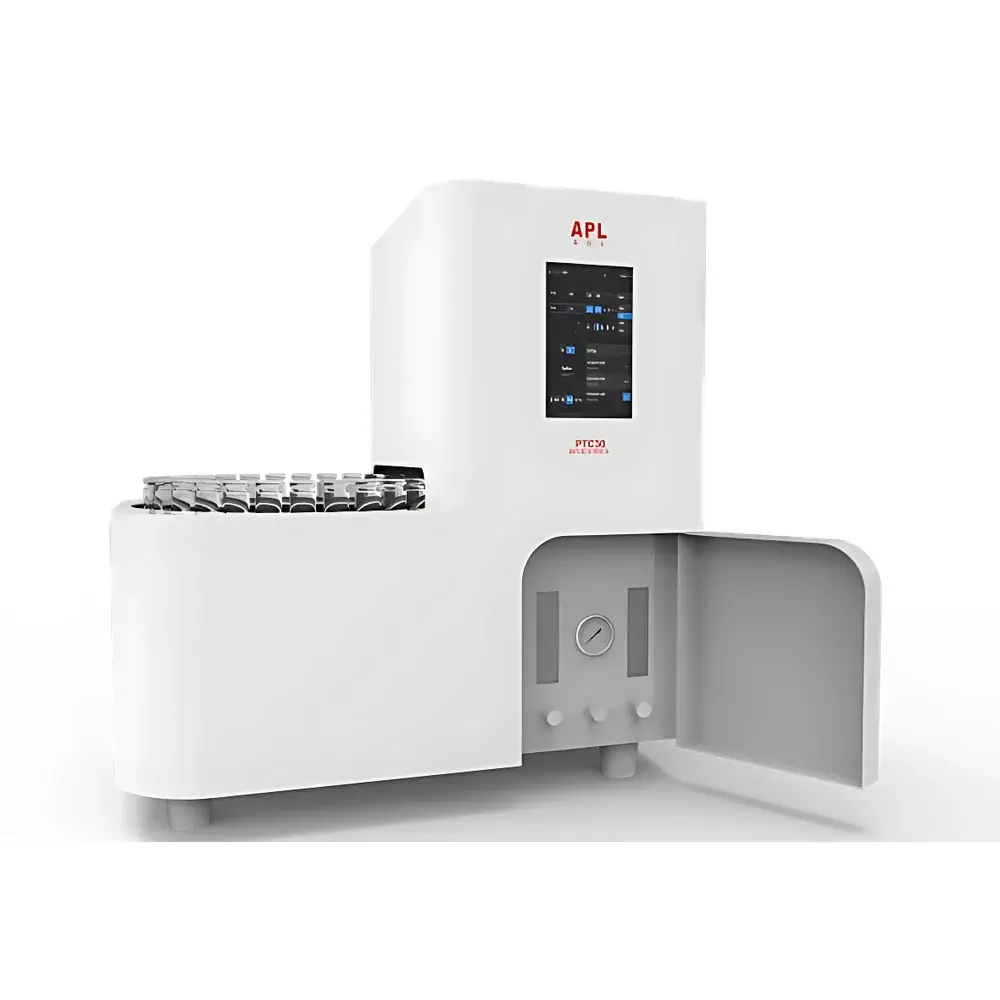
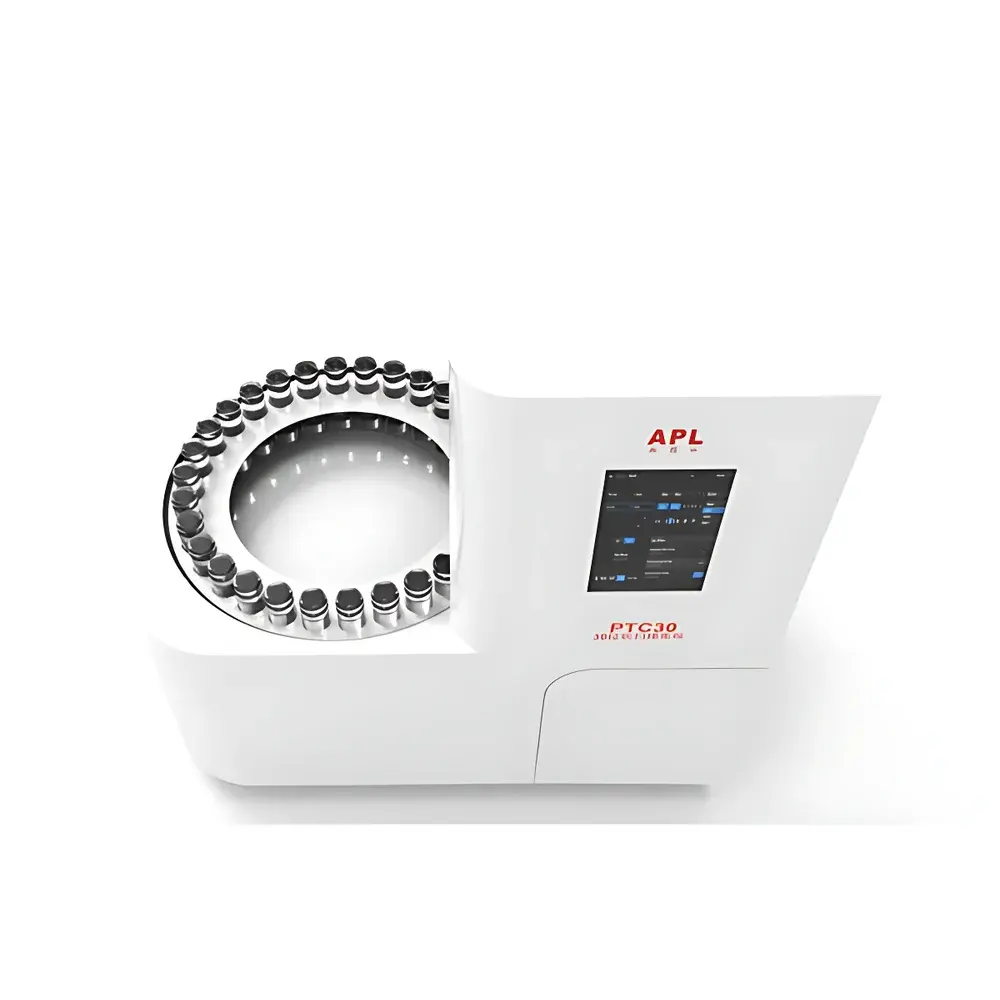
APL Optolab APL-PTC30 30-Position Fully Automated Purge and Trap System
| Brand | APL Optolab |
|---|---|
| Origin | Sichuan, China |
| Manufacturer Type | Original Equipment Manufacturer (OEM) |
| Model | APL-PTC30 |
| Sample Capacity | 30 positions |
| Injection Precision | RSD < 3% |
| Trap Temperature Range | −30 °C to 400 °C |
| Sample Heating Temperature | Ambient to 120 °C |
| Vial Cooling Temperature | −30 °C |
| Purge Flow Rate | 0–100 mL/min (adjustable) |
| Desorption Time | 1–3 min |
| Bake-out Temperature | Up to 250 °C |
| Trap Desorption Efficiency | Optimized for VOCs with C2–C12 volatility range |
| Compliance | ASTM D6866, EPA Method 502.2, EPA Method 524.2, EPA Method 8260D, HJ 605–2011, HJ 639–2012, HJ 686–2014, HJ 713–2014, HJ 735–2015, HJ 866–2017, HJ 893–2017, HJ 896–2017, HJ 1020–2019, SL 393–2007 |
Overview
The APL Optolab APL-PTC30 is a fully automated, 30-position purge and trap system engineered for high-throughput, trace-level analysis of volatile organic compounds (VOCs) in aqueous, solid, and semi-solid matrices. It operates on the principle of dynamic headspace extraction: inert gas (typically helium or nitrogen) purges VOCs from a heated or chilled sample, transporting them through a thermally regulated transfer line into a cryogenically cooled trap packed with sorbent material (e.g., Tenax TA, Carbopack B/C). Following moisture removal via an integrated water management module, the trap is rapidly heated to desorb analytes into a gas chromatograph (GC) or GC-mass spectrometer (GC-MS) for separation and detection. Designed for compliance-driven laboratories, the APL-PTC30 supports method-defined workflows aligned with U.S. EPA, ASTM, and Chinese environmental standard methods—including EPA 524.2, 8260D, and multiple HJ-series standards—ensuring data integrity, reproducibility, and audit readiness.
Key Features
- 30-position carousel with robotic arm for unattended sequential processing of 40 mL vials, enabling overnight operation and batch throughput optimization.
- Independent four-zone thermal control: purge valve, transfer line, water trap, and trap bed—all precisely regulated from ambient to 400 °C (trap) or 240 °C (valve/line), minimizing carryover and ensuring consistent desorption kinetics.
- Integrated Peltier-based cooling system achieves trap temperatures down to −30 °C and vial cooling to −30 °C, enhancing retention of low-boiling compounds (e.g., vinyl chloride, chloromethane) and suppressing matrix interference.
- Magnetic stirring with variable speed control (100–1200 rpm) ensures homogeneous volatilization from heterogeneous samples such as soils, sediments, and sludges.
- Dual-stage moisture management: a programmable water trap (ambient to 240 °C) removes bulk water vapor prior to trapping, while optional hydrophobic membrane integration prevents ice formation and column contamination.
- Auto-backflush capability for both transfer line and six-port valve reduces cross-contamination between high- and low-volatility samples without manual intervention.
- Universal GC/GC-MS trigger interface compatible with Agilent, Thermo Fisher, Shimadzu, PerkinElmer, and Waters instruments via TTL or contact-closure signaling; supports synchronized start of GC oven ramp and data acquisition.
Sample Compatibility & Compliance
The APL-PTC30 accommodates liquid (water, wastewater, leachates), solid (soil, sediment, landfill waste), and semi-solid (sludge, biota homogenates) samples per EPA and HJ regulatory protocols. Its 40 mL vial format complies with standard EPA Method 524.2 and HJ 605–2011 requirements. The system meets GLP and GMP documentation prerequisites through time-stamped method logs, user-accessible audit trails, and password-protected parameter locking. All thermal zones support 1 °C resolution setpoints and NIST-traceable calibration validation. Instrument performance verification follows EPA-defined criteria: surrogate recovery (e.g., bromofluorobenzene, t-butyl alcohol) within 70–130%, internal standard precision (RSD < 5%), and blank integrity (< 0.5× method detection limit across 10 consecutive runs).
Software & Data Management
The embedded Windows-based control software provides intuitive method building with multi-step time programming (purge, dry purge, trap desorption, bake-out, valve/line backflush). Real-time graphical animation displays valve actuation, temperature profiles, and gas flow status. Raw method files (.apt) include full metadata (user ID, timestamp, instrument serial, calibration history) and are exportable in CSV or XML for LIMS integration. Audit trail functionality records all parameter changes, run starts/stops, and error events in immutable format compliant with FDA 21 CFR Part 11 requirements when deployed with electronic signature modules. Remote monitoring via Ethernet enables centralized lab management across multi-instrument networks.
Applications
The APL-PTC30 delivers validated performance in environmental monitoring (drinking water, groundwater, surface water, soil screening), regulatory compliance testing (TCLP, SW-846), food safety (residual solvents, off-flavor volatiles), and industrial hygiene (workplace air condensates). Typical target analytes include BTEX (benzene, toluene, ethylbenzene, xylenes), trihalomethanes (chloroform, bromodichloromethane), haloacetonitriles, carbonyl sulfide, methyl tert-butyl ether (MTBE), and C6–C9 petroleum hydrocarbons. Its robust design supports extended operation under ISO/IEC 17025-accredited laboratory conditions, with documented method transfer success to GC platforms equipped with PTV, split/splitless, or cold-on-column inlets.
FAQ
Does the APL-PTC30 support EPA Method 8260D for soil analysis?
Yes—the system implements all critical parameters specified in Method 8260D, including purge temperature (40 °C), trap desorption (250 °C), and bake-out (270 °C), with full traceability for QA/QC reporting.
Can it be used with cryogen-free GC-MS systems?
Yes—its electronic cooling eliminates liquid nitrogen dependency, and its trap desorption profile is optimized for compatibility with single-quadrupole and triple-quadrupole MS detectors.
Is method validation documentation provided?
APL Optolab supplies a comprehensive IQ/OQ protocol package, including temperature uniformity mapping, flow rate verification certificates, and RSD test reports for injection precision (RSD < 3% at 10 ppb level).
How is carryover mitigated during high-concentration sample runs?
Automated backflush of the transfer line and six-port valve—combined with 5-minute bake-out at 250 °C—reduces carryover to < 0.1% for compounds like naphthalene and 1,2,4-trimethylbenzene.
What maintenance intervals are recommended?
Sorbent trap replacement every 200–300 injections; water trap desiccant every 6 months; Peltier cooler performance verification annually using calibrated thermocouples and flow meters.




