
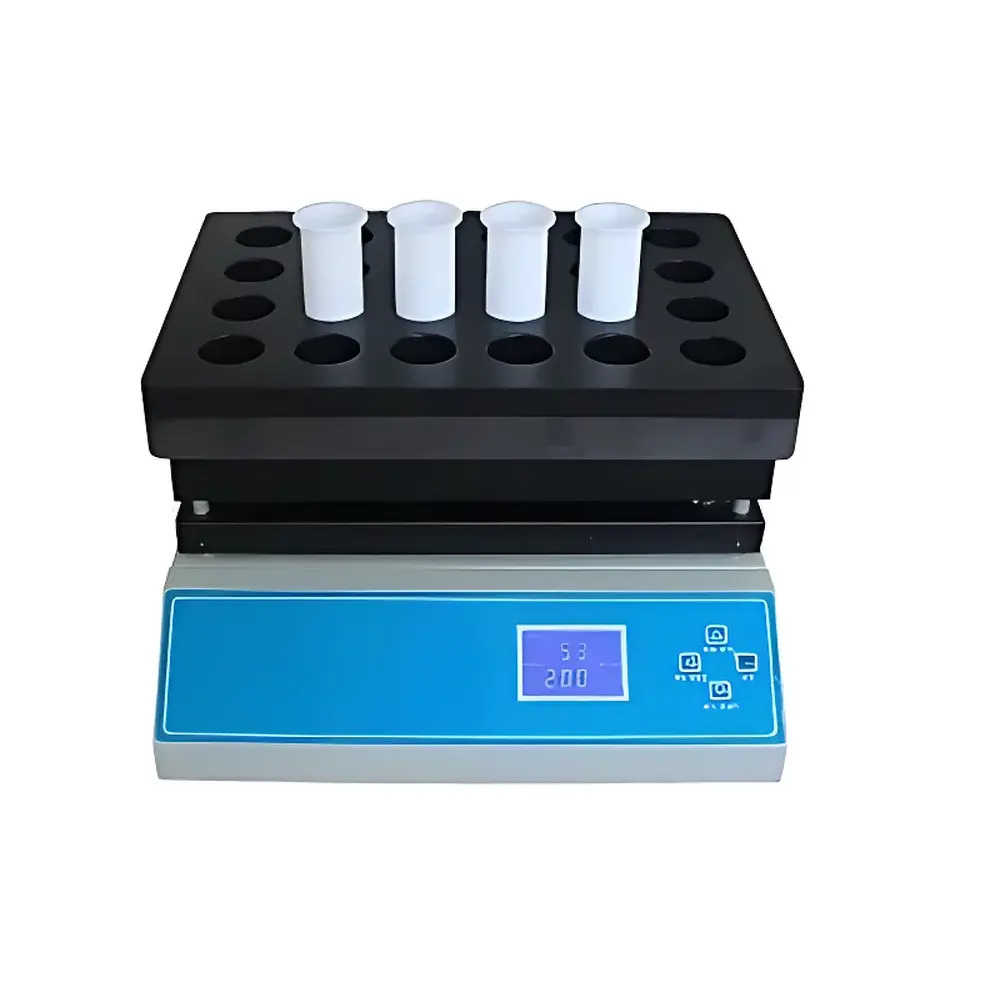
APL Optolab ED24G Graphite Block Digestion System (Acid Evaporation Unit)
| Brand | APL Optolab |
|---|---|
| Origin | Sichuan, China |
| Manufacturer Type | Direct Manufacturer |
| Product Category | Domestic |
| Model | ED24G |
| Instrument Type | Graphite Block Digestion System |
| Temperature Range | Ambient to 250 °C (High-Temp Variant: Ambient to 400 °C) |
| Heating Method | Graphite Block with PTFE Coating (or High-Purity Graphite) |
| Temperature Accuracy | ±1 °C (optional ±0.1 °C sensor) |
| Max Power | 3.6 kW |
| Sample Capacity | 24 positions × 40 mm diameter wells |
| Control System | PID-based digital temperature controller with programmable ramp/hold profiles |
| Optional Interface | RS-232/RS-485 serial port for PC integration and LIMS connectivity |
| Compliance | Designed to meet EPA Methods 200.2, 200.7, 200.8, 3050B, 3051A, 3052 |
Overview
The APL Optolab ED24G Graphite Block Digestion System is an engineered solution for controlled, reproducible acid digestion and post-digestion acid evaporation (commonly referred to as “acid removal” or “acid fuming”) in environmental, pharmaceutical, food safety, clinical, and industrial laboratories. It operates on the principle of conductive heating via a high-density graphite block—thermally stable, chemically inert, and uniformly conductive—ensuring consistent thermal transfer across all sample positions. Unlike open-heating devices such as hot plates or ceramic heaters, the ED24G employs full-wrap conduction from below and lateral contact, minimizing thermal gradients and eliminating convective heat loss. This architecture supports precise method execution per EPA, ISO, and ASTM digestion protocols—including but not limited to EPA 3050B (sediment/soil), EPA 3051A (microwave pre-digestion support), and EPA 3052 (high-pressure microwave-compatible prep)—and serves as a robust alternative or complementary unit to microwave digestion systems for batched, low-risk, high-throughput sample preparation.
Key Features
- 24-position graphite block with 40 mm well diameter, optimized for standard 50 mL Teflon®-lined or quartz digestion tubes
- Dual-temperature configuration: Standard version (ambient–250 °C); high-temperature variant (ambient–400 °C) for aggressive HClO₄ or HF-HNO₃ evaporation
- PTFE-coated or high-purity graphite heating surface—resistant to concentrated HNO₃, HCl, HF, H₂SO₄, and aqua regia under routine operating conditions
- PID-controlled digital thermostat with ±1 °C accuracy (±0.1 °C optional with calibrated RTD probe), programmable ramp rates (0.1–20 °C/min), and multi-step hold profiles
- Integrated over-temperature protection and audible/visual fault alerts; automatic shutdown upon deviation exceeding user-defined thresholds
- Corrosion-resistant control panel with sealed membrane switches rated for Class C laboratory environments (per IEC 60529 IP54)
- Energy-efficient design: Up to 75% lower power consumption vs. conventional hot plates or ceramic heaters during equivalent digestion cycles
Sample Compatibility & Compliance
The ED24G accommodates a broad range of sample matrices—including soils, sediments, biological tissues, food homogenates, polymer ash, and clinical specimens—when paired with appropriate digestion vessels (e.g., PFA, quartz, or borosilicate glass). Its uniform inter-well temperature uniformity (<±1.5 °C across all 24 positions at 250 °C) ensures statistically valid replicate digestion outcomes required for ISO/IEC 17025-accredited testing. The system is validated for use in workflows compliant with EPA SW-846 Methods, USP , ASTM D3682, and ISO 11047 (trace metal analysis in water and sludge). While not itself GLP-certified, its programmable logging capability (via optional serial interface) supports audit-ready data capture aligned with FDA 21 CFR Part 11 requirements when integrated into validated LIMS environments.
Software & Data Management
An optional RS-232 or RS-485 serial interface enables bidirectional communication with host PCs running custom or third-party LabVIEW™, Python-based, or vendor-neutral SCADA software. Real-time temperature streaming, setpoint scheduling, and event-triggered logging (e.g., ramp initiation, hold completion, fault detection) are supported. Export formats include CSV and XML, facilitating traceability and alignment with electronic lab notebook (ELN) platforms. No proprietary software is bundled; integration follows standard Modbus RTU or ASCII command protocols—ensuring compatibility with existing laboratory automation infrastructure without vendor lock-in.
Applications
- Preparation of aqueous extracts for ICP-OES, ICP-MS, AAS, and HG-AFS analysis
- Residue removal after microwave-assisted digestion (e.g., residual nitric or hydrofluoric acid prior to dilution)
- Controlled evaporation of digestates for volume reduction and analyte concentration
- Standardized digestion of certified reference materials (CRMs) for method validation
- High-volume QA/QC processing in environmental contract labs performing TCLP, SPLP, or total recoverable metals testing
- Supporting CLIA- and CAP-accredited clinical labs in heavy metal screening (Pb, Cd, As, Hg) from whole blood or urine
FAQ
Is the ED24G compatible with hydrofluoric acid (HF) digestion?
Yes—when equipped with high-purity graphite (not PTFE-coated) and used with HF-rated digestion vessels (e.g., PFA or quartz), the ED24G supports HF-involved protocols such as EPA 3052. Always observe strict PPE and fume hood requirements.
Can temperature profiles be saved and recalled?
Yes—up to 10 user-defined programs can be stored internally. With serial connectivity, unlimited profiles may be managed externally via PC.
What maintenance is required for long-term stability?
Annual verification of temperature uniformity and sensor calibration is recommended. Graphite surfaces require no lubrication; periodic visual inspection for coating integrity (if PTFE-coated version) is sufficient.
Does the system meet CE or UL safety standards?
The ED24G complies with IEC 61010-1:2010 for electrical safety in laboratory equipment. CE marking is available upon request for EU-distributed units; UL listing is not currently held but conforms to underlying technical requirements.
How is inter-well temperature uniformity verified?
Uniformity is validated using NIST-traceable multi-point RTD probes placed simultaneously across 5 representative wells (center + corners) at 100 °C, 200 °C, and 250 °C—results documented in出厂 calibration report.



