
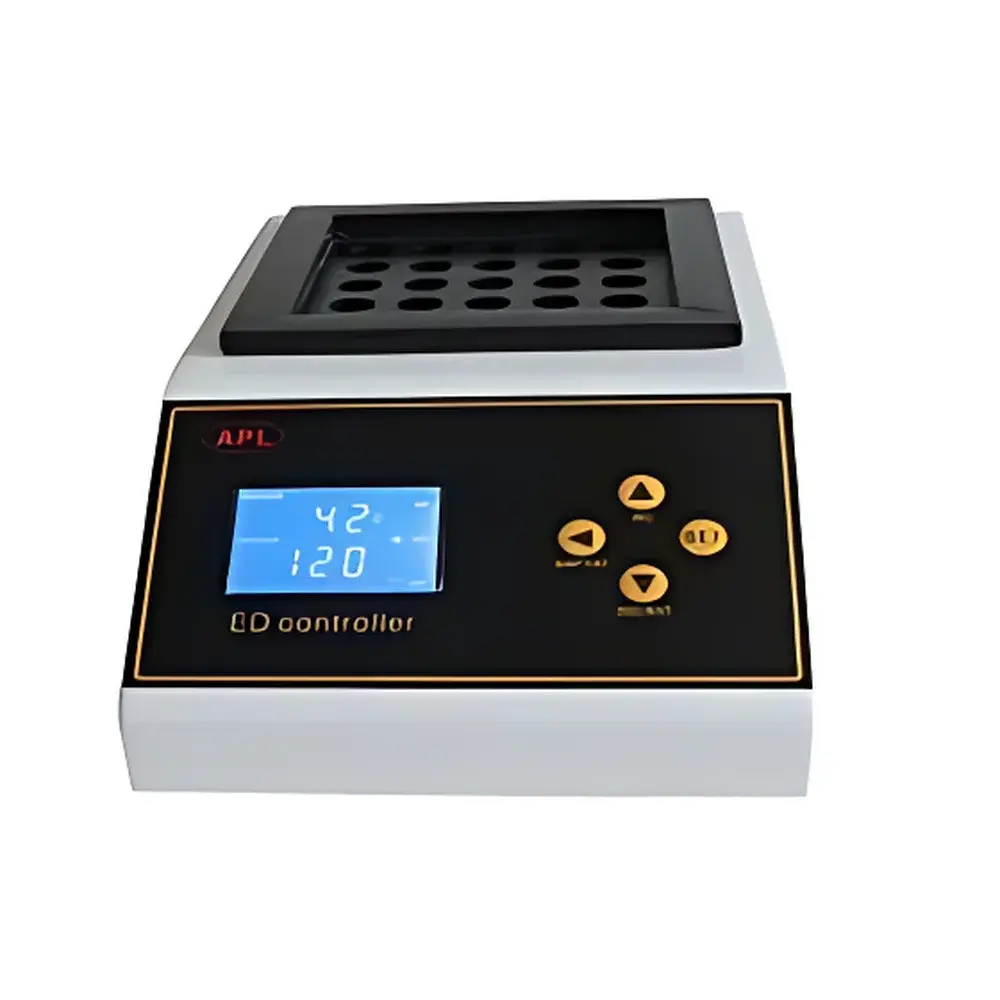
APL Optolab ND25 Constant-Temperature Urinary Iodine Digestion Block
| Brand | APL Optolab |
|---|---|
| Origin | Sichuan, China |
| Manufacturer Type | Direct Manufacturer |
| Region of Origin | Domestic (China) |
| Model | ND25 |
| Price | USD 1,400 (FOB) |
Overview
The APL Optolab ND25 Constant-Temperature Urinary Iodine Digestion Block is a precision-engineered thermal digestion platform designed specifically for compliant sample preparation in iodine quantification workflows. It operates on the principle of controlled conductive heating within chemically inert, temperature-stable graphite blocks, enabling reproducible, closed-vessel wet digestion of urine samples prior to analysis by arsenic-cerium catalytic spectrophotometry—fully aligned with the methodology stipulated in Chinese Health Industry Standards WS/T 107–2006 and WS/T 107–1999. Unlike open-flame or hotplate-based systems, the ND25 employs a monolithic high-purity graphite heating block with PFA (perfluoroalkoxy alkane) coating, ensuring uniform thermal distribution, resistance to aggressive reagents (e.g., HNO₃, HClO₄, H₂SO₄), and minimal risk of cross-contamination. Its architecture supports batch processing under strictly defined thermal profiles, making it suitable for routine high-throughput laboratories in public health institutions, CDCs, and clinical reference labs where regulatory traceability and inter-laboratory comparability are critical.
Key Features
- High-purity graphite block with PFA anti-corrosion coating — withstands prolonged exposure to concentrated mineral acids and oxidizing agents without degradation or metal leaching.
- Precision PID temperature control system with ±0.2 °C accuracy across the operational range (ambient to 250 °C); supports programmable ramp-hold cycles with adjustable heating rate and dwell time.
- 360° circumferential heating design minimizes radial thermal gradients; inter-hole temperature uniformity maintained at ≤±1.0 °C across all 25 positions (16 mm diameter × 50 mm depth).
- Corrosion-resistant control housing constructed from chemically inert polymers and coated metals — rated for continuous operation in environments with acid vapors or splashes.
- Integrated over-temperature and low-temperature alarm functions with automatic power cutoff to prevent sample degradation or instrument damage.
- Modular footprint optimized for benchtop integration; compatible with standard 16-mm borosilicate glass test tubes and PTFE digestion vials.
Sample Compatibility & Compliance
The ND25 is validated for use with human urine matrices processed under standardized arsenic-cerium catalytic digestion protocols. It accommodates up to 25 samples simultaneously in standardized tube geometry, supporting full compliance with WS/T 107–2006 requirements for digestion temperature (95–100 °C), duration (≥10 min), and reagent stability. While not certified to ISO/IEC 17025 or FDA 21 CFR Part 11 out-of-the-box, its deterministic thermal behavior, programmable profiles, and hardware-level alarm logging enable integration into GLP- and GMP-aligned workflows when paired with documented SOPs and external audit trails. The absence of moving parts or consumable heaters contributes to long-term calibration stability and reduces maintenance-related variability.
Software & Data Management
The ND25 operates via an embedded digital controller with tactile keypad interface and dual-line LCD display. No proprietary software or PC connectivity is included; all parameters—including setpoint temperature, ramp rate, hold time, and real-time block temperature—are configured and monitored locally. For laboratories requiring electronic recordkeeping, optional RS-232 or analog 4–20 mA output modules (sold separately) allow connection to LIMS or SCADA systems for timestamped thermal profile capture. All operational events—including alarms, power interruptions, and manual overrides—are logged in non-volatile memory with retention ≥12 months, supporting internal QA audits and method validation documentation per CNAS-CL01:2018 guidelines.
Applications
- Routine urinary iodine monitoring in national nutrition surveillance programs and maternal-child health initiatives.
- Quality control and proficiency testing in provincial and municipal CDC laboratories performing iodine deficiency disorder (IDD) assessments.
- Method development and validation studies requiring precise, repeatable digestion conditions for spectrophotometric, ICP-MS, or IC-ICP-MS iodine quantification.
- Batch digestion of biological fluids where matrix consistency, low blank levels, and thermal reproducibility are essential for sub-µg/L detection sensitivity.
- Teaching laboratories conducting hands-on training in trace element sample preparation under standardized public health protocols.
FAQ
Is the ND25 compatible with automated tube handling or robotic liquid handlers?
No—the ND25 is a standalone thermal block without mechanical interfaces or API support for robotics. Manual tube loading/unloading is required.
Can the heating block be replaced independently of the controller unit?
Yes—graphite blocks are field-replaceable service parts with standardized mounting and thermocouple integration; replacement requires no recalibration.
Does the instrument meet CE or UL safety certification requirements?
It complies with GB 4793.1–2019 (Chinese equivalent of IEC 61010-1) for laboratory electrical equipment safety; CE/UL certification is not held but can be pursued via third-party assessment upon request.
What is the expected service life of the PFA-coated graphite block under daily use with nitric-perchloric acid mixtures?
Under recommended operating conditions (<200 °C, ≤2 hr/daily exposure), the coated block typically exceeds 5 years of functional service before observable erosion or thermal drift occurs.
Is there a validated method transfer document available for WS/T 107–2006 implementation?
APL Optolab provides a technical application note (AN-ND25-01) detailing digestion parameter mapping, blank evaluation, and recovery validation data—available upon request with proof of institutional affiliation.
Related Products



