
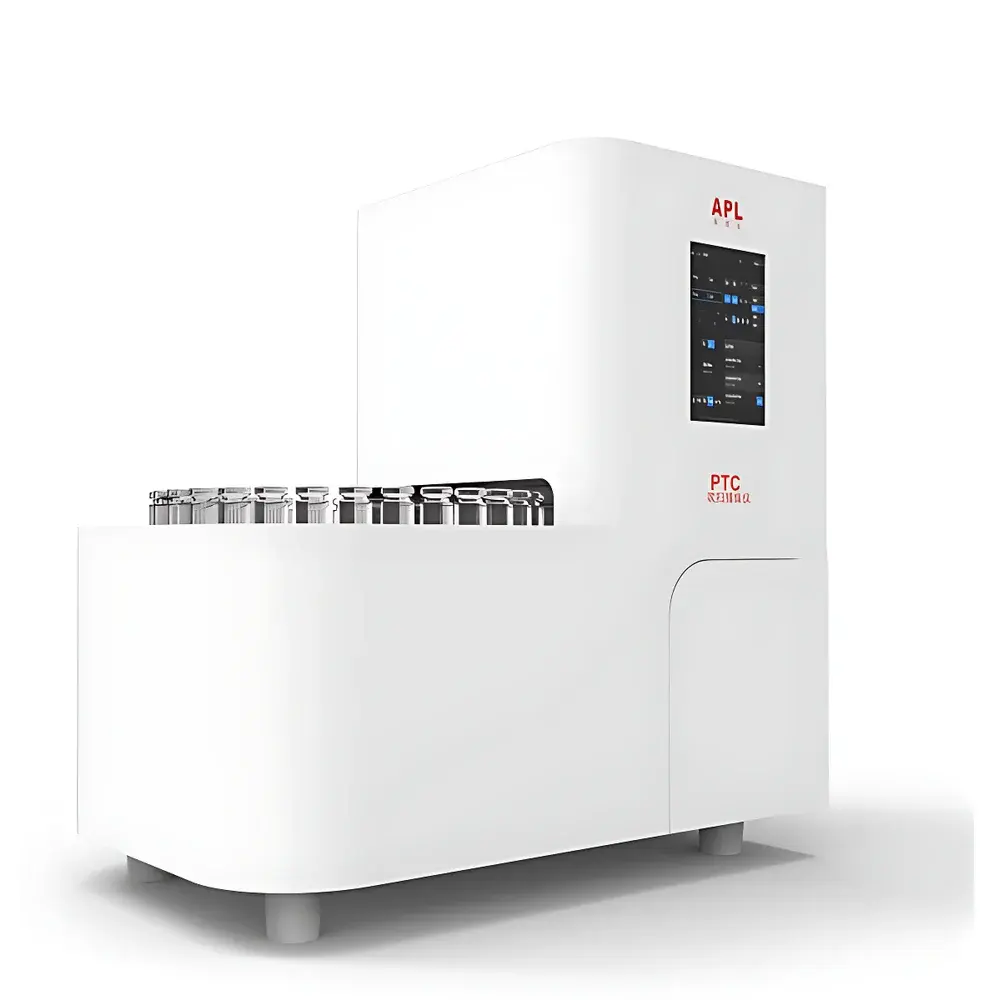
APL PT30D Automated Purge and Trap System
| Brand | APL |
|---|---|
| Origin | Sichuan, China |
| Manufacturer Type | Direct Manufacturer |
| Product Category | Domestic |
| Model | PT30D |
| Instrument Type | Water & Soil Integrated VOC Analyzer |
| Sample Tray Capacity | 30 positions |
| Injection Precision | RSD < 3% |
| Trap Temperature Range | –30 °C to 400 °C |
| Sample Heating Temperature | Ambient to 120 °C |
| Vial Cooling Temperature | –30 °C |
| Desiccant Trap Temperature | Ambient to 240 °C |
| Valve & Transfer Line Temperature | Ambient to 220 °C |
| Purge Flow Rate | 0–100 mL/min (adjustable) |
| Back-Flush Flow Rate | 0–100 mL/min (adjustable) |
| Vial Volume | 40 mL |
Overview
The APL PT30D Automated Purge and Trap System is an integrated sample preparation platform engineered for the quantitative extraction and preconcentration of volatile organic compounds (VOCs) from aqueous, solid, and semi-solid matrices—including drinking water, wastewater, soil, sediment, and food samples. It operates on the principle of dynamic headspace purge-and-trap enrichment followed by thermal desorption and transfer to gas chromatography (GC) or gas chromatography–mass spectrometry (GC–MS) systems. The system complies with a comprehensive suite of Chinese environmental standard methods, including HJ 605–2011, HJ 639–2012, HJ 686–2014, HJ 713–2014, HJ 735–2015, HJ 866–2017, HJ 893–2017, HJ 896–2017, HJ 1020–2019, and SL 393–2007—making it suitable for regulatory laboratories performing routine environmental monitoring under national compliance frameworks.
Key Features
- 30-position automated sample carousel with programmable sequence execution, enabling unattended analysis of up to 30 samples per batch;
- Independent four-zone temperature control: trap zone (–30 °C to 400 °C), purge valve assembly (ambient to 220 °C), transfer line (ambient to 220 °C), and desiccant trap (ambient to 240 °C), ensuring precise thermal management across all critical interfaces;
- Integrated magnetic stirring function with adjustable speed for homogeneous sample agitation during purge, improving VOC release reproducibility in heterogeneous or viscous matrices;
- Active vial cooling capability down to –30 °C, minimizing analyte loss during extended purge cycles and enhancing recovery of highly volatile species such as vinyl chloride or methylene chloride;
- Dual-stage moisture removal: a dedicated desiccant trap operating at up to 240 °C prevents water vapor breakthrough into the adsorbent trap, thereby reducing GC column contamination and baseline instability;
- Automated back-flush functionality for both the transfer line and six-port valve, minimizing carryover between analyses and supporting long-term method robustness;
- Universal GC/GC–MS trigger interface compatible with major instrument platforms (Agilent, Thermo Fisher, Shimadzu, PerkinElmer, etc.) via TTL-level start signal output and customizable bracket adapters;
- Real-time graphical workflow display with animated status indicators for purge, trap, dry purge, desorption, and bake-out stages—facilitating immediate operational verification and troubleshooting.
Sample Compatibility & Compliance
The PT30D supports direct analysis of liquid samples (e.g., surface water, groundwater, leachates) and solid-phase samples (e.g., soils, sediments, sludges) following appropriate homogenization and spiking protocols. Solid samples are accommodated using 40 mL screw-cap vials with septa, while optional vial shakers or sonication accessories may be integrated upstream for enhanced extraction efficiency. All thermal zones meet trace-level stability requirements for EPA Method 502.2, 524.4, and 8260-compliant workflows when configured with certified adsorbent traps (e.g., Tenax TA/Carbopack B/Carboxen 1000). The system architecture aligns with GLP documentation practices and supports audit-ready operation when paired with compliant LIMS or electronic lab notebook (ELN) systems.
Software & Data Management
Control is executed via embedded firmware with a touchscreen HMI interface, supporting method storage, user-defined scheduling, and event logging with timestamps. Each run generates a complete metadata record—including setpoints, actual temperatures, flow rates, timing events, and hardware status flags—which can be exported in CSV format for QA/QC review. While the base system does not include 21 CFR Part 11–compliant electronic signatures or audit trail modules, its deterministic I/O architecture allows integration with third-party chromatography data systems (CDS) that provide full regulatory compliance features. Remote monitoring via Ethernet port enables centralized lab management and predictive maintenance alerts based on heater duty cycle and valve actuation counts.
Applications
- Regulatory testing of VOCs in drinking water per HJ 686–2014 and HJ 639–2012;
- Soil and sediment screening for petroleum hydrocarbons (C6–C9), chlorinated solvents, and halogenated benzenes per HJ 605–2011 and HJ 1020–2019;
- Analysis of volatile sulfur compounds (e.g., mercaptans, hydrogen sulfide) in wastewater treatment effluents;
- Food safety applications involving residual solvents (e.g., ethyl acetate, hexane) or off-flavor volatiles (e.g., geosmin, 2-methylisoborneol);
- Forensic toxicology workflows requiring ultra-low detection limits for volatile drugs and metabolites;
- Environmental fate studies evaluating VOC partitioning between aqueous and solid phases under controlled temperature conditions.
FAQ
Does the PT30D support EPA Method 502.2 or 524.4?
Yes—when equipped with appropriate adsorbent traps and operated within specified temperature and flow parameters, the PT30D meets instrumental performance criteria outlined in these methods for drinking water analysis.
Can it handle high-salinity or turbid water samples without clogging?
The system includes a particulate filter option and recommends centrifugation or filtration prior to loading; however, no inline filtration is built into the purge gas path.
Is the trap cooling achieved via liquid nitrogen or thermoelectric elements?
Cooling is accomplished using a solid-state Peltier module, enabling stable –30 °C operation without cryogenic consumables.
What is the maximum allowable water content in solid samples?
For optimal trapping efficiency and minimal water breakthrough, total moisture content should remain below 30% w/w; drier matrices yield higher recoveries for polar VOCs.
How frequently must the desiccant trap be replaced?
Under typical use (≤20 samples/day), replacement is recommended every 200–300 runs—or sooner if observed pressure drop exceeds 15 psi during purge cycles.





