
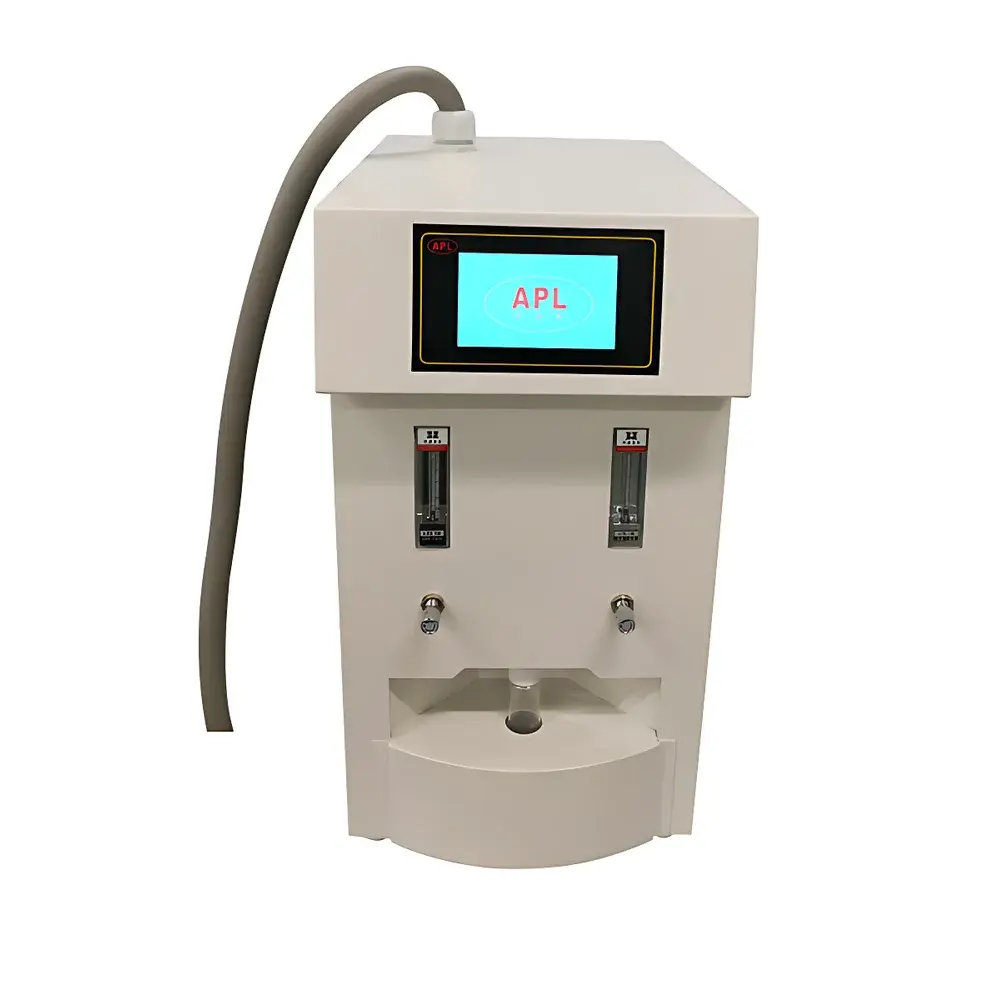
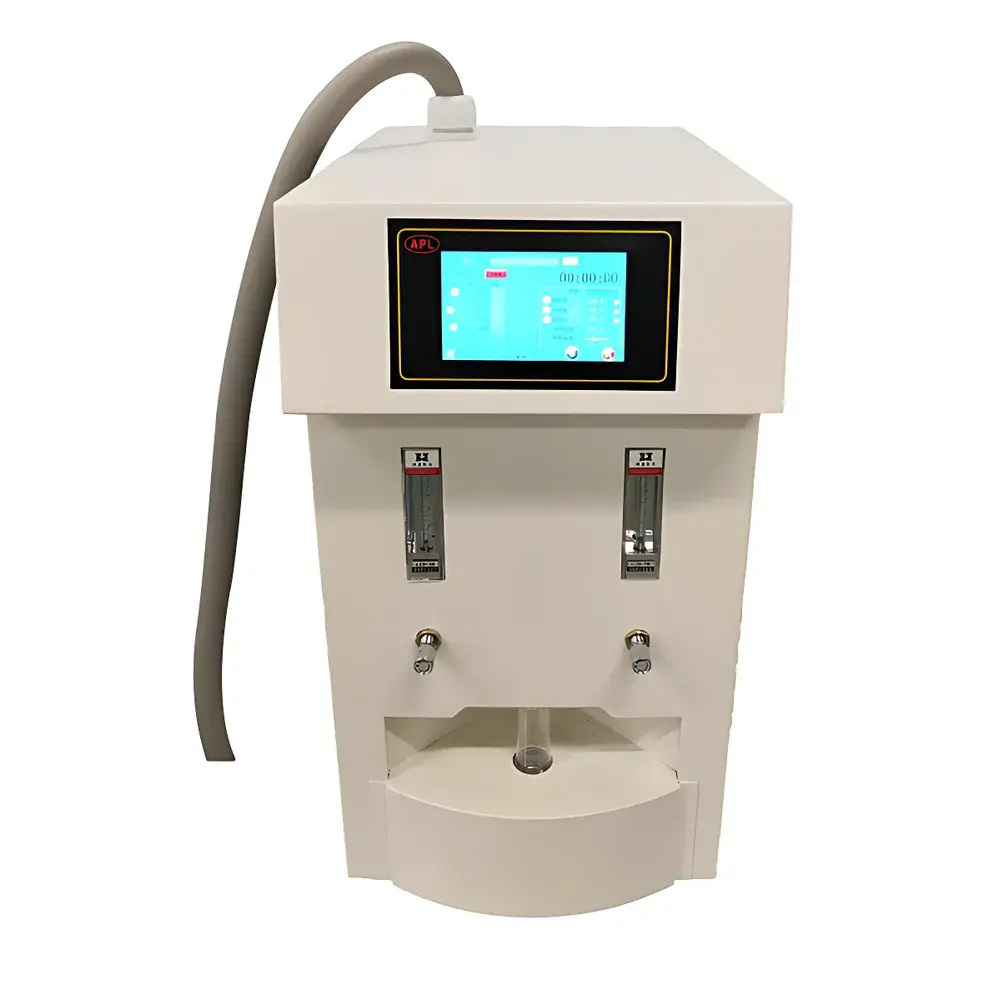
APL PTC-100 Automated Purge and Trap Concentrator
| Brand | APL |
|---|---|
| Origin | Sichuan, China |
| Manufacturer Type | Original Equipment Manufacturer (OEM) |
| Product Category | Domestic |
| Model | APL-PTC100 |
| Instrument Type | Water & Soil VOC Analysis System |
| Sample Tray Capacity | 1 position |
| Injection Precision | RSD < 3% |
| Trap Temperature Range | –30 °C to 220 °C |
| Sample Heating Temperature Range | Ambient to 220 °C |
| Sample Vial Cooling Temperature | 20 °C |
Overview
The APL PTC-100 Automated Purge and Trap Concentrator is a fully integrated sample preparation system engineered for the quantitative preconcentration of volatile organic compounds (VOCs) from aqueous and solid environmental matrices prior to gas chromatographic analysis. It operates on the fundamental principle of dynamic headspace extraction: an inert purge gas (typically helium or nitrogen) is passed through a heated, agitated sample—causing VOCs to volatilize and transfer into the gas phase. These analytes are then selectively trapped on a sorbent-packed cold trap (–30 °C), followed by rapid thermal desorption and transfer to the GC or GC/MS inlet under controlled flow and temperature conditions. Designed in strict compliance with U.S. EPA Method 524.2, 502.2, and 8260D, as well as Chinese national standards including HJ 605–2011 (soil/sediment), HJ 639–2012 and HJ 686–2014 (water), the PTC-100 delivers high reproducibility, low carryover, and robust method transferability across regulatory-compliant laboratories.
Key Features
- Four independently programmable heating zones: purge valve, sample transfer line, water removal trap, and trap desorption zone—each adjustable in 1 °C increments for precise thermal management.
- Integrated magnetic stirring with variable speed control ensures homogeneous volatilization from heterogeneous soil slurries or viscous liquid samples.
- Automated time-sequence programming enables unattended execution of full analytical cycles: purge (up to 11 min at 40 mL/min), dry purge (N₂ backflush), thermal desorption (1–3 min), GC injection trigger, and high-temperature bake-out (5 min at 250 °C).
- Dual-stage water management: a dedicated water removal trap (ambient–240 °C) intercepts moisture prior to the main trap, minimizing water-induced column degradation and detector saturation in GC/MS systems.
- Auto-backflush capability for both the transfer line and six-port valve prevents cross-contamination between sequential samples—critical for trace-level VOC quantitation.
- Universal GC/GC-MS interface: TTL-compatible start signal output and customizable inlet adapter kits support seamless integration with Agilent, Thermo Fisher, Shimadzu, PerkinElmer, and other major GC platforms.
Sample Compatibility & Compliance
The PTC-100 accommodates 40 mL standard EPA vials and supports direct analysis of drinking water, wastewater, groundwater, surface water, soil extracts (slurry mode), and food-related aqueous homogenates. Its validated operating range meets the performance criteria outlined in ISO 15681-2:2003 (water quality — determination of volatile organic compounds — purge-and-trap GC/MS), ASTM D5027 (standard test method for VOCs in water by purge-and-trap GC/MS), and USP chromatographic system suitability requirements. All temperature and flow parameters are logged with timestamps and stored internally for audit-ready GLP/GMP documentation.
Software & Data Management
The embedded control interface provides real-time graphical animation of system status (valve positions, trap cooling/desorption phases, gas flow rates) and allows method storage for up to 100 user-defined protocols. Data export is supported via USB 2.0 to CSV or Excel-compatible formats. While the instrument does not include FDA 21 CFR Part 11-compliant electronic signatures, its event-log architecture—recording all temperature setpoints, timing events, and hardware actuations—fully supports laboratory internal validation and external inspection under ISO/IEC 17025:2017 accreditation frameworks.
Applications
- Regulatory monitoring of trihalomethanes (THMs), benzene, toluene, ethylbenzene, xylenes (BTEX), vinyl chloride, chloroform, and other priority VOCs in municipal water supplies per EPA Safe Drinking Water Act requirements.
- Soil and sediment screening for petroleum hydrocarbons (e.g., gasoline-range organics, diesel-range organics) and chlorinated solvents (PCE, TCE) in site remediation projects.
- Food safety testing for residual solvents (e.g., dichloromethane, hexane) in flavor extracts, edible oils, and packaging leachates.
- Environmental forensics and source identification using compound-specific isotope analysis (CSIA)-compatible trapping efficiency (<95% recovery for C₂–C₁₀ aliphatics and aromatics).
FAQ
What sample matrices can the PTC-100 process?
It is validated for liquid water samples (drinking, wastewater, groundwater) and solid-phase samples (soil, sediment) when prepared as aqueous slurries. Food homogenates and pharmaceutical aqueous extracts are also compatible.
Does the system support automated calibration standards?
Yes—via optional external standard spiking module (not included), or manual introduction of certified reference materials directly into the vial prior to purge.
Is the cold trap cooled using liquid nitrogen or electronic refrigeration?
Electronic Peltier cooling is used, enabling stable operation at –30 °C without consumables or cryogenic handling hazards.
How is method transfer ensured between labs?
All temperature gradients, flow profiles, and timing sequences are digitally stored and exportable; inter-laboratory precision studies demonstrate RSD < 2.8% for BTEX recovery across three independent installations.
Can the PTC-100 be operated in standalone mode without a connected GC?
Yes—the instrument runs full purge-trap-desorb cycles independently; GC triggering is optional and configurable via TTL signal polarity selection.






