
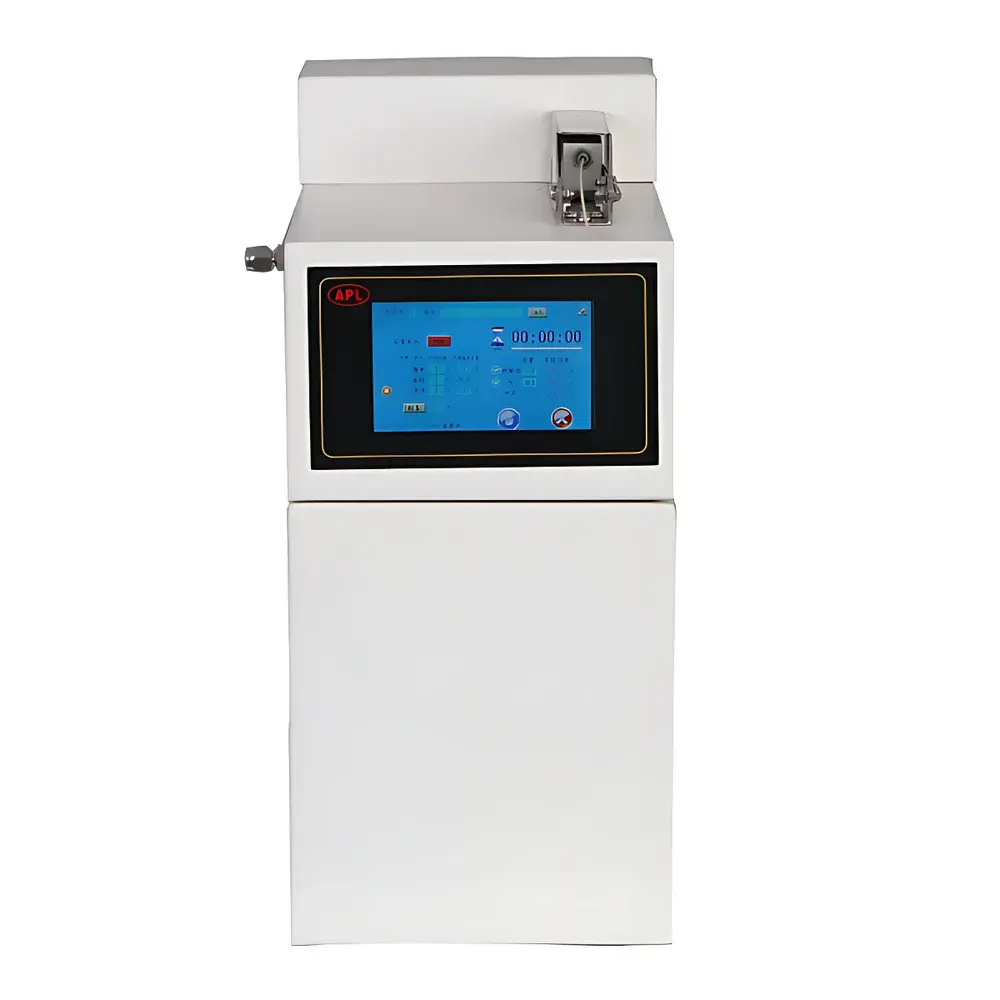
APL SC-100 Sulfide Cryo-Concentrator
| Brand | APL |
|---|---|
| Origin | Sichuan, China |
| Manufacturer Type | Direct Manufacturer |
| Country of Origin | China |
| Model | APL-SC-10 |
| Price | USD 12,200 (FOB) |
| Application Category | Atmospheric Pre-concentrator for GC-FPD Analysis of Volatile Sulfur Compounds |
| Compliance Reference | GB/T 14678–1993 |
Overview
The APL SC-100 Sulfide Cryo-Concentrator is a dedicated low-temperature pre-concentration system engineered for trace-level quantification of volatile sulfur compounds (VSCs) — including carbon disulfide (CS₂), methanethiol (CH₃SH), dimethyl sulfide (CH₃SCH₃), and dimethyl disulfide (CH₃SSCH₃) — in ambient air and stack emission samples. It operates on the principle of cryogenic trapping followed by thermal desorption, enabling quantitative enrichment of sub-ppbv analytes prior to injection into gas chromatography systems equipped with flame photometric detection (GC-FPD). Unlike generic cold traps, the SC-100 integrates thermally controlled inert flow paths, programmable multi-step valve sequencing, and solid-state cooling to eliminate reliance on liquid nitrogen while maintaining reproducible trapping efficiency across 1 L sample volumes. Its design aligns with the analytical workflow specified in GB/T 14678–1993, supporting regulatory-compliant odorant monitoring in environmental and industrial hygiene laboratories.
Key Features
- Automated six-port electric valve coupled with solenoid valves for precise, repeatable sequence control of trap loading, thermal desorption, and post-run backflush cleaning
- Intuitive 7-inch capacitive touchscreen interface with method editor, storage for ≥100 user-defined methods, and real-time status visualization
- Fully inert sample pathway: Sulfinert®-treated stainless steel tubing, zero-dead-volume fittings, and heated valve manifolds (up to 260 °C) minimize adsorption and memory effects
- Independent temperature zoning: Valve zone (RT–220 °C, ±1 °C), transfer line (RT–260 °C, ±1 °C), and cryo-trap (-30 °C to 300 °C) with PID-controlled semiconductor cooling
- Programmable flow control (0–100 mL/min) ensures optimal trapping kinetics for varying matrix complexities and analyte volatilities
- Universal GC interface: Standard 1/8″ or 1/4″ VCR-compatible inlet port; compatible with Agilent, Thermo Fisher, Shimadzu, and PerkinElmer GC models
Sample Compatibility & Compliance
The SC-100 accepts gaseous samples collected in Tedlar® or polyester sampling bags (per EPA Method TO-15 recommendations) or via direct syringe injection for high-concentration matrices. It supports both static and dynamic sampling modes, with validated performance for sulfur compound recovery rates ≥92% at 0.5–50 ppbv levels in humidified air (RH ≤80%). Instrument operation adheres to ISO/IEC 17025:2017 requirements for method validation and traceability. While GB/T 14678–1993 serves as its primary reference standard, the system’s thermal desorption profile and inert flow path architecture also satisfy key elements of ASTM D5504–22 (Standard Test Method for Determination of Sulfur Compounds in Natural Gas and Gaseous Fuels by Gas Chromatography and Chemiluminescence) and USP chromatographic system suitability criteria when paired with FPD detection.
Software & Data Management
The embedded firmware logs all critical operational parameters—including trap temperature ramp profiles, valve actuation timestamps, flow rate setpoints, and thermal history—with automatic timestamping and user ID tagging. Audit trails are stored locally on internal flash memory (≥16 GB) and exportable via USB 2.0 in CSV format for integration with LIMS platforms. The system supports 21 CFR Part 11-compliant data integrity practices when operated within a validated laboratory IT environment: electronic signatures, role-based access control (admin/operator modes), and immutable event logs ensure compliance during GLP or GMP audits. No external PC dependency is required for routine operation; optional Ethernet connectivity enables remote monitoring via secure HTTP(S) API.
Applications
- Regulatory monitoring of odor-causing VSCs from wastewater treatment plants, composting facilities, and pulp & paper mills per local air quality ordinances
- Occupational exposure assessment in chemical manufacturing and petroleum refining environments
- Method development and validation for EPA Method TO-15 extension to sulfur speciation
- Research-grade kinetic studies of sulfur compound adsorption/desorption behavior on activated carbon and metal-organic frameworks
- Calibration standard preparation via dynamic dilution of certified sulfur gas mixtures
FAQ
Does the SC-100 require liquid nitrogen or other cryogens?
No. It employs a high-efficiency thermoelectric (Peltier) cooling module capable of reaching -30 °C without consumables or external chillers.
Can the instrument be integrated into an autosampler workflow?
Yes. Digital I/O ports (TTL-level) support synchronization with third-party autosamplers for unattended batch analysis of up to 40 samples.
What maintenance intervals are recommended for the inert flow path?
Quarterly bake-out at 280 °C for 2 hours is advised; valve seals and trap frits should be inspected annually or after 500 cycles.
Is method validation documentation provided?
APL supplies a Factory Acceptance Test (FAT) report, including temperature uniformity mapping, flow calibration certificates, and trap recovery data for CS₂ and CH₃SH at three concentration levels.
How is carryover addressed between high- and low-concentration samples?
The automated backflush cycle purges residual analytes from the transfer line and valve manifold using carrier gas at elevated temperature (220 °C), reducing carryover to <0.5% RSD across consecutive injections.



