
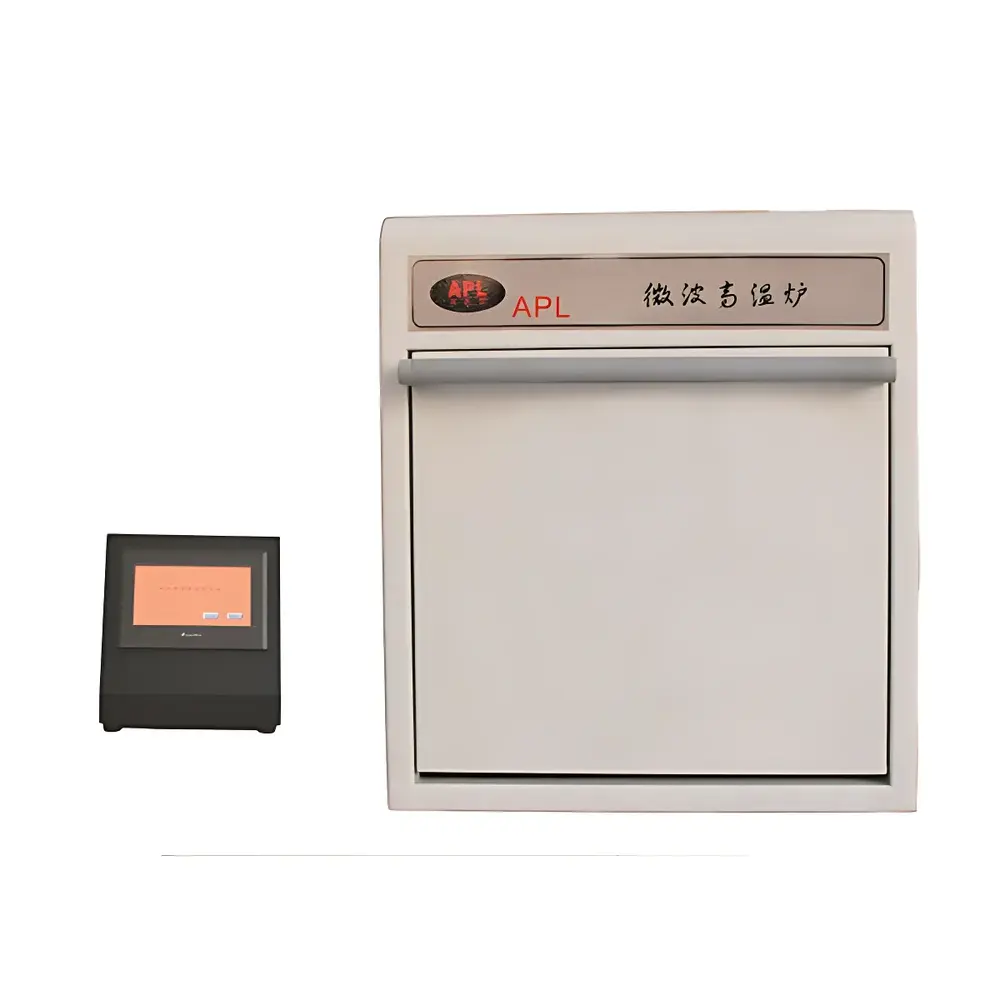
APL Touchwin Microwave Muffle Furnace
| Brand | APL |
|---|---|
| Origin | Sichuan, China |
| Manufacturer Type | Direct Manufacturer |
| Region of Origin | Domestic (China) |
| Model | Touchwin |
| Instrument Type | Box-Type Muffle Furnace |
| Maximum Temperature | 1600 °C |
| Temperature Control Accuracy | ±1 °C |
| Rated Power | 5 kW |
| Microwave Output Power | 0–3 kW (continuously adjustable) |
| Microwave Frequency | 2.45 GHz ±25 MHz |
| Internal Chamber Dimensions | 200 × 150 × 150 mm (W × D × H) |
| Loading Volume | 150 × 200 × 150 mm (D × W × H) |
| Heating Method | Microwave |
| Time to Max Temperature | ≤40 min |
| Temperature Measurement | Dual-mode — Infrared Pyrometer (385–1600 °C) and Type S Thermocouple (0–1600 °C) |
| Control System | Embedded Linux-based touchscreen interface with optional laptop connectivity |
| Programmable Profiles | Up to 10 multi-segment thermal cycles (40 segments per profile) |
| Data Logging | Optional USB/RS485 export with timestamped storage |
| Microwave Leakage | <1 mW/cm² (compliant with GB 10436-2008 and IEC 62233) |
Overview
The APL Touchwin Microwave Muffle Furnace is an advanced high-temperature laboratory furnace engineered for rapid, energy-efficient, and volumetrically uniform heating of refractory, ceramic, metallurgical, and advanced material samples. Unlike conventional resistive muffle furnaces that rely on conduction and convection from external heating elements, the Touchwin employs 2.45 GHz microwave energy to induce molecular-level dielectric heating directly within the sample and susceptor materials. This results in significantly faster thermal ramp rates—achieving 1600 °C in under 40 minutes—and reduced thermal gradients across the 200 × 150 × 150 mm insulated chamber. Designed for research laboratories, quality control centers, and university materials science departments, it supports precise thermal processing under controlled inert or air atmospheres (with optional gas inlet ports), making it suitable for sintering, ashing, calcination, heat treatment, and rapid thermal annealing protocols.
Key Features
- True dual-sensor temperature monitoring: Integrated Type S thermocouple (0–1600 °C) for contact measurement and non-contact infrared pyrometer (385–1600 °C) for real-time surface temperature validation—ensuring cross-verified thermal feedback and improved process repeatability.
- High-fidelity programmable control: Embedded Linux-based touchscreen HMI with intuitive graphical interface; supports up to 10 independent thermal profiles, each configurable with up to 40 time-temperature segments and dwell steps.
- Adjustable microwave power delivery: 0–3 kW continuous output regulation enables fine-tuned energy coupling—critical for sensitive materials prone to thermal runaway or cracking during rapid heating.
- Compliant electromagnetic safety architecture: Microwave leakage <1 mW/cm² at 5 cm distance (well below the 5 mW/cm² limit specified in GB 10436-2008 and IEC 62233), achieved via double-shielded cavity, interlocked door mechanism, and RF-absorbing gasketing.
- Modular data management: Optional USB flash drive logging or RS485 serial interface for integration into LIMS or SCADA systems; all temperature, power, and time stamps are recorded with ISO/IEC 17025-aligned traceability.
- Rugged industrial build: Ceramic fiber insulation (1600 °C rated), stainless-steel 304 chamber lining, and reinforced quartz viewing window ensure long-term stability under repeated thermal cycling.
Sample Compatibility & Compliance
The Touchwin accommodates a wide range of sample geometries and compositions—including oxide ceramics (Al₂O₃, ZrO₂), carbides (SiC), battery cathode precursors (NMC, LFP), metal powders, and geological specimens—provided they exhibit sufficient microwave absorption or are used with compatible susceptors (e.g., SiC crucibles). Its design conforms to key international standards for laboratory thermal equipment: ASTM E1112 (specifications for muffle furnaces), ISO 11358-1 (thermogravimetric analysis compatibility), and GB/T 10066.1–2004 (general safety requirements for industrial electroheating equipment). For regulated environments, the system supports audit-ready data export and can be validated per IQ/OQ protocols aligned with GLP and GMP frameworks.
Software & Data Management
The embedded control firmware provides native support for CSV-formatted data export via USB 2.0 port, including timestamped records of setpoint, actual temperature (dual-sensor), microwave power level, and elapsed time. Optional PC software (Windows/Linux compatible) enables remote monitoring, real-time graphing, and automated report generation compliant with FDA 21 CFR Part 11 requirements—including electronic signatures, user access levels, and immutable audit trails. All stored profiles retain metadata such as operator ID, calibration date, and version stamp—facilitating full traceability in accredited testing labs.
Applications
- Rapid sintering of nanostructured ceramics and composites
- Thermal decomposition and ash content determination (ASTM D3174, ISO 1171)
- Pre-oxidation of Ni-based superalloys prior to hot isostatic pressing
- Calcination of catalyst supports (e.g., γ-Al₂O₃, CeO₂)
- Heat treatment of lithium-ion battery electrode materials
- Development of microwave-responsive functional materials (e.g., microwave-transparent coatings, hybrid susceptors)
FAQ
Can this furnace operate under inert or reducing atmospheres?
Yes—optional gas inlet/outlet ports (M10 threaded) allow connection to nitrogen, argon, or forming gas lines; users must supply compatible sealed crucibles and verify gas compatibility with internal insulation materials.
Is the infrared pyrometer calibrated traceably to NIST standards?
The factory calibration is performed against reference blackbody sources certified to ISO/IEC 17025-accredited laboratories; end-user recalibration services are available through APL’s authorized metrology partners.
What safety interlocks are implemented?
Five independent hardware interlocks monitor door position, cavity temperature, microwave generator status, cooling airflow, and power supply integrity; any fault triggers immediate microwave cutoff and audible alarm.
Does the system support third-party SCADA integration?
Yes—Modbus RTU over RS485 is natively supported; register maps and protocol documentation are provided upon request for seamless integration with Siemens, Rockwell, or LabVIEW-based control systems.
How is temperature uniformity verified across the chamber?
Uniformity is characterized per ASTM E2203 using a 9-point thermocouple array at 1200 °C and 1600 °C; typical deviation is ±5 °C at center and ±12 °C at corners—values documented in the Certificate of Conformance shipped with each unit.



