
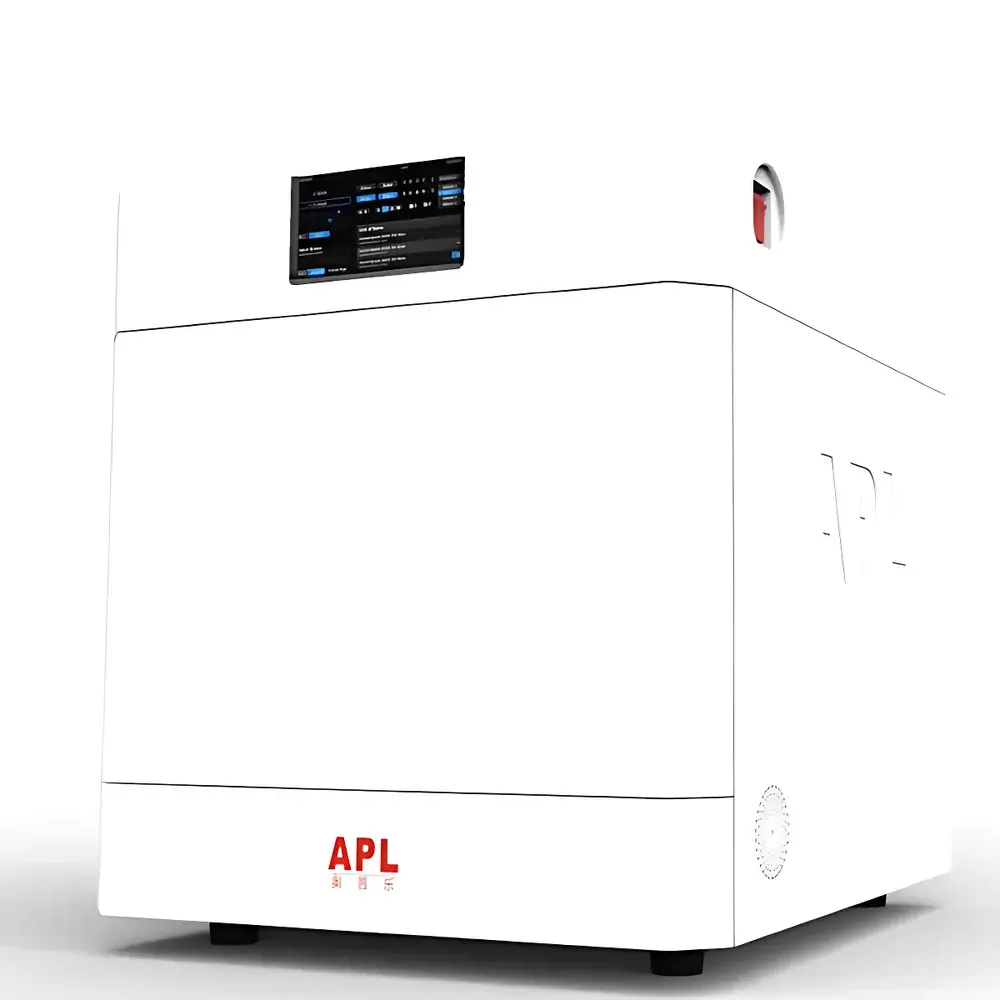
APL Touchwin2.0 Microwave Ashing Furnace
| Brand | APL |
|---|---|
| Origin | Sichuan, China |
| Manufacturer Type | Direct Manufacturer |
| Product Origin | Domestic (China) |
| Model | Touchwin2.0 |
| Maximum Temperature | 1000 °C |
| Temperature Control Accuracy | ±1 °C |
| Chamber Volume | 5.0 L |
| Temperature Uniformity | ±1 °C |
| Exhaust Flow Rate | 3.5 m³/min |
| Power Supply | 230 V AC, 50 Hz (16 A & 10 A sockets) |
| Operating Ambient | 8–38 °C, 10–80 % RH |
| Crucible Compatibility | Quartz, Platinum, Ceramic, Nickel, Inconel® |
| Safety Features | Microwave Interlock, Over-Temperature Protection, Rapid Cooling System, Combustion Suppression Mechanism |
| Control System | PID-Based Programmable Ramp/Soak Profiles with Onboard Storage |
| Interface | Integrated Color Touchscreen with Real-Time Monitoring, Parameter Setting, Auto-Calibration, and Data Logging |
Overview
The APL Touchwin2.0 Microwave Ashing Furnace is an advanced thermal processing instrument engineered for precise, rapid, and controlled ash residue determination in organic and polymeric materials. Unlike conventional resistive muffle furnaces, this system integrates microwave-assisted heating technology to achieve faster energy transfer directly into the sample matrix—reducing total ashing time by up to 60% while maintaining strict compliance with gravimetric ash content standards. It operates on the principle of controlled oxidative pyrolysis under inert or ambient airflow conditions, enabling complete carbon removal without volatilization losses of metallic oxides. Designed specifically for laboratories performing routine quality control, regulatory testing, and R&D validation, the furnace supports standardized methodologies including GB/T 9345.1, ASTM D5630, ISO 3451-1, and PEG#306 for polyethylene resin analysis.
Key Features
- Microwave-powered heating architecture with real-time power modulation ensures uniform thermal distribution across the 5.0 L chamber, validated at ±1 °C temperature uniformity and ±1 °C control accuracy at 1000 °C.
- Programmable PID controller supports multi-step ramp/soak thermal profiles; up to 20 user-defined methods can be stored onboard and recalled via touchscreen interface.
- Dual-circuit safety interlock system prevents microwave emission during door opening and automatically disables magnetron operation if cavity pressure or temperature exceeds preset thresholds.
- Integrated rapid cooling module enables post-ash quenching within <15 minutes—critical for minimizing oxide rehydration and ensuring reproducible gravimetric results.
- Modular crucible support accommodates standard geometries in quartz, platinum, high-purity alumina, nickel, and Inconel®—ensuring chemical compatibility across diverse sample matrices (e.g., plastics, pharmaceutical excipients, food additives, catalysts).
- Onboard data handling includes timestamped temperature logging, method execution history, and auto-calibration prompts aligned with GLP documentation requirements.
Sample Compatibility & Compliance
The Touchwin2.0 is validated for ash content determination in thermoplastics (e.g., PE, PP, PET), elastomers, composites, and organic-rich industrial feedstocks. Its combustion suppression system—comprising staged air injection and dynamic oxygen partial pressure regulation—prevents flash ignition during volatile release phases, thereby preserving ash integrity per ASTM D5630 Annex A2. The furnace meets mechanical and electrical safety requirements per IEC 61000-6-3 (EMC) and IEC 61010-1 (Laboratory Equipment Safety). All operational parameters—including temperature setpoints, dwell times, and cooling cycles—are fully traceable and exportable in CSV format, supporting audit readiness for ISO/IEC 17025-accredited laboratories and FDA 21 CFR Part 11-compliant environments when paired with optional networked data archiving.
Software & Data Management
The embedded Touchwin2.0 OS features a 7-inch capacitive color touchscreen with intuitive icon-driven navigation. Users can initiate runs, monitor live temperature curves, adjust PID tuning parameters, and access historical logs without external PCs. Each experiment generates a structured metadata file containing operator ID, method name, start/stop timestamps, peak temperature, final mass loss %, and deviation alerts. Data export supports USB flash drive transfer and optional Ethernet/Wi-Fi connectivity for integration into LIMS platforms. Audit trail functionality records all parameter modifications with user authentication, satisfying ALCOA+ principles for data integrity in regulated industries.
Applications
- Quantitative ash residue analysis in polymer manufacturing per ISO 3451-1 and GB/T 9345.1.
- Residual catalyst quantification in petrochemical intermediates and fine chemical synthesis.
- Inorganic filler content verification in composite materials and flame-retardant formulations.
- Pharmaceutical excipient purity screening (e.g., microcrystalline cellulose, lactose) under USP <281> guidelines.
- Environmental testing of contaminated soils and sludges where rapid throughput and low detection limits are essential.
FAQ
Does the furnace require external exhaust ducting?
Yes—while the built-in 3.5 m³/min blower handles internal fume extraction, connection to a dedicated lab exhaust manifold is mandatory for compliance with local ventilation codes and safe disposal of acidic vapors generated during halogenated polymer ashing.
Can the system be calibrated internally without third-party service?
Yes—the unit includes NIST-traceable reference thermocouple inputs and automated calibration routines accessible via maintenance mode; full calibration reports are generated and stored with digital signatures.
Is remote monitoring supported out of the box?
Basic remote status viewing (temperature, run state, alarms) is available via Ethernet; full remote control and data streaming require optional firmware upgrade and secure TLS-enabled API configuration.
What maintenance intervals are recommended for the magnetron and waveguide assembly?
Under normal use (≤8 hrs/day), magnetron performance verification is advised every 12 months; waveguide inspection and ceramic window cleaning should occur quarterly per preventive maintenance checklist included in the technical manual.



