
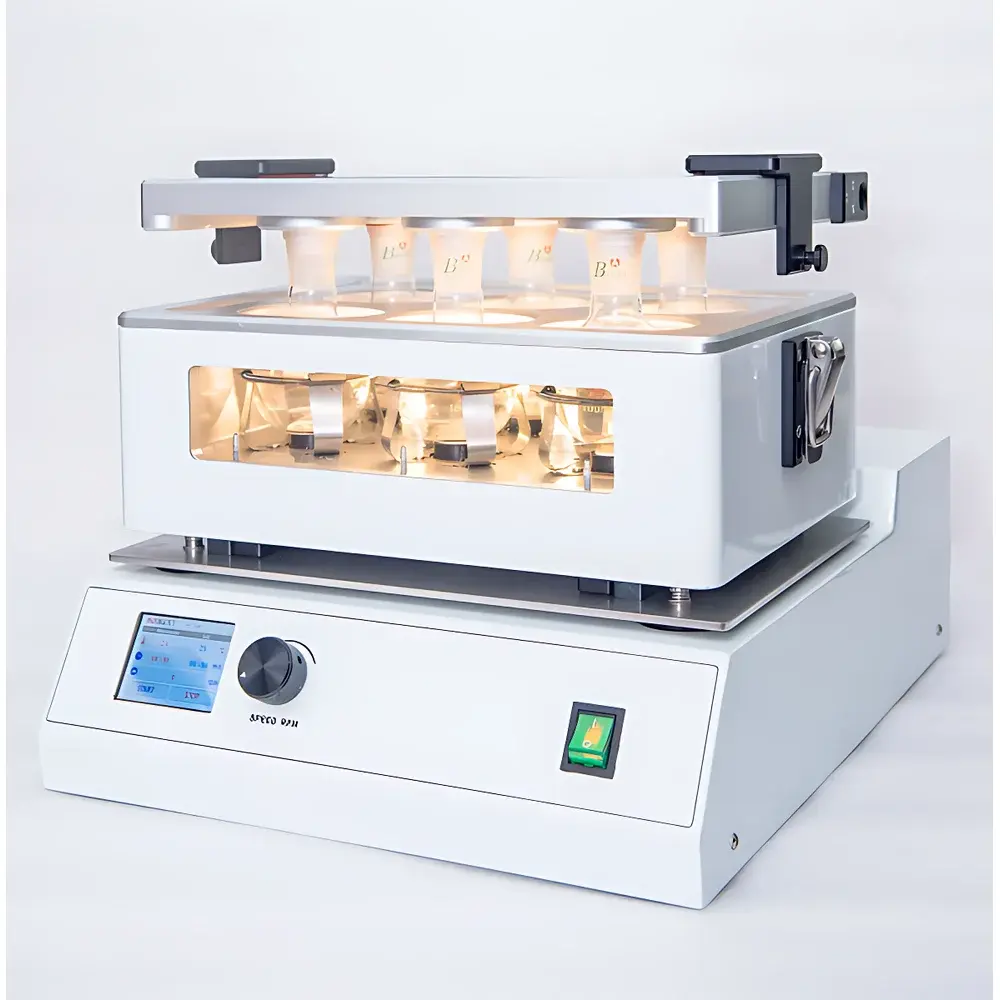
APL WPP106 Parallel Evaporation Platform
| Brand | APL |
|---|---|
| Origin | Sichuan, China |
| Manufacturer Type | Direct Manufacturer |
| Region of Origin | Domestic (China) |
| Model | WPP106 |
| Capacity | 1 L (per position, 6-position platform) |
| Ultimate Vacuum | 0.098 MPa |
| Rotation Speed | 20–300 rpm |
| Temperature Range | Ambient to 100 °C |
| Temperature Control Accuracy | ±1 °C |
| Cooling Surface Area | 0.5 m² |
Overview
The APL WPP106 Parallel Evaporation Platform is an engineered solution for high-throughput, gentle solvent removal in analytical and preparative laboratories. Unlike conventional rotary evaporators—designed for single-sample operation—the WPP106 employs simultaneous water-bath heating, vacuum-assisted evaporation, and controlled orbital agitation across up to six sample positions. Its operational principle relies on the synergistic combination of reduced pressure (down to 0.098 MPa absolute), precise temperature regulation (ambient to 100 °C, ±1 °C accuracy), and programmable rotation (20–300 rpm) to accelerate solvent volatilization while minimizing thermal degradation of thermolabile analytes. This makes it especially suitable for applications requiring reproducible, parallel processing of environmental extracts, food matrices, and pharmaceutical intermediates—where consistency across replicates and compliance with method-defined evaporation profiles are critical.
Key Features
- Forced-circulation transparent water bath: Ensures rapid thermal equilibration, superior temperature uniformity (±0.5 °C across bath volume), and efficient heat transfer to low-polarity solvents—outperforming metal-block alternatives where poor vessel contact limits conductive efficiency.
- Optically clear pressure-sealing lid with integrated vacuum control valve: Enables real-time visual monitoring of boiling behavior and immediate adjustment of vacuum level to suppress bumping or foaming—critical for maintaining sample integrity during near-dry endpoint control.
- Illuminated transparent water reservoir: Equipped with dual LED light sources for unobstructed observation of meniscus recession, crystal formation, or foam development within tubes or flasks—eliminating guesswork in endpoint determination.
- Full-color capacitive touchscreen interface: Supports independent programming of bath temperature, rotation speed, evaporation duration, and pause/resume sequences; displays real-time rpm, temperature, and elapsed time.
- Dual safety architecture: Includes dry-run overtemperature cutoff (activated when water level falls below sensor threshold) and hardware-based thermal limiter (110 °C hard stop) compliant with IEC 61010-1 safety standards.
- Inert-material construction: All wetted and load-bearing components—including sample modules, sealing gaskets, and vacuum manifolds—are fabricated from PTFE-coated aluminum, borosilicate glass-compatible polymers, and 316 stainless steel—ensuring chemical resistance to chlorinated solvents, esters, alcohols, and acidic eluents.
Sample Compatibility & Compliance
The WPP106 accommodates a broad range of standard laboratory vessels—including 10–50 mL graduated conical tubes, 100–250 mL round-bottom flasks, Kuderna-Danish concentrators, and volumetric calibration vials—via interchangeable, snap-fit aluminum heating blocks. Its modular design supports method transfer from EPA Method 505, 525.3, and 8081B; AOAC 2007.01; and ISO 17025-accredited workflows. The system meets GLP documentation requirements through timestamped parameter logging (optional USB export), and its sealed vacuum path and inert surfaces minimize cross-contamination risk—supporting ISO/IEC 17025 clause 5.4.2 (sample handling integrity). No regulatory certification (e.g., FDA 21 CFR Part 11) is claimed; however, audit-ready operation logs and manual intervention records are fully traceable.
Software & Data Management
The WPP106 operates as a standalone instrument with embedded firmware—no PC dependency required. All user-defined protocols (up to 20 stored presets) and runtime data (temperature setpoint, actual bath temp, rpm, vacuum status, elapsed time) are retained in non-volatile memory. Timestamped session reports can be exported via USB flash drive in CSV format for integration into LIMS or ELN systems. While no proprietary software suite is provided, the device’s ASCII-based serial output (RS-232 optional) enables third-party automation via SCPI-like command sets—facilitating integration into robotic sample preparation lines compliant with ASTM E2655-20 (standard guide for automated liquid handling).
Applications
- Environmental analysis: Parallel concentration of pesticide residues (e.g., organophosphates, pyrethroids) from QuEChERS extracts prior to GC-MS/MS or LC-MS/MS injection—reducing batch turnaround time by >60% versus sequential rotary evaporation.
- Food safety testing: High-fidelity recovery of mycotoxins (aflatoxins, ochratoxin A) and veterinary drug residues (fluoroquinolones, sulfonamides) from hydrolyzed tissue homogenates under oxygen-limited vacuum conditions.
- Pharmaceutical R&D: Solvent exchange and lyophilization pre-concentration of peptide fractions, natural product isolates, and formulation intermediates—preserving stereochemical integrity during dimethyl sulfoxide (DMSO) or N,N-dimethylformamide (DMF) removal.
- Forensic toxicology: Quantitative evaporation of blood plasma extracts containing benzodiazepines and synthetic cannabinoids—where visual endpoint confirmation prevents analyte loss due to over-evaporation.
FAQ
What vacuum pump compatibility does the WPP106 require?
The platform interfaces with standard diaphragm or scroll vacuum pumps delivering ≤0.1 MPa absolute pressure; recommended ultimate vacuum specification: ≤10 mbar.
Can the WPP106 be used under inert gas purging?
No—its sealed lid and vacuum manifold are not rated for positive-pressure inert gas introduction; use only under vacuum or ambient atmosphere.
Is the water bath fluid level monitored automatically?
Yes—a float-level sensor triggers audible/visual alerts and halts heating if water volume drops below operational minimum.
What maintenance intervals are recommended for long-term reliability?
Inspect O-rings and vacuum tubing every 6 months; calibrate temperature sensor annually using NIST-traceable RTD probe; clean water bath weekly with deionized water to prevent mineral buildup.
Does the system support external trigger inputs for synchronized automation?
Not natively—but RS-232 communication port (optional add-on) enables TTL-level start/stop signaling and status polling in integrated lab automation environments.



