
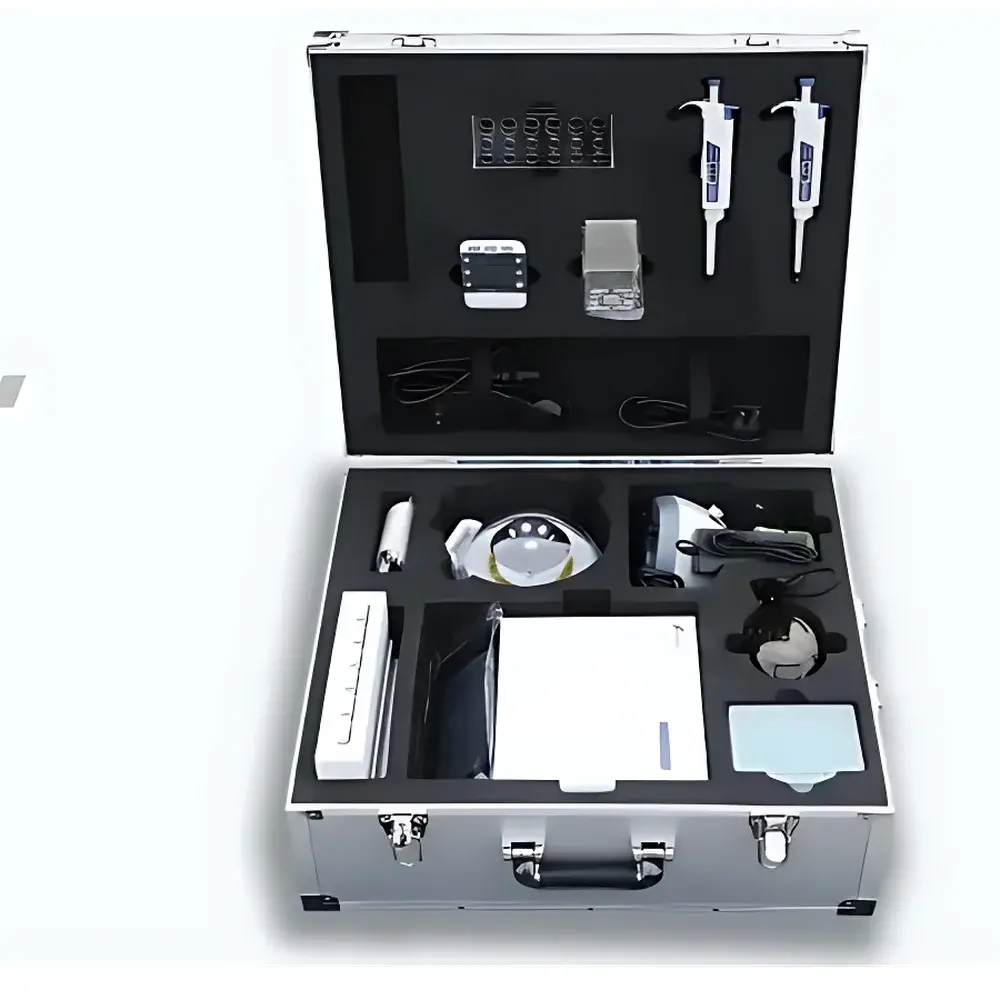
APN-P Heavy Metal Lead Rapid Quantitative Analyzer for Edible Oils
| Brand | ANPRO |
|---|---|
| Origin | Sichuan, China |
| Manufacturer | ANPRO Biotechnology Co., Ltd. |
| Type | Domestic |
| Model | APN-P |
| Price | USD 8,300 (approx.) |
| Detection Principle | Colloidal Gold Immunochromatographic Assay (Quantitative Lateral Flow) |
| Detection Target | Lead (Pb) in Edible Oils |
| LOD | 0.02 ppm |
| Quantitative Range | 0–1 ppm |
| Display | Color Resistive Touchscreen |
| Data Output | Built-in Thermal Printer |
| Test Card Storage | Ambient Temperature (15–30 °C) |
| Regulatory Alignment | Compliant with GB 2762–2022 (National Food Contaminant Limits), aligned with ISO/IEC 17025 validation practices for rapid screening methods |
Overview
The APN-P Heavy Metal Lead Rapid Quantitative Analyzer is a purpose-built, field-deployable instrument engineered for the quantitative detection of lead (Pb) in edible oils—including refined and crude corn oil, peanut oil, rapeseed oil, soybean oil, and blended cooking oils. It leverages a validated colloidal gold immunochromatographic assay platform, where Pb-specific monoclonal antibodies conjugated to colloidal gold nanoparticles bind selectively to lead ions in extracted oil samples. This binding generates a visible test line whose optical density is linearly correlated with Pb concentration across the 0–1 ppm range. Unlike qualitative lateral flow strips, the APN-P integrates an embedded reflectance photometer calibrated against NIST-traceable Pb reference standards, enabling reproducible quantification with a limit of detection (LOD) of 0.02 ppm—meeting the stringent requirements of GB 2762–2022 for lead in vegetable oils (max. 0.1 ppm). The system operates on the principle of competitive inhibition: free Pb in the sample competes with immobilized Pb analogs on the test line for antibody binding sites, yielding a signal inversely proportional to analyte concentration. This method eliminates reliance on hazardous acid digestion or atomic spectroscopy, making it suitable for decentralized testing at grain depots, oil refineries, port inspection labs, and third-party QA facilities.
Key Features
- Quantitative capability: Delivers numerical Pb concentration (ppm) with inter-assay CV ≤ 12% (n = 20, within-run precision per ISO 5725-2)
- Oil-optimized extraction protocol: Includes proprietary non-aqueous solvent system and centrifugal phase separation module, minimizing matrix interference from triglycerides and oxidation byproducts
- Integrated optical reader: 630 nm LED excitation with dual-channel photodiode detection, auto-compensating for strip lot variability via embedded calibration codes
- Self-contained field operation: All components—including pre-loaded test cassettes, extraction vials, pipettes, and power bank—fit within a ruggedized 42 × 32 × 18 cm instrument case (IP54 rated)
- Operator safety by design: Pre-programmed calibration curves eliminate user handling of Pb standard solutions; all reagents are non-hazardous and classified under UN3082 (Environmentally Hazardous Substance)
- Regulatory-ready documentation: Each instrument ships with factory calibration certificate, traceability log to CNAS-accredited reference materials, and electronic audit trail export (CSV/Excel)
Sample Compatibility & Compliance
The APN-P is validated for use with clarified liquid oils (viscosity < 50 cSt at 40 °C) and meets performance criteria outlined in GB/T 5009.12–2017 (Method for Determination of Lead in Foods) for rapid screening applications. It has undergone independent verification by SGS Guangzhou and the Sichuan Provincial Institute for Food and Drug Control, confirming ≥ 95% concordance with ICP-MS reference results (n = 120 blind samples). While not intended as a definitive confirmatory method per ISO/IEC 17025, the APN-P satisfies the “presumptive positive” threshold defined in China’s National Grain and Oils Quality Supervision and Inspection Center Technical Guidelines (2023 Edition) for on-site triage. All test cassettes are manufactured under ISO 13485-certified cleanroom conditions and carry CE marking for in vitro diagnostic use (IVDR Annex XVI).
Software & Data Management
The embedded Linux-based firmware supports touchscreen navigation in English and Chinese, with configurable user roles (Operator, Supervisor, Administrator). Measurement data—including timestamp, operator ID, sample ID, raw OD values, and calculated Pb concentration—is stored locally (8 GB eMMC) with automatic backup to USB drive or cloud via optional Wi-Fi module (IEEE 802.11n). Audit trails record all critical events (calibration, result override, firmware update) with immutable timestamps and digital signatures, satisfying GLP-aligned data integrity requirements. Export formats include CSV (for LIMS integration), PDF reports with QR-coded result verification, and XML compliant with China’s National Food Safety Information Platform (NFSP) API schema.
Applications
- Routine surveillance of finished edible oils at bottling lines and storage terminals
- Pre-shipment screening of crude oil lots prior to refining
- Emergency response testing during contamination incidents (e.g., Pb-contaminated packaging migration)
- Contract laboratory support for GMP-compliant feed and food manufacturers requiring rapid release testing
- Field deployment by provincial grain bureaus conducting annual quality monitoring programs under State Administration for Market Regulation (SAMR) Notice No. 18/2022
FAQ
What sample preparation is required prior to analysis?
A 1.0 g oil sample is mixed with 0.5 mL proprietary extraction reagent, vortexed for 30 s, and centrifuged at 10,000 × g for 2 min. The supernatant is directly applied to the test cassette—no filtration or dilution needed.
Can the APN-P quantify other heavy metals in oils?
No. The APN-P is specifically optimized and validated for lead (Pb) only. Cross-reactivity with cadmium, arsenic, or mercury is below 0.5% at 1 ppm, per manufacturer validation report ANPRO-VAL-APNP-2023-08.
How often must the instrument be recalibrated?
Factory calibration remains valid for 12 months or 500 tests, whichever occurs first. A quick 2-point verification (0 ppm and 0.5 ppm controls) is recommended before each daily batch.
Is method validation documentation available for regulatory submission?
Yes. Full validation package—including specificity, linearity (R² ≥ 0.995), accuracy (recovery 88–105%), and ruggedness data—is provided upon request under NDA.
Does the system comply with FDA 21 CFR Part 11 requirements?
While not certified for Part 11 compliance out-of-box, the APN-P’s audit trail, electronic signature, and data encryption modules can be configured to meet Part 11 expectations when deployed in validated environments with documented SOPs.




