
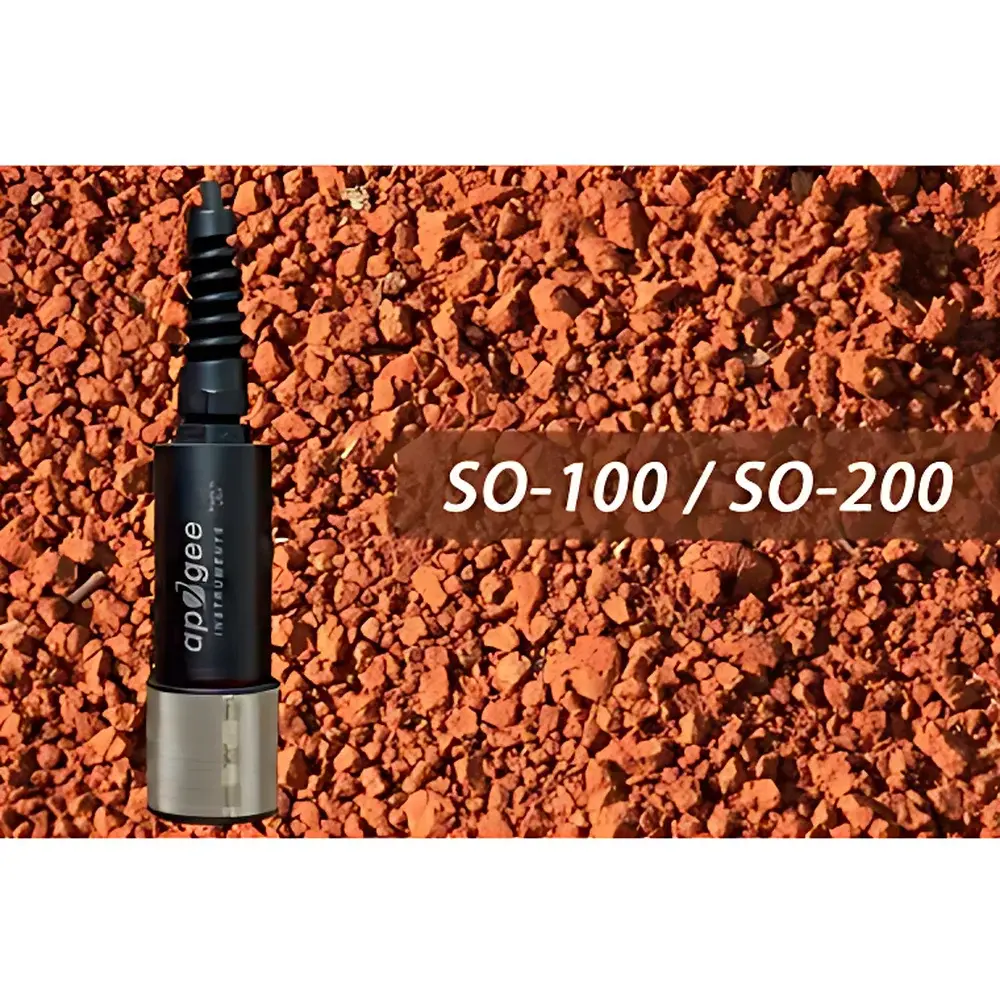
Apogee SO-100 & SO-200 Oxygen Sensors
| Brand | Apogee |
|---|---|
| Origin | USA |
| Model | SO-100 |
| Output | 0–50 mV (SO-100), 0–12 mV (SO-200) |
| Measurement Range | 0–100% O₂ |
| Accuracy | <0.02% drift/day |
| Repeatability | ±0.001% O₂ (10 ppm) |
| Response Time | 60 s (SO-100), 12 s (SO-200) |
| Operating Temperature | –20 to +60 °C |
| Relative Humidity | 0–100% RH |
| Pressure Range | 60–140 kPa |
| Power Supply | 12 V for heater |
| Sensor Housing | Polypropylene valve body |
| Cable Length | 2 m |
| Weight | 210 g |
| Lifetime | >10 years (SO-100), >5 years (SO-200) |
| Interference | None from CO₂, CO, NO, NO₂, H₂S, H₂, CH₄ |
Overview
The Apogee SO-100 and SO-200 oxygen sensors are electrochemical galvanic cell-based instruments engineered for long-term, high-stability O₂ measurement in demanding environmental and laboratory applications. Unlike optical or zirconia-based sensors, these devices employ a self-powered, lead-anode/air-cathode electrochemical architecture that generates a millivolt-level output directly proportional to ambient oxygen partial pressure. This principle ensures zero power consumption for the sensing element itself—only the integrated heater (for SO-100) and thermistor excitation require external power. The SO-100 is optimized for diffusion-limited deployment in soils, compost piles, and vadose zones, while the SO-200 features a flow-through design enabling rapid, dynamic O₂ quantification in controlled lab environments, gas streams, or headspace analysis systems. Both models comply with fundamental requirements for environmental monitoring under ISO 17025-accredited measurement practices when deployed with traceable calibration protocols.
Key Features
- Two distinct configurations: SO-100 with heated diffusion head (prevents water condensation and vapor diffusion interference in high-humidity soil matrices); SO-200 with stainless-steel flow-through fitting (1/8″ NPT) for integration into gas sampling manifolds or respirometry chambers.
- Integrated thermistor housed in a hermetically sealed cavity within the sensor body—enables simultaneous temperature compensation without external probes or software interpolation.
- Polypropylene valve-body construction provides chemical resistance and mechanical robustness for direct burial or long-term field deployment; rated for continuous operation across –20 to +60 °C and 0–100% RH.
- Linear analog output: 50 mV at 20.95% O₂ (SO-100); 12 mV at 20.95% O₂ (SO-200)—simplifies integration with SDI-12 data loggers, PLCs, or custom DAQ systems without signal conditioning.
- Calibration protocol based on two-point verification: ambient air (20.95% O₂) and nitrogen-scrubbed zero-gas (<10% O₂ recommended)—yields a slope and offset correction factor applicable across the full 0–100% range.
- Exceptional long-term stability: <0.02% O₂ daily drift and ±10 ppm repeatability support multi-year unattended monitoring campaigns compliant with EPA Method TO-15 and ASTM D5402 referencing criteria.
Sample Compatibility & Compliance
The SO-100 is validated for direct insertion into mineral and organic soils (including saturated and anaerobic horizons), compost windrows, tailings storage facilities, and landfill cover systems. Its 125-mesh diffusion membrane permits O₂ equilibration while excluding particulates and liquid water ingress. The SO-200 is suitable for gaseous samples delivered at laminar flow rates up to 500 mL/min through its 1/8″ tubing interface. Neither sensor requires carrier gas or purge cycles. Cross-sensitivity testing per IEC 60079-29-1 confirms no measurable response to CO₂, CO, NO, NO₂, H₂S, H₂, or CH₄; 50 ppb degrade performance over time. For GLP/GMP-regulated use, raw voltage outputs meet FDA 21 CFR Part 11 audit trail readiness when recorded via compliant data acquisition firmware.
Software & Data Management
While the sensors operate autonomously as analog transducers, Apogee provides open-source calibration scripts (Python/Matlab) for converting mV readings to %O₂ using user-determined temperature-compensated slope/offset coefficients. When paired with SDI-12-compatible loggers (e.g., Campbell Scientific CR1000X, Onset HOBO RX3000), timestamped measurements auto-associate with internal thermistor values for real-time correction. All output formats adhere to CF Metadata Conventions v1.8 for interoperability with EDI Data Portal, USDA SNOTEL, and ICOS atmospheric networks. Raw voltage logs retain full traceability for ISO/IEC 17025 uncertainty budgeting—including combined standard uncertainty contributions from thermistor tolerance (±0.2 °C), excitation voltage stability (±0.5%), and analog-to-digital conversion resolution (16-bit).
Applications
- Soil respiration monitoring in ecological research—quantifying microbial O₂ consumption rates in response to moisture, temperature, and carbon amendments.
- In-situ redox potential profiling in contaminated aquifer remediation projects where O₂ thresholds define biogeochemical reaction zones (e.g., aerobic vs. denitrifying conditions).
- Climatic control validation in controlled-environment agriculture (CEA) facilities and post-harvest storage chambers.
- Process gas monitoring in aerobic composting operations to optimize turning frequency and moisture management.
- Long-term landfill gas migration studies—detecting O₂ intrusion into methane-dominated plumes as an indicator of cover integrity failure.
- Lab-scale closed-chamber respirometry for plant root metabolism, seed germination assays, and biodegradation kinetics under standardized USP <1225> validation frameworks.
FAQ
What is the difference between SO-100 and SO-200?
The SO-100 uses a diffusion-limited membrane for passive soil gas equilibration and includes a 12 V heater to prevent condensation; the SO-200 employs a flow-through design with faster response (12 s) for active gas stream analysis.
Can these sensors measure dissolved oxygen?
No—they are strictly designed for gaseous-phase O₂ detection. Dissolved oxygen measurement requires Clark-type or optical DO probes with membrane-sealed electrolyte cells.
Is field calibration possible without nitrogen gas?
Yes—single-point calibration using certified ambient air (20.95% O₂ at local barometric pressure) is sufficient for most environmental applications; zero-point verification is optional but recommended for sub-5% O₂ work.
How does temperature affect accuracy?
The built-in thermistor enables real-time linear compensation; residual error after correction is <±0.05% O₂ across the full operating range.
What maintenance is required?
No routine maintenance—electrochemical lifetime is governed by anode depletion rate. Avoid exposure to SO₂, Cl₂, or O₃; inspect diffusion membrane for biofouling in long-term soil deployments every 12–24 months.







