
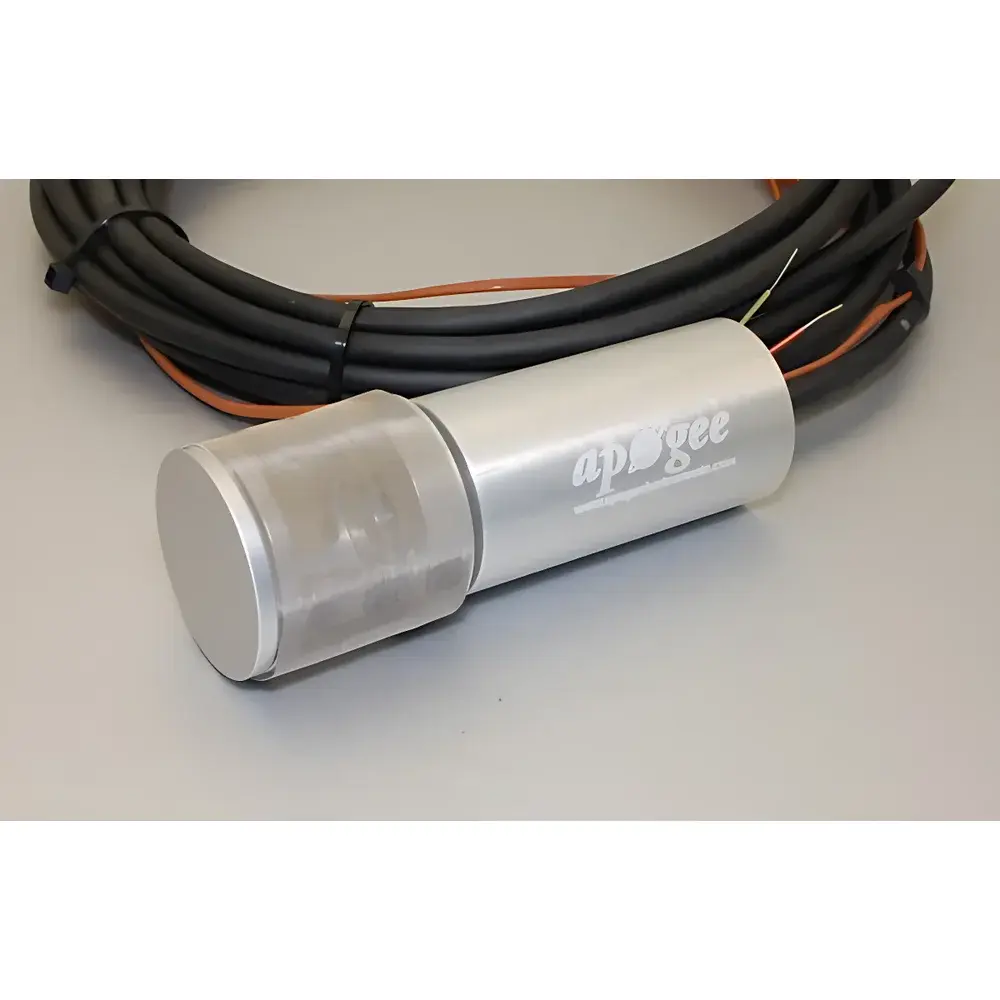
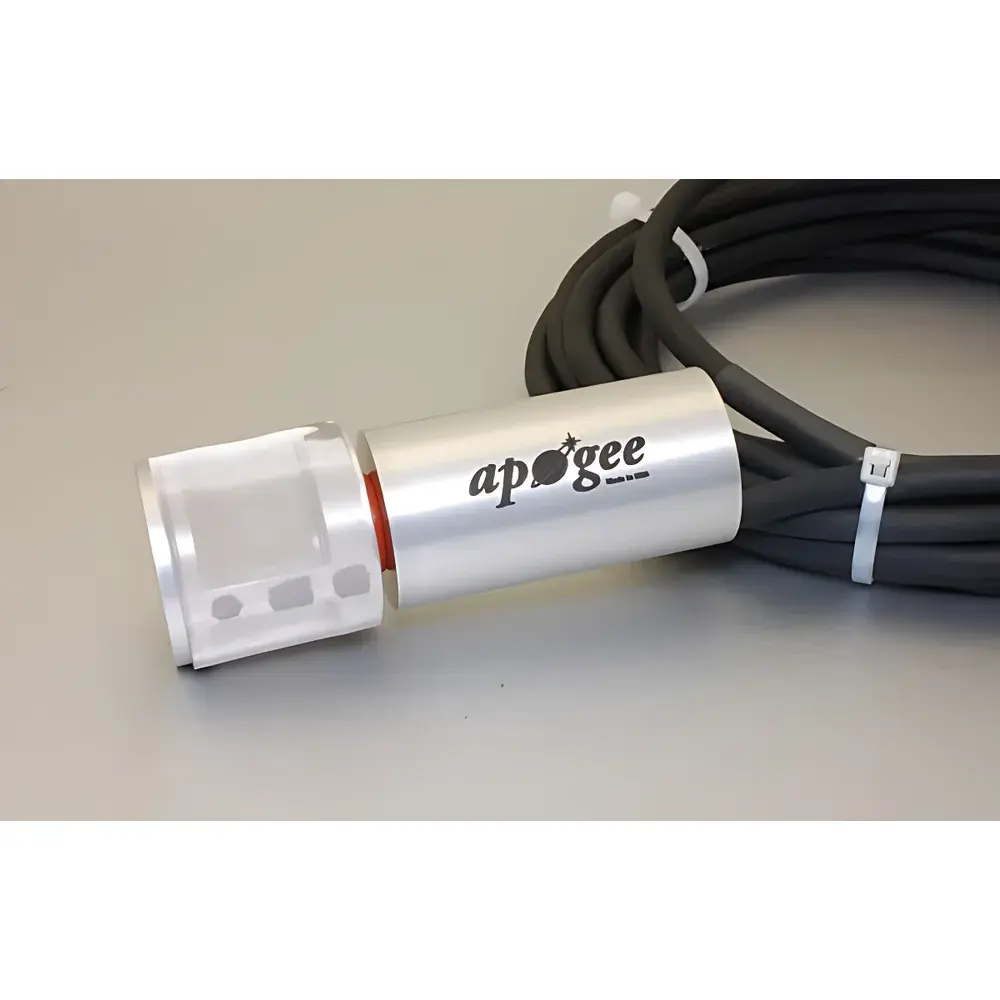
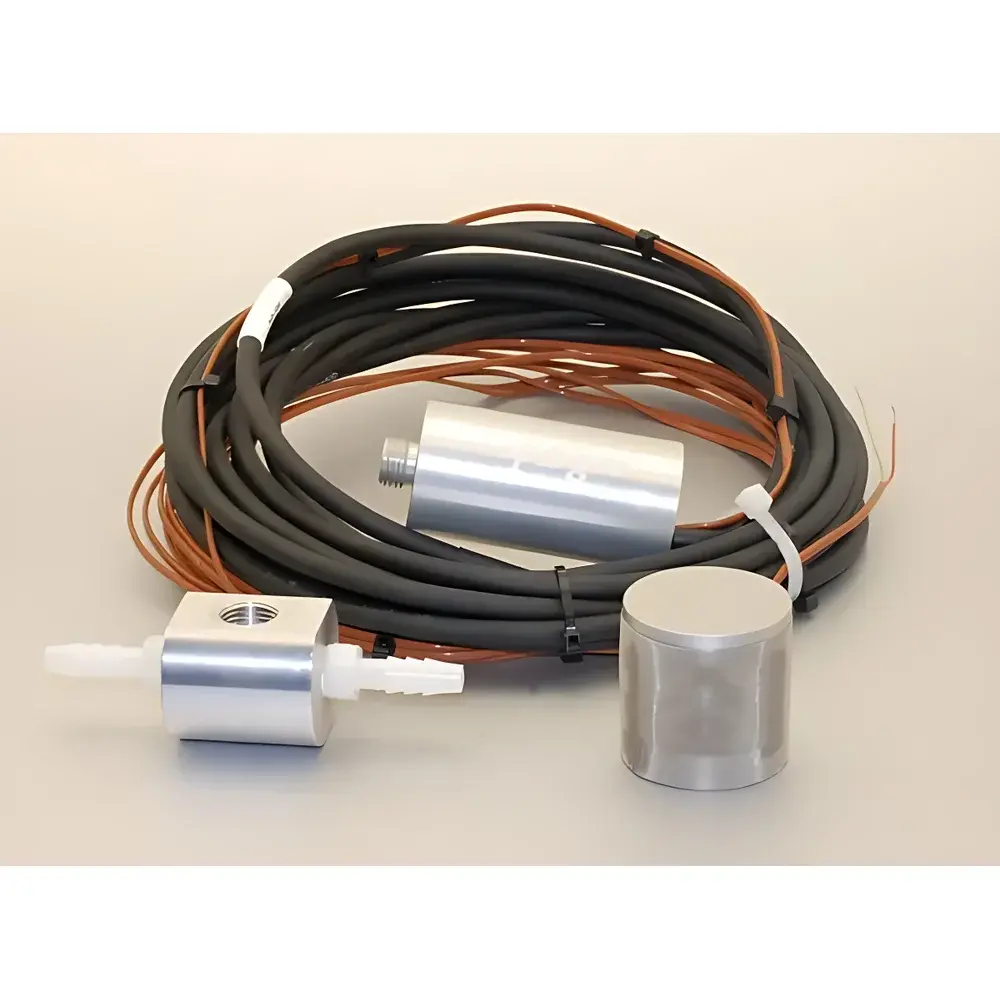
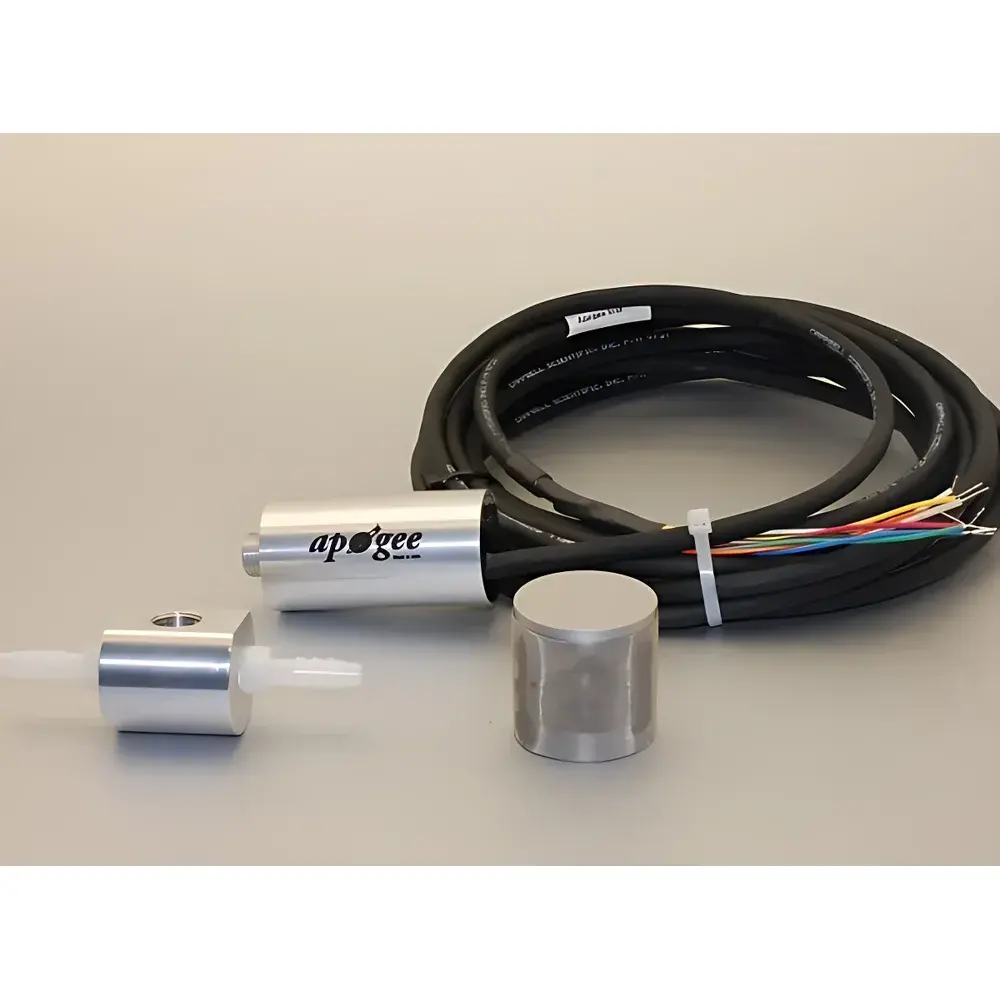
Apogee SO-110 / SO-120 / SO-210 / SO-220 Soil Oxygen Sensors
| Brand | Apogee |
|---|---|
| Origin | USA |
| Model | SO-110, SO-120, SO-210, SO-220 |
| Measurement Range | 0–100 % O₂ |
| Output Sensitivity | 2.6 mV/%O₂ (SO-110/SO-210), 0.6 mV/%O₂ (SO-120/SO-220) |
| Output at 20.95 %O₂ | 6 mV (SO-110), 3 mV (SO-120), 55 mV (SO-210), 12.5 mV (SO-220) |
| Repeatability | ±0.001 %O₂ |
| Nonlinearity | <0.01 %O₂ |
| Long-term Drift | 1 mV/year (SO-110/SO-210), 0.8 mV/year (SO-120/SO-220) |
| Response Time (t₉₀) | 60 s (SO-110/SO-120), 14 s (SO-210/SO-220) |
| Operating Temperature | –20 to +60 °C |
| Relative Humidity Range | 0–100 % RH |
| Pressure Range | 60–140 kPa |
| Supply Voltage | 12 V DC (with heater), 2.5 V DC (for thermistor excitation) |
| Heater Current | 6.2 mA |
| Thermistor Excitation Current | 0.1 mA |
| Sensor Dimensions | 32 mm Ø × 68 mm L |
| Diffusion Probe (optional) | 35 mm Ø × 35 mm L, 125-mesh stainless steel screen |
| Flow-through Probe (optional) | 32 mm Ø × 91 mm L, 0.25″ nylon connector |
| Housing Material | Anodized aluminum or polypropylene |
| Internal Temperature Sensor | Yes, for thermal compensation |
| Heating Element | Integrated, prevents membrane condensation |
Overview
The Apogee SO-110, SO-120, SO-210, and SO-220 Soil Oxygen Sensors are precision electrochemical instruments engineered for continuous, in-situ measurement of gaseous oxygen concentration (0–100 % O₂) within soil matrices and porous media. These sensors operate on the principle of galvanic or polarographic oxygen sensing—depending on model configuration—where molecular oxygen diffuses through a gas-permeable membrane and undergoes reduction at a cathode, generating a current proportional to partial pressure. The signal is converted to a stable analog voltage output, calibrated against ambient air (20.95 % O₂) and traceable to NIST-certified reference standards. Designed explicitly for long-term field deployment, each sensor integrates an internal temperature sensor for real-time thermal compensation and an embedded heating element to suppress condensation on the sensing membrane—a critical feature for maintaining signal integrity in high-humidity or diurnally fluctuating soil environments. Unlike optical or fluorescence-based alternatives, these Clark-type sensors deliver high reproducibility under variable redox conditions without photobleaching or quenching interference.
Key Features
- Four model variants optimized for distinct accuracy–response trade-offs: SO-110/SO-210 (higher sensitivity, slower response) and SO-120/SO-220 (lower sensitivity, faster t₉₀ = 14 s)
- Dual housing options: corrosion-resistant anodized aluminum for general use; chemically inert polypropylene for acidic soils (pH < 4.5) or organic-rich composts where aluminum passivation may fail
- Integrated PTC heater (6.2 mA @ 12 V DC) actively maintains membrane surface temperature above dew point, eliminating condensate-induced signal attenuation and baseline drift
- Onboard thermistor or K-type thermocouple (model-dependent) enables automatic temperature compensation per ASTM D5752 and ISO 11274 protocols
- Hermetically sealed diffusion barrier with 125-mesh stainless steel screen (optional diffusion probe) ensures mechanical protection while preserving O₂ permeability and minimizing biofouling
- Low-power design compatible with battery-operated data loggers (e.g., Campbell Scientific CR1000X, Onset HOBO UX120) and solar-powered remote stations
Sample Compatibility & Compliance
The SO-series sensors are validated for direct insertion into mineral soils, peat, vermicompost, landfill cover layers, and engineered bioremediation substrates. Their compact 32 mm diameter and tapered tip allow minimally disruptive installation using standard soil coring tools. Optional flow-through probes support forced-air sampling in controlled-environment chambers (e.g., hypoxic/hyperoxic growth rooms per ISO 14644-1 Class 5 specifications) or industrial stack monitoring applications. All models comply with IEC 61326-1 (EMC for laboratory and industrial use) and meet material safety requirements per RoHS 2011/65/EU. Calibration traceability aligns with ISO/IEC 17025:2017 accredited practices when performed using certified gas mixtures (e.g., Air Liquide O₂/N₂ blends). Data acquisition systems interfacing with these sensors may be configured to satisfy FDA 21 CFR Part 11 audit-trail requirements when paired with compliant logging software (e.g., LoggerNet v5+ with electronic signature modules).
Software & Data Management
Apogee provides calibration coefficients and linearization equations (including temperature-compensated polynomial terms) in datasheet format for integration into custom LabVIEW, Python (NumPy/SciPy), or MATLAB workflows. No proprietary software is required; raw mV outputs are directly scalable using factory-provided gain and offset values. When deployed with third-party loggers, users can configure automated zero-span checks using nitrogen-purged reference chambers or ambient-air equilibration cycles. For GLP/GMP-aligned deployments, metadata tagging (sensor ID, installation depth, soil texture class) is supported via CSV header conventions or JSON schema extensions in modern edge-computing gateways. Firmware-upgradable data loggers enable over-the-air recalibration parameter updates without site revisits.
Applications
- Agricultural research: Quantifying root-zone O₂ dynamics during irrigation scheduling, cover cropping trials, and anaerobic soil disinfestation (ASD) process validation
- Horticulture & greenhouse management: Monitoring aerobic stability in containerized substrates and hydroponic aggregate beds
- Environmental remediation: Tracking aerobic biodegradation rates in petroleum-contaminated soils and nitrate-reducing zones in constructed wetlands
- Geotechnical & mining engineering: Assessing oxidation state changes in tailings storage facilities and acid mine drainage prediction models
- Climate science: Measuring soil respiration fluxes (as proxy for microbial activity) in eddy covariance tower networks per FLUXNET Tier-1 standards
- Regulatory compliance: Supporting EPA Method 8260D (volatile organic compounds) and ASTM D4448 (soil aeration testing) documentation requirements
FAQ
What is the recommended calibration frequency for long-term field deployment?
Annual two-point calibration (0 % O₂ in N₂ and 20.95 % O₂ in ambient air) is advised; however, drift rates ≤1 mV/year permit semi-annual verification in stable environments with documented temperature history.
Can these sensors measure dissolved oxygen in saturated soil pore water?
No—these are gaseous O₂ sensors designed for headspace or unsaturated zone measurements. For aqueous-phase DO, Apogee’s separate DO-100 series (optical sensor) is recommended.
Is the heater function mandatory for all installations?
It is strongly recommended for any site experiencing >80 % RH or diurnal temperature swings exceeding 15 °C. In arid, well-drained soils with stable thermal profiles, heater operation may be disabled to conserve power.
How does polypropylene housing improve performance in acidic soils?
Polypropylene exhibits negligible ion exchange and no galvanic coupling with soil electrolytes, preventing accelerated corrosion and electrolyte leaching that compromise aluminum housing integrity below pH 4.5.
Are optional probes supplied with pre-installed filters or membranes?
Yes—both diffusion and flow-through probes include factory-installed, replaceable Teflon® hydrophobic membranes (5 µm pore size) and stainless-steel diffusion screens; replacement kits (MEM-SO-1) are available separately.
Related Products







