
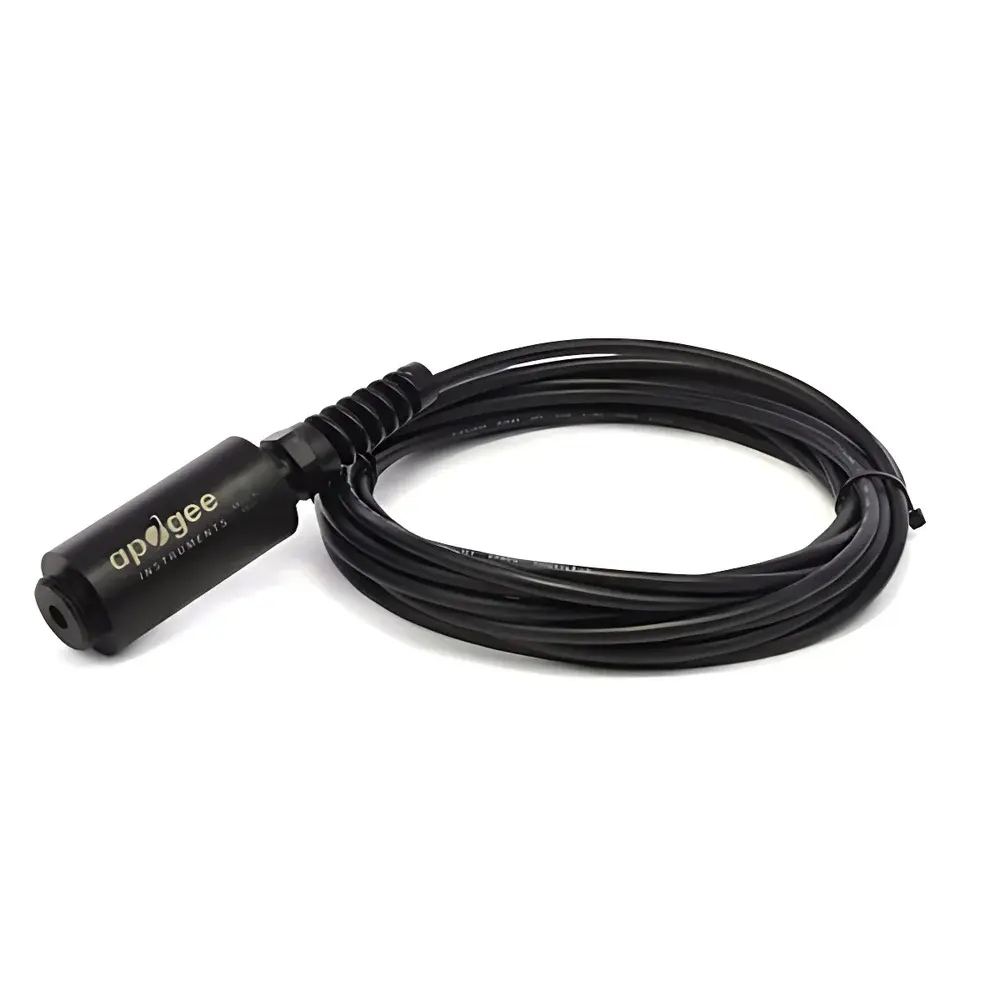
Apogee SO-210 Ambient Oxygen Sensor
| Brand | Apogee |
|---|---|
| Origin | USA |
| Model | SO-210 Ambient Oxygen Sensor |
| Measurement Range | 0–100% O₂ |
| Accuracy (Stability) | ±0.05% O₂ (under stable ventilation) |
| Repeatability | ±0.001% O₂ (10 ppm) |
| Operating Temperature | −20 to +60 °C |
| Relative Humidity Range | 0–100% RH |
| Pressure Range | 60–140 kPa |
| Response Time (t₉₀) | 12 s |
| Output Signal | 12 mV at 20.95% O₂ |
| O₂ Consumption Rate | 2.2 µmol/day at 20.95% O₂, 23 °C |
| Cross-Sensitivity | Negligible to CO₂, CO, NO, NO₂, H₂S, H₂, CH₄ |
| Power Supply | 12 V for heater, 2.5 V for thermistor excitation |
| Cable | 5 m foil-shielded twisted pair |
| Optional Diffusion Cap | 3.5 cm L × 3.5 cm Ø, 125 vent holes |
| Optional Flow-Through Cap | 3.2 cm L × 3.2 cm Ø, 1/8″ conical hose adapter |
| Integrated Temperature Sensor | NTC thermistor |
| Weight | 175 g |
Overview
The Apogee SO-210 Ambient Oxygen Sensor is an electrochemical galvanic cell sensor engineered for continuous, low-maintenance measurement of oxygen partial pressure in ambient air. It operates on the principle of amperometric oxygen reduction at a gold cathode and lead anode, immersed in an aqueous alkaline electrolyte and sealed behind a gas-permeable polytetrafluoroethylene (PTFE) membrane. Oxygen diffuses through the membrane and undergoes electrochemical reduction at the cathode surface, generating a current proportional to the partial pressure of O₂ in the sample gas. This current is converted to a stable analog voltage output via an internal precision bridge resistor. Unlike optical or paramagnetic sensors, the SO-210 requires no external power for sensing—only low-voltage excitation for its integrated NTC thermistor—making it ideal for long-term unattended deployments in environmental monitoring networks, indoor air quality stations, and controlled atmosphere storage facilities.
Key Features
- Galvanic cell design with Pb anode and Au cathode ensures self-powered operation without polarization or external bias voltage
- PTFE diffusion membrane provides consistent permeability, high chemical resistance, and immunity to water vapor condensation
- Integrated NTC thermistor enables real-time temperature compensation, critical for accurate conversion between kPa (O₂ partial pressure) and % O₂ or ppm units
- Low oxygen consumption rate (2.2 µmol/day at 20.95% O₂, 23 °C) minimizes local depletion effects in low-flow or static sampling configurations
- Proven stability of ±0.05% O₂ under controlled ventilation conditions supports multi-month calibration intervals in routine monitoring applications
- Robust mechanical architecture: stainless steel housing, foil-shielded 5 m cable, and IP65-rated diffusion cap option for outdoor installations
- Minimal cross-sensitivity to common atmospheric interferents—including CO₂, CO, NOₓ, H₂S, H₂, and CH₄—ensuring reliability in complex urban or industrial air matrices
Sample Compatibility & Compliance
The SO-210 is validated for use in ambient air, laboratory-grade breathing air, greenhouse atmospheres, and inert gas blanketing environments. Its performance complies with ISO 8573-1:2010 (compressed air purity classes) for Class 3 oxygen measurement and meets the functional requirements of EPA Method TO-11A for ambient O₂ reference in photochemical assessment monitoring. While not intrinsically safe, the sensor may be deployed in non-hazardous locations per IEC 60079-0. It is compatible with data loggers and SCADA systems supporting 0–25 mV analog input ranges and thermistor resistance readout (e.g., 10 kΩ @ 25 °C). No regulatory certification (e.g., CE, UKCA, UL) is required for ambient air use, though integration into certified AQMS platforms must follow system-level conformity assessments per EN 14625:2022.
Software & Data Management
The SO-210 delivers analog outputs only and does not include embedded firmware or digital communication protocols. Voltage (mV) and thermistor resistance (Ω) signals are processed externally using calibrated lookup tables or polynomial equations defined in Apogee’s publicly available technical note TN-023. These conversions support traceable derivation of O₂ concentration in %, ppm, or kPa—accounting for barometric pressure, temperature, and humidity as specified in ISO 10780:2019 for stack and ambient gas analysis. When integrated into GLP- or GMP-aligned environmental monitoring systems, the sensor’s analog output can be captured with audit-trail-capable data acquisition hardware compliant with FDA 21 CFR Part 11, provided appropriate electronic signature and metadata logging are implemented at the system level.
Applications
- Continuous ambient air quality monitoring networks (AQN), particularly for background O₂ baseline tracking alongside CO₂, NO₂, and PM₂.₅ measurements
- Controlled environment agriculture (CEA) and vertical farming systems requiring precise O₂ setpoint maintenance in growth chambers
- Post-harvest storage monitoring of fruits, grains, and pharmaceuticals in modified-atmosphere packaging (MAP) rooms
- Validation of nitrogen purge efficiency in semiconductor fabrication cleanrooms and laboratory gloveboxes
- Educational laboratories for teaching electrochemical gas sensing principles, diffusion kinetics, and partial pressure thermodynamics
- Calibration transfer standards for paramagnetic O₂ analyzers in metrology labs operating under ISO/IEC 17025
FAQ
Does the SO-210 require periodic recalibration?
Yes—while exhibiting excellent short-term stability, galvanic cells experience gradual anode depletion. Apogee recommends annual two-point calibration (0% O₂ in N₂ and ambient air at known barometric pressure) for applications demanding ≤±0.1% O₂ total uncertainty.
Can the sensor operate in saturated humidity or rain-exposed enclosures?
The standard housing is rated IP65 when used with the optional diffusion cap. However, prolonged exposure to liquid water ingress may compromise membrane integrity; condensation management via desiccant or heated sample lines is advised above 95% RH.
Is the output linear across the full 0–100% range?
The voltage output is linear with respect to O₂ partial pressure (kPa), not % O₂. Conversion to % requires simultaneous pressure and temperature inputs; linearity deviation exceeds ±0.5% only beyond 95% O₂ at elevated temperatures (>50 °C).
What is the expected service life under typical ambient conditions?
Based on accelerated aging tests, median operational life is 24–36 months at 20–25 °C and 40–60% RH. Life decreases approximately 30% per 10 °C rise above 30 °C due to electrolyte evaporation and anode corrosion kinetics.







