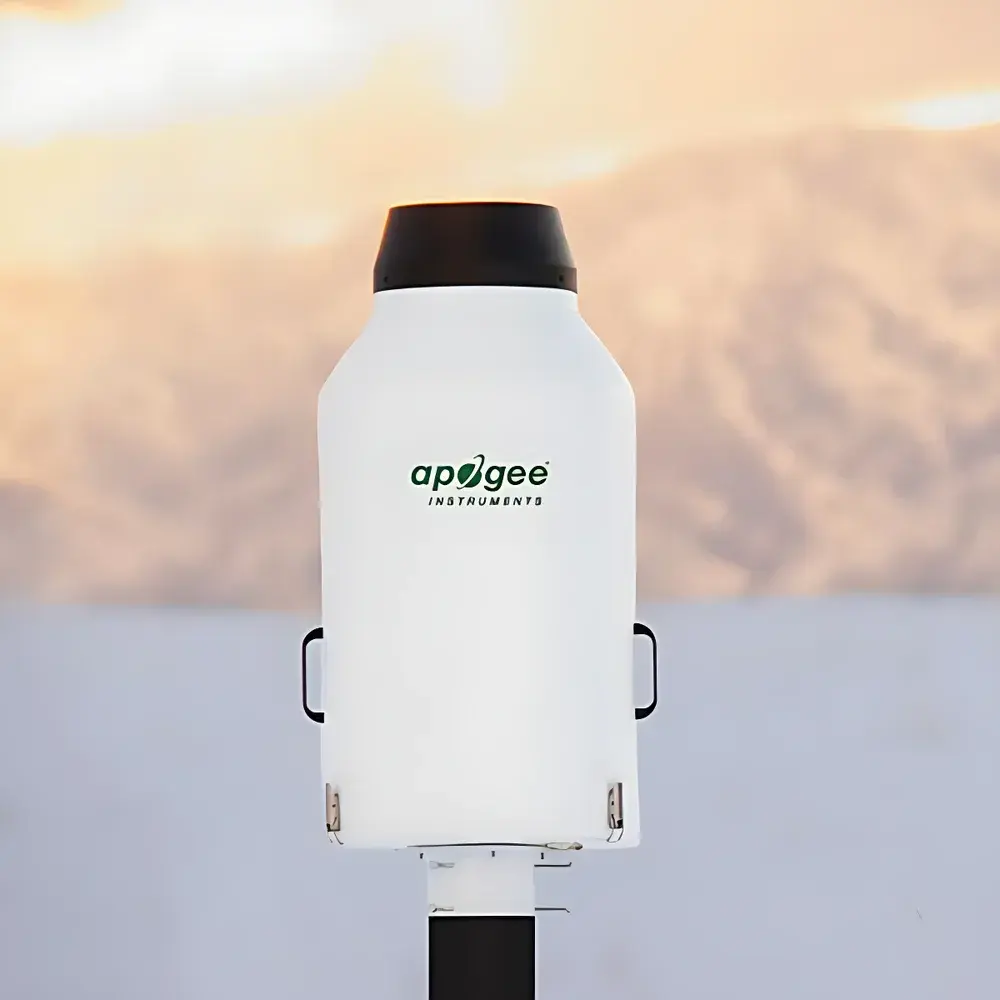
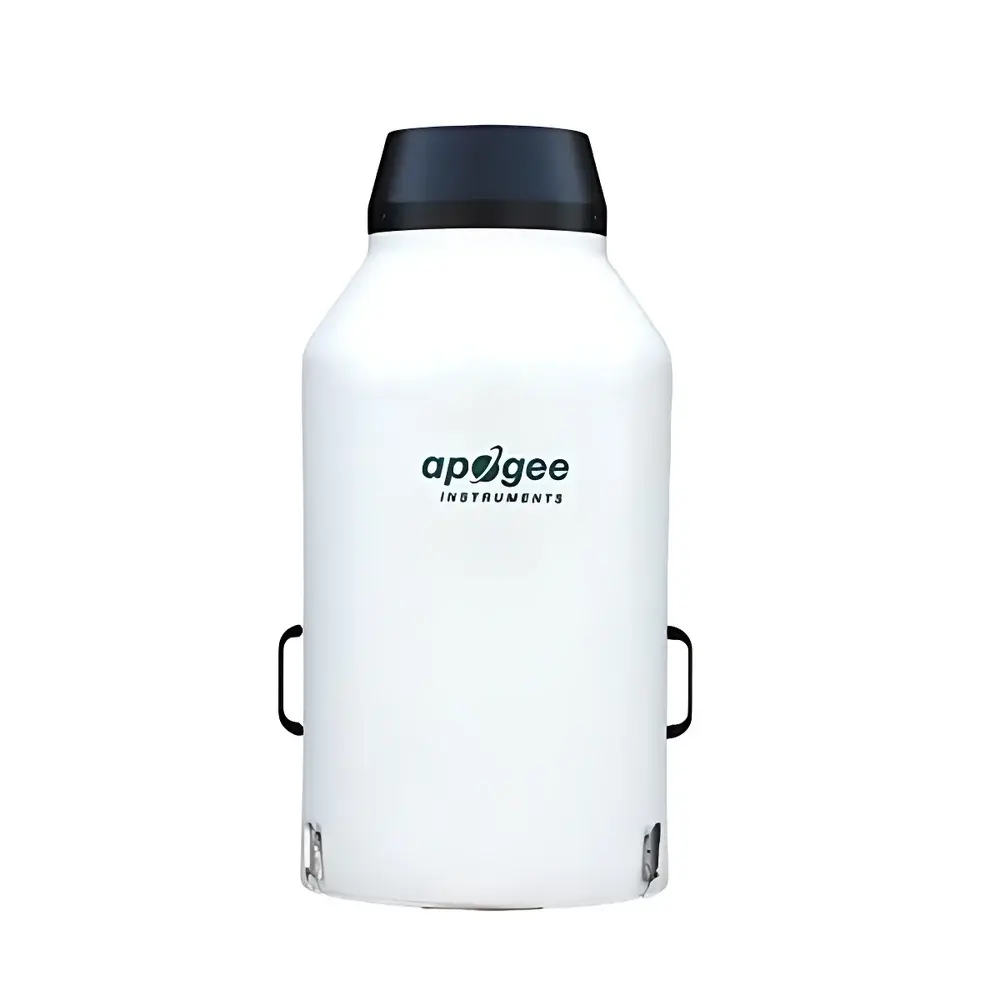
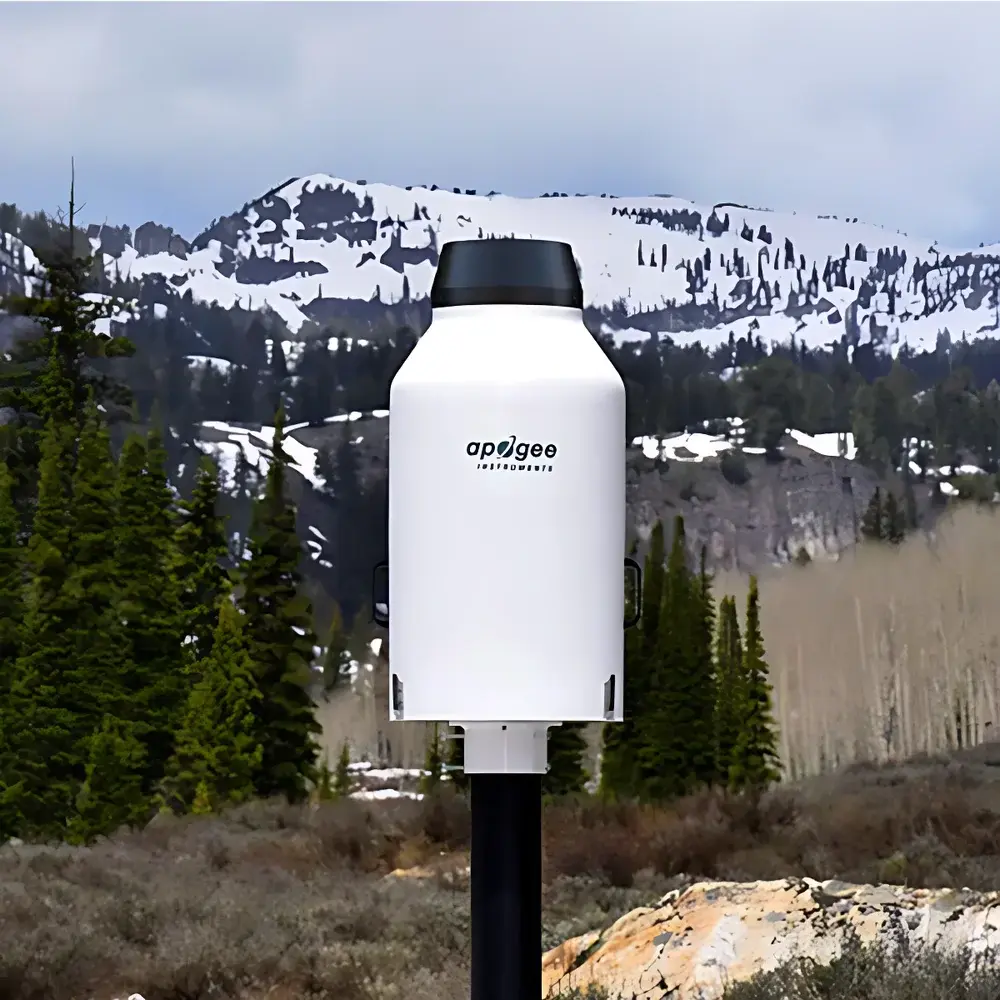
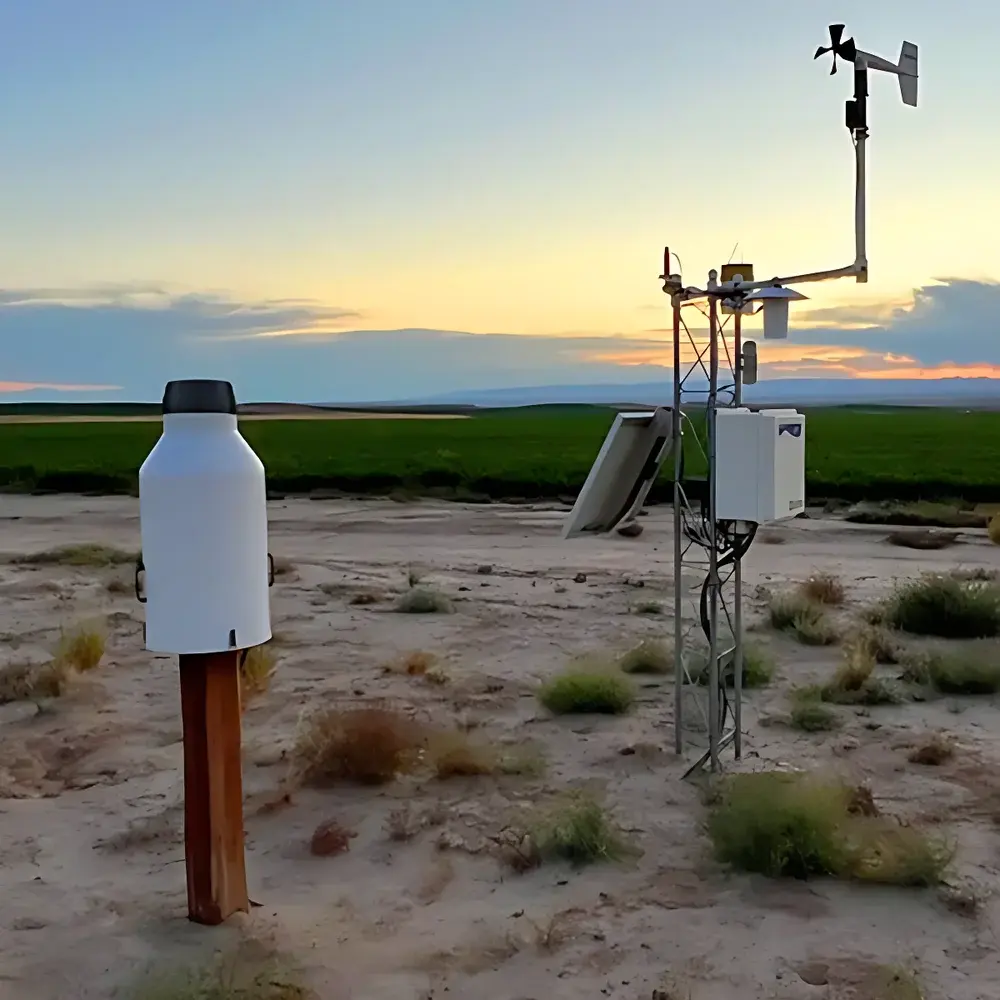
Apogee Cloudburst SG-400 / SG-410 / SG-420 / SG-430 Weighing Precipitation Gauges
| Brand | Apogee |
|---|---|
| Origin | USA |
| Manufacturer Type | Authorized Distributor |
| Product Origin | Imported |
| Model | Cloudburst SG-400 Series |
| Output Interface | SDI-12 v1.4 (Modbus option planned) |
| Capture Area | 324 cm² (SG-400/SG-410) or 200 cm² (SG-420/SG-430) |
| Inlet Diameter | 8 in (20.3 cm) or 6.3 in (16 cm) |
| Precipitation Capacity | 900 mm (SG-400/SG-410) or 1500 mm (SG-420/SG-430) |
| Bucket Volume | 30 L |
| Heating Option | Optional (SG-410 & SG-430) |
| Accuracy (Cumulative) | ±0.1 mm (<5 mm), ±1% (>5 mm) |
| Accuracy (Rate) | ±5% (>2 mm/hr) |
| Resolution | 0.01 mm |
| Temperature Sensitivity | ±0.01 mm/°C |
| Long-Term Drift | <0.5%/year |
| Nonlinearity | <0.1 mm (SG-400/SG-420), <0.2 mm (SG-410/SG-430) |
| Sensor Type | Stainless Steel Strain-Gauge Load Cell |
| Power Supply | 5.5–26 VDC |
| Current Draw | 20 mA (non-heated), +2.1 A @24 VDC (heated) |
| Power Consumption | 240 mW (base), up to 50 W (heater active) |
| Operating Temperature | –20 to +60 °C |
| Humidity Range | 0–100% RH |
| Enclosure Rating | IP67 |
| Dimensions | Ø38 cm × H80 cm |
| Weight | 12 kg |
| Mounting | Compatible with 15.24 cm wooden posts or 10.16 cm metal pipes |
| Cable Length | 5 m standard |
Overview
The Apogee Cloudburst SG-400, SG-410, SG-420, and SG-430 series are high-accuracy, all-weather weighing precipitation gauges engineered for continuous, unattended measurement of total accumulated precipitation—including rain, snow, sleet, and hail—without phase-dependent bias. Unlike tipping-bucket or optical gauges, these instruments operate on the fundamental principle of mass-based accumulation: precipitation is collected in a precision-engineered 30-liter stainless-steel bucket mounted directly on a calibrated strain-gauge load cell. The resulting weight signal is digitized via a low-noise, temperature-compensated analog-to-digital converter and processed using adaptive digital filtering algorithms to suppress artifacts from wind-induced vibration, thermal expansion/contraction, and evaporation losses. This architecture eliminates mechanical wear, phase-transition errors, and undercatch common in traditional gauges—particularly during freezing conditions—while maintaining compliance with World Meteorological Organization (WMO) Guide to Meteorological Instruments and Methods of Observation (CIMO Guide, Chapter 8) and U.S. National Weather Service (NWS) Technical Attachment 10-2021.
Key Features
- High-stability stainless steel strain-gauge load cell with <0.5% annual drift and <0.1 mm nonlinearity (SG-400/SG-420) or <0.2 mm (SG-410/SG-430)
- Dual-wall insulated inlet design minimizes heater power demand while preventing snow bridging and rim icing
- Two capture area configurations: 324 cm² (8-inch aperture, NWS-compliant) and 200 cm² (6.3-inch aperture, WMO-recommended)
- Integrated SDI-12 v1.4 interface with configurable output intervals (1 min raw; 1–30 min filtered); Modbus RTU support under development
- IP67-rated enclosure with powder-coated stainless steel inlet and UV-stabilized polymer housing for long-term field deployment
- Temperature-compensated signal processing: ±0.01 mm/°C sensitivity mitigated via real-time thermal modeling
- No moving parts—zero maintenance requirement beyond periodic cleaning and calibration verification
- Low-power operation: 240 mW base consumption; heater draws ≤2.1 A @24 VDC (max 50 W) only when activated
Sample Compatibility & Compliance
The Cloudburst series is validated for quantitative measurement across all precipitation phases without physical phase discrimination. Its weighing methodology inherently captures solid-phase accumulation (e.g., dry snow density ~50–300 kg/m³) and mixed-phase events (e.g., wet snow, graupel, freezing rain) with equal fidelity. Calibration traceability follows NIST-traceable mass standards, and cumulative accuracy meets WMO Class A performance thresholds (±0.1 mm for accumulations 5 mm). Rate accuracy is specified at ±5% for intensities exceeding 2 mm/hr—a threshold aligned with operational hydrological forecasting requirements. The instruments comply with IEC 60529 (IP67), ISO 9001 manufacturing controls, and environmental stress testing per MIL-STD-810G (temperature cycling, humidity soak, vibration). For regulated environments (e.g., NOAA Cooperative Observer Program, EPA air quality monitoring networks), the system supports audit-ready data logging when paired with compatible dataloggers compliant with FDA 21 CFR Part 11 metadata requirements.
Software & Data Management
Data acquisition relies on industry-standard SDI-12 protocol, enabling seamless integration with Campbell Scientific CR-series, Onset HOBO, or Decagon EM50 loggers. Raw mass readings (in grams) and derived precipitation depth (mm) are timestamped and transmitted with user-configurable averaging windows. Firmware includes embedded filtering routines—based on recursive exponential smoothing and outlier rejection—to attenuate transient noise from wind gusts and thermal transients. While Apogee does not supply proprietary software, the open SDI-12 interface allows ingestion into Python (via PySDI12), R (sdi12 package), or commercial platforms such as LabVIEW, MATLAB, or Aqua4D. All models support GLP/GMP-aligned metadata tagging (e.g., sensor ID, firmware version, calibration date) within the SDI-12 response frame. Future Modbus implementation will enable direct SCADA integration and remote configuration of filter parameters and heating activation thresholds.
Applications
- Climate monitoring networks requiring multi-decadal consistency in solid/liquid precipitation partitioning
- Hydrological modeling inputs for snowmelt-runoff forecasting in mountainous and boreal regions
- Airport weather stations needing reliable freezing precipitation detection for de-icing operations
- Ecological research on water balance in tundra, alpine, and forest ecosystems
- Calibration reference for disdrometers, radar QPE algorithms, and satellite precipitation products
- Regulatory compliance reporting for EPA Clean Water Act stormwater management plans
FAQ
How does the Cloudburst series distinguish between rain and snow without heating the entire collector?
It does not distinguish phases—it measures total mass accumulation. Snow density variations are inherently captured as mass; subsequent conversion to liquid-equivalent depth assumes standard density (10 mm snow ≈ 1 mm water) unless site-specific density correction is applied externally.
Is the heater required for accurate snow measurement?
No. The heater prevents inlet obstruction (bridging) but is not necessary for mass accuracy. Unheated units (SG-400/SG-420) perform identically in terms of weighing fidelity; heater use is driven by local climatology and maintenance access constraints.
Can the gauge be used in high-wind coastal environments?
Yes. Wind-induced vibration is suppressed via dual-stage digital filtering and mechanical damping inherent in the suspended bucket geometry. Field validation shows <2% undercatch at 10 m/s wind speed with standard wind shield (not included but compatible with WMO-recommended Alter-type shields).
What maintenance is required?
Annual visual inspection, bucket cleaning with deionized water, and verification against NIST-traceable test weights. No recalibration is needed within specification limits unless physical damage occurs.
Does the SDI-12 output include diagnostic flags?
Yes. Each response includes status bits indicating heater state, over-range condition, temperature out-of-spec, and internal ADC fault—enabling automated health monitoring in networked deployments.