
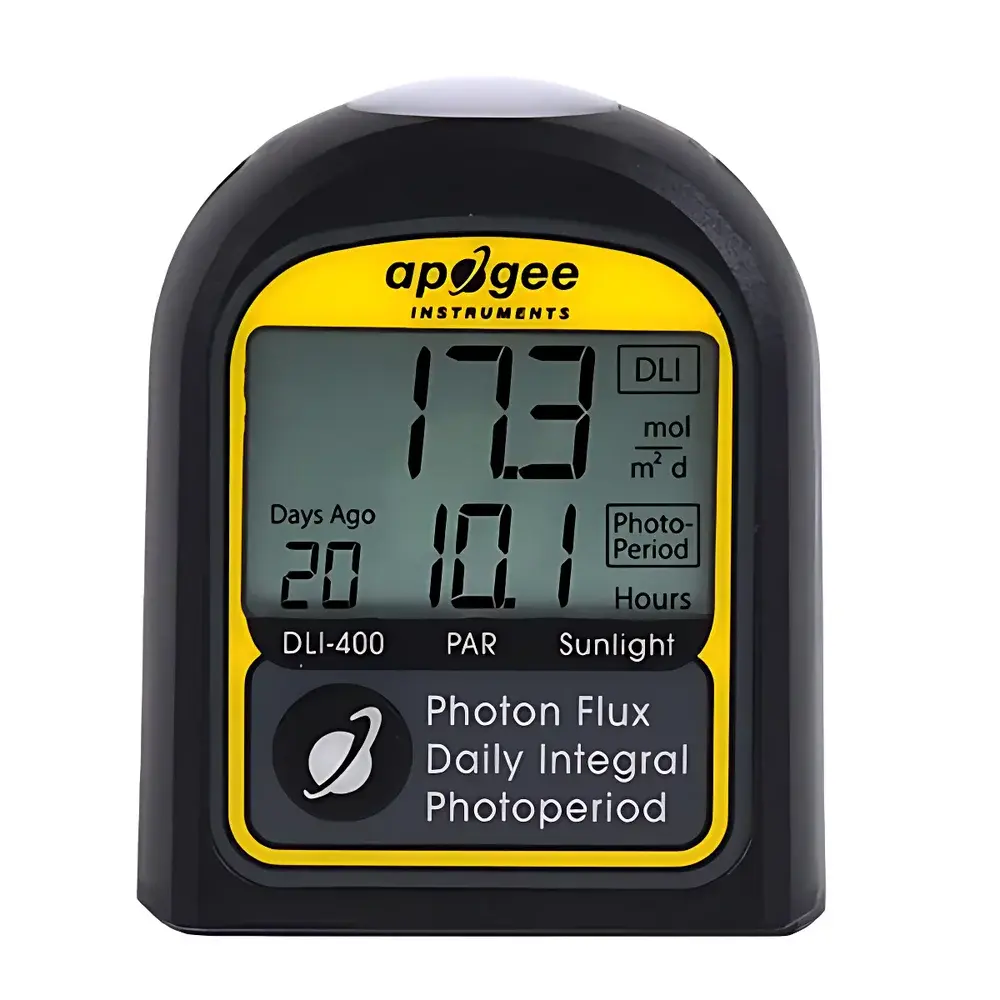
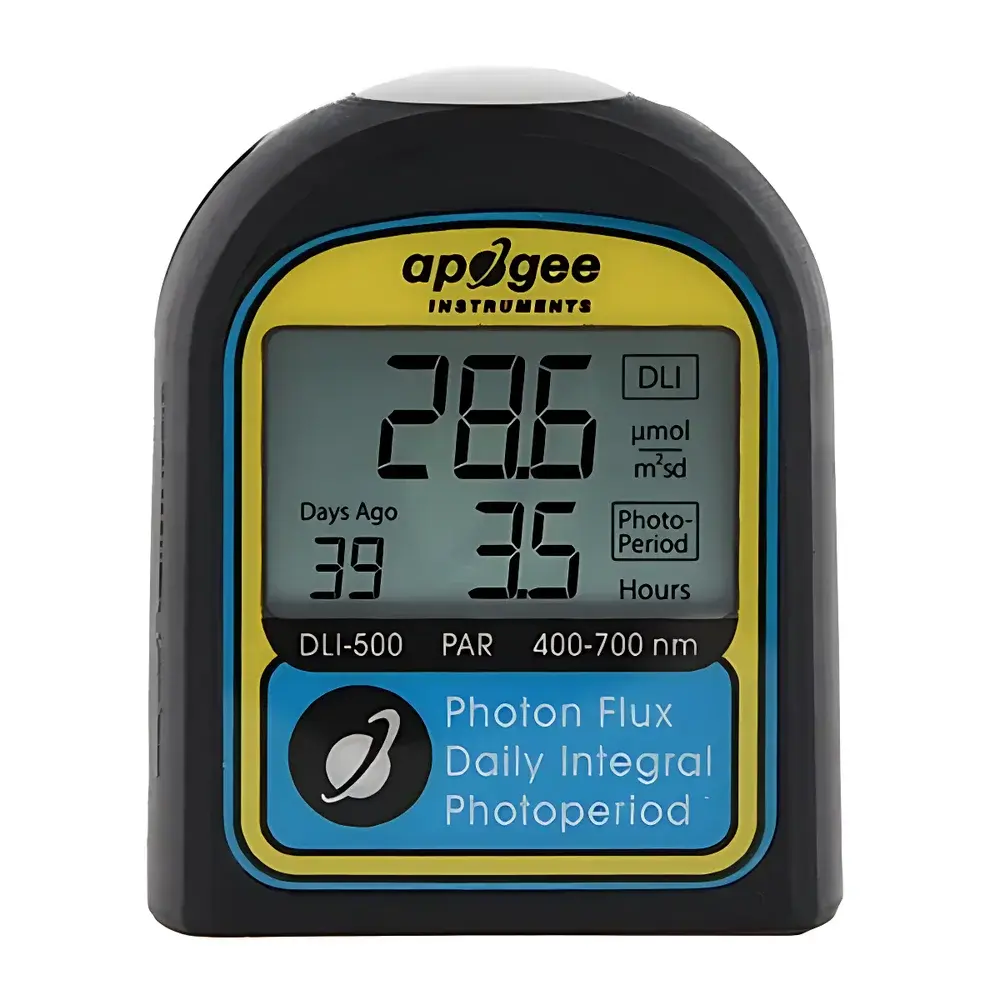
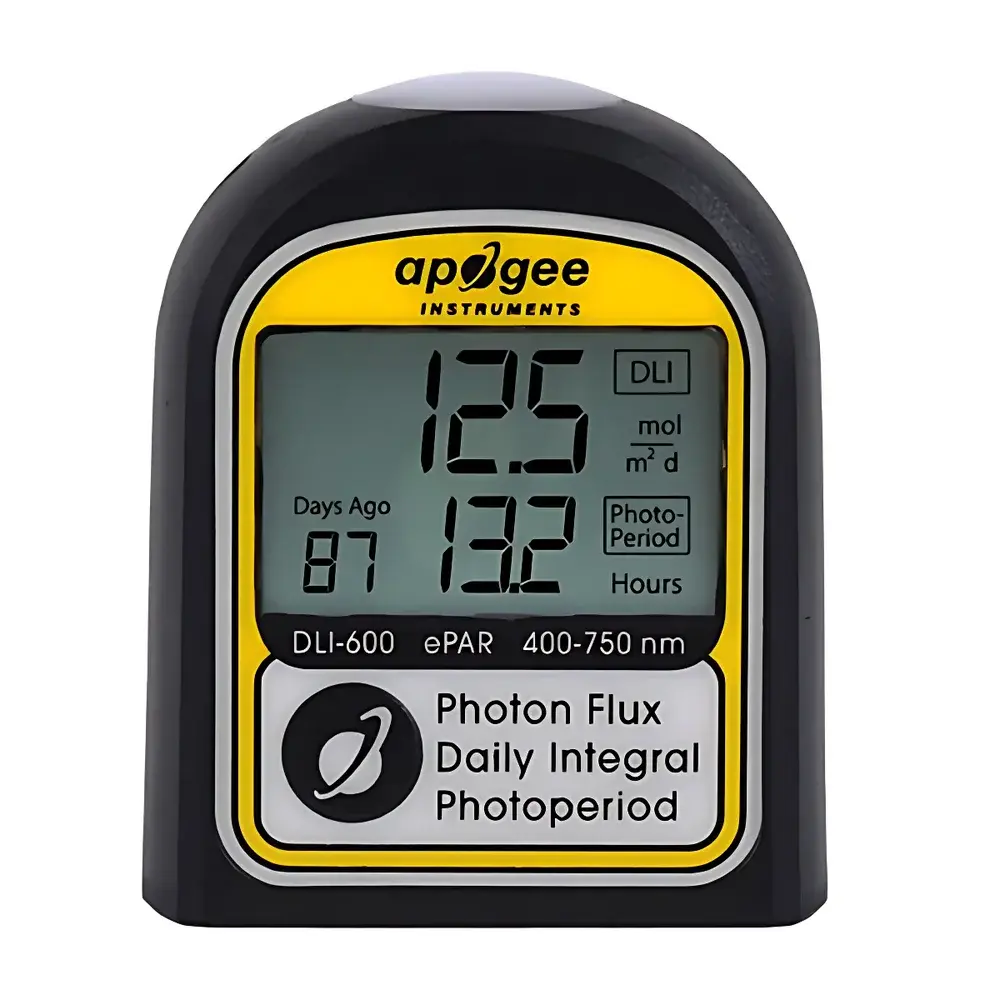
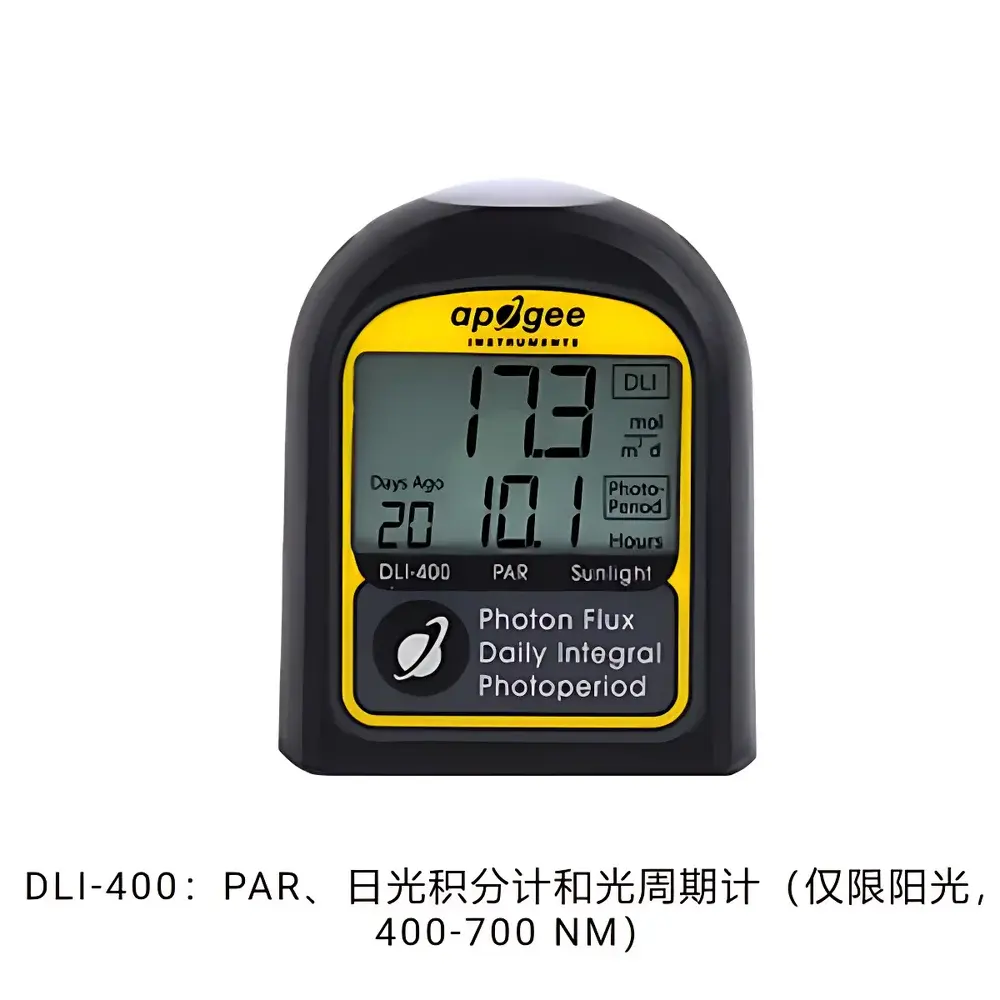
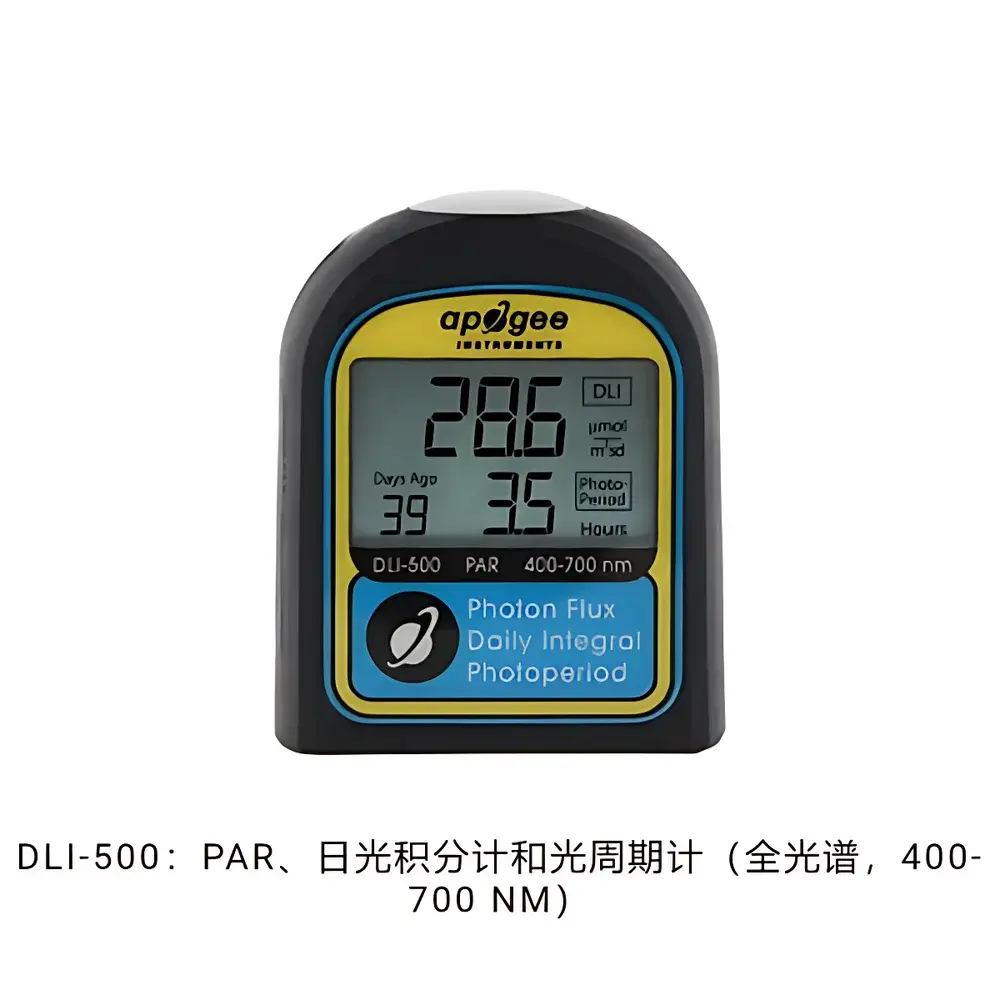
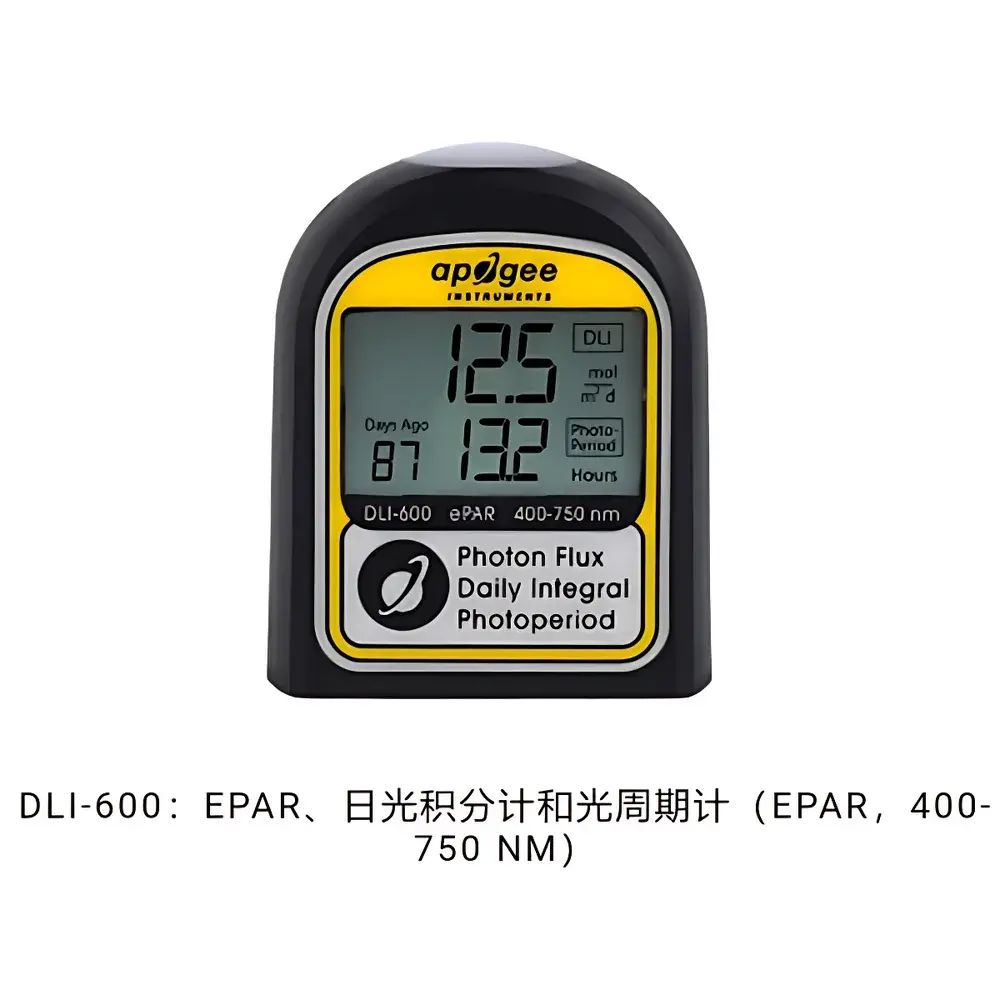
Apogee DLI400 / DLI500 / DLI600 Photosynthetic Photon Flux Density (PPFD) and Daily Light Integral (DLI) Integrating Meters
| Brand | Apogee |
|---|---|
| Origin | USA |
| Model | DLI400, DLI500, DLI600 |
| Measurement Wavelength Range | 400–700 nm (DLI400), 389–692 nm (DLI500), 383–757 nm (DLI600) |
| Measurement Range | 0–4000 µmol/m²/s |
| Resolution | 1 µmol/m²/s (real-time), 0.1 µmol/m²/s (stored PPFD), 0.1 mol/m²/day (DLI), 0.1 h (photoperiod) |
| Calibration Uncertainty | ±5% |
| Long-term Drift | <2%/year |
| Cosine Response Error | ±5% up to 75° zenith angle |
| Field of View | 180° |
| Response Time | 2.5 s |
| Data Logging Capacity | 99 days (DLI & photoperiod), 10 days (30-min averaged PPFD/ePPFD) |
| Operating Temperature | –40 to +70 °C (DLI500/DLI600), –10 to +60 °C (DLI400) |
| IP Rating | IP65 |
| Weight | 67 g |
| Power | Two AAA batteries (≈6 months life) |
Overview
The Apogee DLI400, DLI500, and DLI600 are precision-calibrated, handheld integrating meters engineered for quantitative assessment of photosynthetically active radiation (PAR) and its time-integrated metrics—daily light integral (DLI) and photoperiod—in controlled-environment agriculture, greenhouse operations, plant physiology research, and vertical farming. Each model employs a thermally stabilized silicon photodiode coupled with a custom-engineered acrylic diffuser and optical bandpass filter to deliver spectrally selective quantum response aligned with internationally recognized PAR definitions. The DLI400 conforms to the classical 400–700 nm PAR definition and is optimized for solar and select broadband artificial sources. The DLI500 extends spectral fidelity across 389–692 nm, ensuring accurate ePAR (extended PAR) quantification under full-spectrum LEDs, fluorescent, metal halide, and high-pressure sodium lamps. The DLI600 further broadens detection to 383–757 nm, supporting emerging research on far-red (700–750 nm) contributions to phytochrome-mediated morphogenesis and photosynthetic efficiency. All models operate on the quantum principle: photon flux density (PPFD or ePPFD) is measured in micromoles of photons per square meter per second (µmol/m²/s), while DLI integrates this value over 24 hours to yield mol/m²/day—a biologically meaningful metric directly correlated with carbon assimilation, biomass accumulation, and developmental timing.
Key Features
- IP65-rated rugged enclosure constructed from ASA plastic, enabling reliable operation in high-humidity, condensing, and wash-down environments typical of greenhouses and growth chambers.
- 180° field-of-view cosine-corrected optical system with ≤±5% angular response error up to 75° zenith angle—critical for representative hemispherical irradiance capture on horizontal or inclined plant canopies.
- Real-time 2.5-second running average display of instantaneous PPFD (DLI400/DLI500) or ePPFD (DLI600), plus dual-screen interface for immediate field assessment and historical data review.
- Onboard memory stores up to 99 days of DLI and photoperiod values, plus 10 days of 30-minute averaged PPFD/ePPFD—no external logger required.
- USB-C interface exports timestamped, comma-separated (CSV) data files compatible with Excel, R, Python, and LIMS platforms; supports audit-ready traceability for GLP/GMP-aligned trials.
- ¼-20 threaded base enables repeatable mounting on tripods, clamps, or soil stakes for unattended long-term monitoring—ideal for spatial mapping or multi-zone light uniformity studies.
- 24-bit analog-to-digital conversion ensures high dynamic range and low-noise signal processing, minimizing quantization error across the full 0–4000 µmol/m²/s range.
Sample Compatibility & Compliance
The DLI series is validated for use across diverse lighting conditions: natural sunlight, broad-spectrum white LEDs, narrow-band red/blue horticultural LEDs, ceramic metal halide (CMH), and legacy HID sources. Spectral calibration traceability follows NIST-traceable standards per Apogee’s ISO/IEC 17025-accredited laboratory protocols. Device performance complies with ASTM E2915–21 (Standard Practice for Determining Photobiological Safety of Lamps and Lamp Systems) and aligns with ISO 17025 requirements for measurement uncertainty reporting (±5% at 25 °C). The extended spectral response of the DLI500 and DLI600 satisfies recent recommendations from the International Society for Horticultural Science (ISHS) Task Force on ePAR standardization. All units meet IEC 60529 for IP65 ingress protection and operate within USDA-defined environmental tolerances for agricultural instrumentation.
Software & Data Management
Data export occurs via native USB-C connection—no proprietary drivers or cloud dependencies. CSV output includes UTC timestamps, PPFD/ePPFD (µmol/m²/s), cumulative DLI (mol/m²/day), photoperiod duration (h), and instrument serial number. Files conform to FAIR (Findable, Accessible, Interoperable, Reusable) data principles and integrate seamlessly with common agronomic analysis workflows. For regulated environments, the fixed sampling interval (3-minute default, non-adjustable) and immutable onboard clock support 21 CFR Part 11-compliant electronic records when paired with validated laboratory information management systems (LIMS). Firmware updates—delivered as signed binary packages—maintain cryptographic integrity and version control per ISO 13485 medical device software guidelines.
Applications
- Greenhouse light recipe optimization: Quantify DLI deficits or excesses across crop growth stages to adjust supplemental lighting duration and intensity.
- Vertical farm canopy uniformity mapping: Deploy multiple units on rail-mounted fixtures to generate spatial PPFD heatmaps and identify shadow zones.
- Phenotyping trials: Correlate photoperiod-triggered flowering onset (e.g., in cannabis or chrysanthemum) with recorded DLI thresholds under variable LED spectra.
- Nursery stock acclimation: Monitor ePAR-driven photomorphogenic responses during hardening-off using DLI600’s 400–750 nm sensitivity.
- Academic plant physiology: Validate spectral weighting models (e.g., McCree curve vs. ePAR integrals) using side-by-side DLI400/DLI600 deployments.
- Regulatory compliance reporting: Generate auditable DLI logs for USDA Organic, GlobalG.A.P., or EU Plant Passport certification dossiers.
FAQ
What distinguishes DLI400, DLI500, and DLI600 in terms of spectral applicability?
The DLI400 is calibrated for classical 400–700 nm PAR and performs optimally under sunlight and select broadband sources. The DLI500 covers 389–692 nm, delivering accurate ePAR measurements across modern horticultural LEDs and mixed-source environments. The DLI600 extends to 383–757 nm, capturing biologically relevant far-red photons used in phytochrome photoequilibrium studies.
Can these meters be used for long-term unattended logging?
Yes—each unit autonomously records DLI and photoperiod daily, plus 30-minute averaged PPFD/ePPFD, for up to 99 and 10 days respectively. Mounting via the ¼-20 thread enables stable, vibration-resistant deployment.
How is cosine correction validated?
Each sensor undergoes angular responsivity testing per ISO 9060:2018 Annex E, with certified cosine error ≤±5% at 75° zenith angle—verified during factory calibration and documented in the individual certificate of conformance.
Is temperature compensation applied in real time?
Yes—temperature coefficients (–0.04%/°C for DLI400; –0.11 ±0.04%/°C for DLI500/DLI600) are embedded in firmware and applied continuously during measurement and data logging.
Does the device meet FDA or USDA regulatory requirements for agricultural data collection?
While not a medical device, its deterministic sampling, tamper-evident CSV export, and NIST-traceable calibration support compliance with USDA AMS Good Agricultural Practices (GAP) audits and FDA Food Safety Modernization Act (FSMA) environmental monitoring provisions.






