
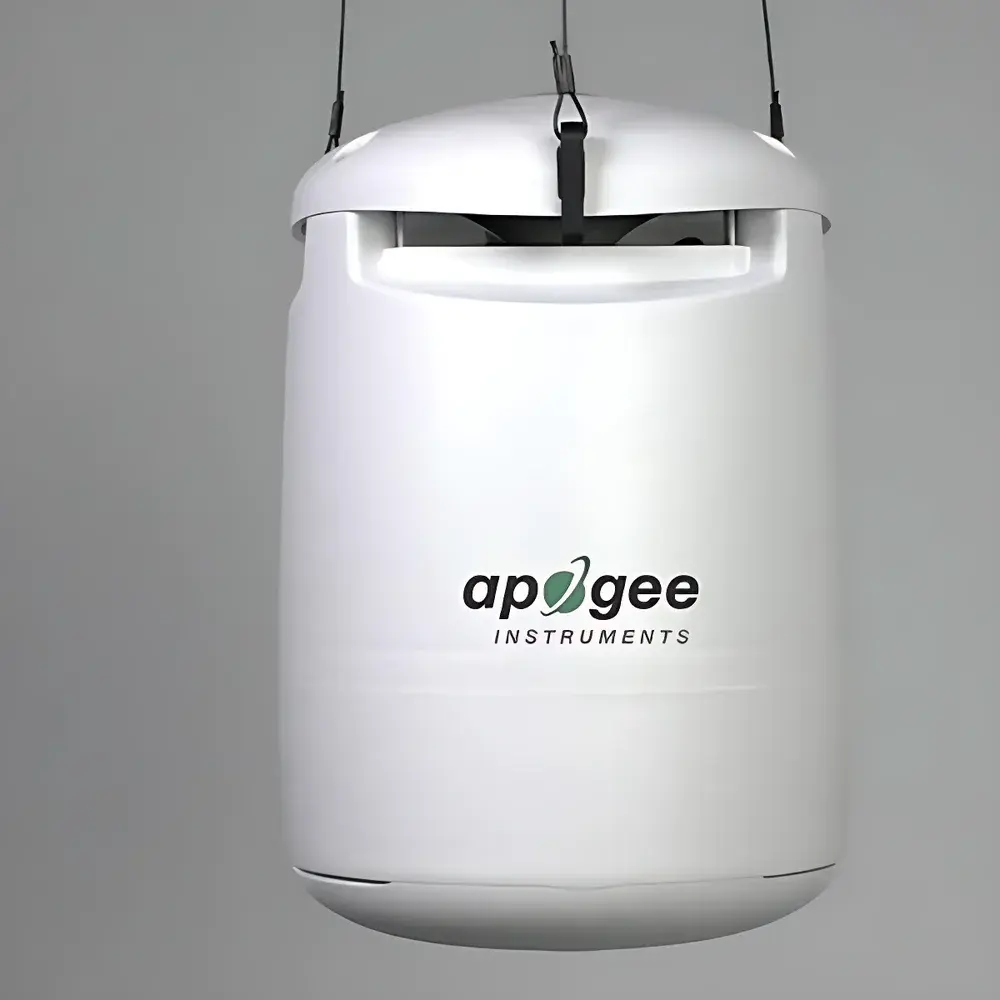
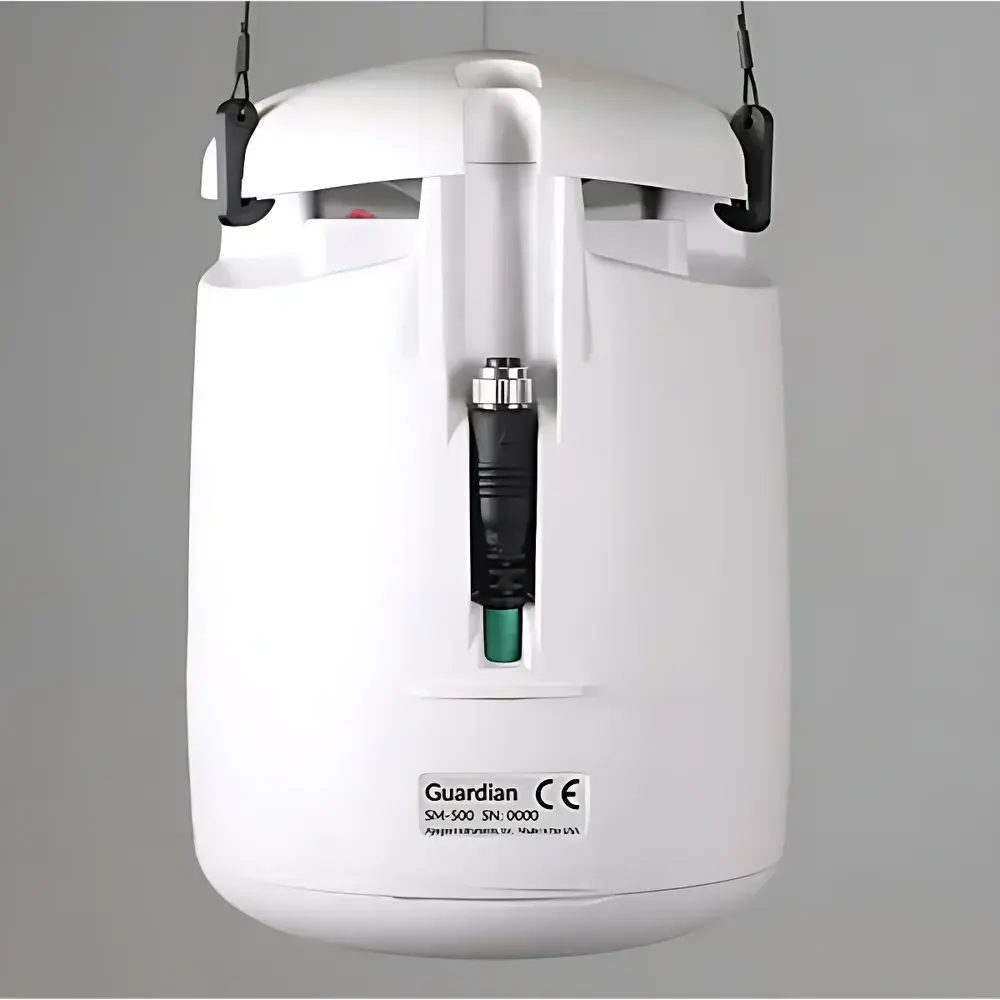
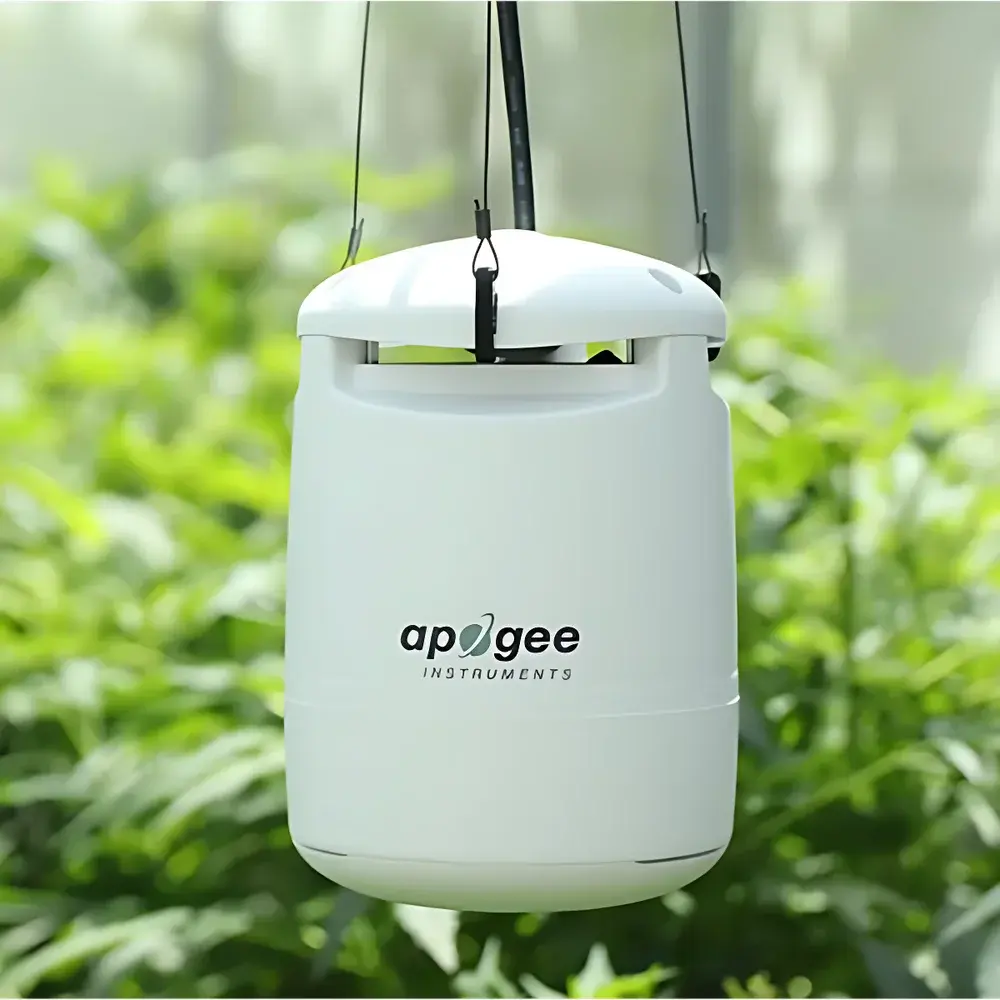
Apogee Guardian SM500 Agricultural Environmental Monitor & SM600 ECA Environmental Monitor
| Brand | Apogee |
|---|---|
| Origin | USA |
| Model | SM500 / SM600 |
| Temperature Range | –60 to +80 °C |
| Temp Accuracy | ±0.2 °C |
| Temp Drift | <0.02 °C/year |
| Temp Repeatability | <0.01 °C |
| Temp Response Time | 7 s |
| RH Range | 0–95 %RH |
| RH Accuracy | ±3 % @ 20–80 %RH |
| CO₂ Range | 0–2000 ppm |
| CO₂ Accuracy | ±50 ppm + 2 % of reading |
| CO₂ Response Time | 105 s |
| Barometric Pressure Range | 70–110 kPa |
| Spectral Range (SM500) | 389–692 nm |
| Spectral Range (SM600) | 383–757 nm |
| PAR/ePAR Range | 0–4000 µmol·m⁻²·s⁻¹ |
| Calibration Uncertainty | ±5 % |
| Long-term Instability | <2 %/year |
| Measurement Repeatability | <0.5 % |
| Field of View | 180° |
| Directional Response Error | ±5 % @ 75° zenith angle |
| Azimuthal Error | <0.5 % |
| Tilt Error | <0.5 % |
| Nonlinearity | <1 % |
| Sensor Response Time | 1 ms |
| Temp Coefficient | –0.11 % ±0.04 %/°C |
| Daily Integral Uncertainty | <5 % |
| Power Supply | 5–30 V DC |
| Power Consumption | 1.1–1.5 W |
| Data Storage | 9 months of 1-minute intervals |
| Output Interfaces | Modbus RTU (RS-232 & RS-485) and Bluetooth 5.0 |
| Operating Environment | –40 to +60 °C, 0–100 %RH |
| Enclosure Material | White ASA plastic |
| IP Rating | IP53 |
| Weight | 392 g |
| Dimensions | Ø105 mm × H157 mm |
| Cable Length | 5 m |
Overview
The Apogee Guardian SM500 and SM600 are high-precision, integrated environmental monitoring systems engineered for controlled-environment agriculture (CEA), greenhouse operations, vertical farms, and plant physiology research. Both models combine multiple calibrated sensors into a single, field-deployable unit—measuring photosynthetically active radiation (PAR) or extended PAR (ePAR), air temperature, relative humidity, barometric pressure, CO₂ concentration, dew point, daily light integral (DLI), and photoperiod. The SM500 employs a quantum sensor calibrated to the standard PAR spectral band (389–692 nm), ensuring accurate irradiance quantification under broad-spectrum sources including LEDs, fluorescent, and HID lamps. The SM600 extends this capability with an ePAR sensor covering 383–757 nm—a range validated by recent peer-reviewed studies on photosynthetic efficiency across diverse light-emitting technologies. Both sensors feature cosine-corrected optics with directional response errors ≤±5% at 75° zenith angle and azimuthal/tip errors <0.5%, enabling reliable measurements under low-angle illumination typical in high-latitude or shaded canopy conditions.
Key Features
- Integrated multi-parameter sensing: simultaneous measurement of PAR/ePAR, temperature, humidity, CO₂, pressure, and derived metrics (dew point, DLI, photoperiod)
- Thermally optimized enclosure: white ASA polymer housing with low thermal conductivity and reduced emissivity; internal foam insulation minimizes radiative heating effects
- Passive airflow design: venturi-constricted internal ducting enhances convective heat transfer across the thermistor, reducing boundary-layer error in temperature measurement
- Dual-mode gas sampling: CO₂, RH, and pressure module utilizes fluid entrainment principle—no moving parts, no power draw, and minimal maintenance
- Simultaneous dual-interface communication: concurrent Modbus RTU (RS-232/RS-485) and Bluetooth 5.0 operation enables both system-level integration and on-site diagnostics without interrupting network connectivity
- Robust environmental rating: IP53 ingress protection; operational range from –40 to +60 °C and 0–100 %RH; long-term stability <2 %/year per sensor channel
Sample Compatibility & Compliance
The Guardian platform is designed for continuous, unattended deployment in agricultural and horticultural environments where regulatory traceability and data integrity are critical. While not certified to specific ISO or ASTM standards as a complete system, each sensor complies with internationally recognized metrological principles: quantum sensors conform to ISO 17025-accredited calibration protocols (NIST-traceable); CO₂ sensing meets ANSI/ASHRAE Standard 62.1 requirements for indoor air quality monitoring; temperature and humidity modules satisfy IEC 60751 Class A tolerances. The device supports audit-ready data logging with timestamped records stored onboard for up to nine months at one-minute intervals. When integrated into larger control systems, Guardian data can be exported in CSV or Modbus register-mapped format for inclusion in GLP/GMP-compliant documentation workflows.
Software & Data Management
Data acquisition and visualization are supported via two complementary pathways. First, the ApogeeConnect mobile application (iOS and Android) provides real-time telemetry, historical trend review, sensor health diagnostics, and over-the-air firmware updates via Bluetooth. Second, Modbus RTU communication enables seamless integration into SCADA, PLC, or building management systems (BMS). Register mapping follows industry-standard conventions, allowing direct mapping of raw sensor values, compensated outputs, and calculated parameters (e.g., dew point, DLI) into third-party platforms. All logged data include UTC timestamps, sensor-specific calibration coefficients, and status flags indicating saturation, out-of-range conditions, or self-test anomalies. No proprietary cloud subscription is required—data remain fully under user control.
Applications
- Greenhouse climate optimization: closed-loop feedback for supplemental lighting, ventilation, and CO₂ enrichment systems
- Vertical farm lighting validation: empirical verification of spectral distribution, photon flux density, and DLI uniformity across growth zones
- Plant phenotyping studies: correlation of environmental variables with growth rate, stomatal conductance, and chlorophyll fluorescence
- Agronomic research: long-term monitoring of microclimate gradients in open-field trials or protected cultivation structures
- Post-harvest storage monitoring: tracking temperature-humidity-CO₂ interactions affecting shelf life and quality retention
- Educational instrumentation: hands-on teaching tool for environmental science, horticulture, and precision agriculture curricula
FAQ
What is the difference between PAR and ePAR, and why does it matter for LED-based cultivation?
ePAR (extended PAR) covers 383–757 nm, incorporating violet and far-red wavelengths increasingly used in modern horticultural LEDs to modulate photomorphogenesis. Standard PAR (400–700 nm) underestimates photon capture in cultivars responsive to these edge bands. The SM600’s ePAR sensor aligns with emerging consensus in plant photobiology.
Can the Guardian operate independently without a central controller?
Yes—it functions as a self-contained data logger with onboard memory and battery-compatible power input (5–30 V DC). Bluetooth access allows full configuration and download without external infrastructure.
How is sensor drift managed over time?
Each unit ships with NIST-traceable calibration certificates. Long-term instability is specified at <2 %/year under accelerated aging and field validation; users may perform field recalibration using Apogee’s portable reference standards (sold separately).
Is the device suitable for outdoor mounting?
The IP53 rating protects against dust ingress and water spray from any direction, making it appropriate for semi-outdoor use (e.g., greenhouse roofs, shade houses). For prolonged direct exposure to rain or UV, optional weather shields are recommended.
Does the Modbus interface support both RTU and ASCII modes?
Only Modbus RTU over RS-232 and RS-485 is implemented. Register maps and protocol documentation are publicly available in Apogee’s technical library.
Related Products







