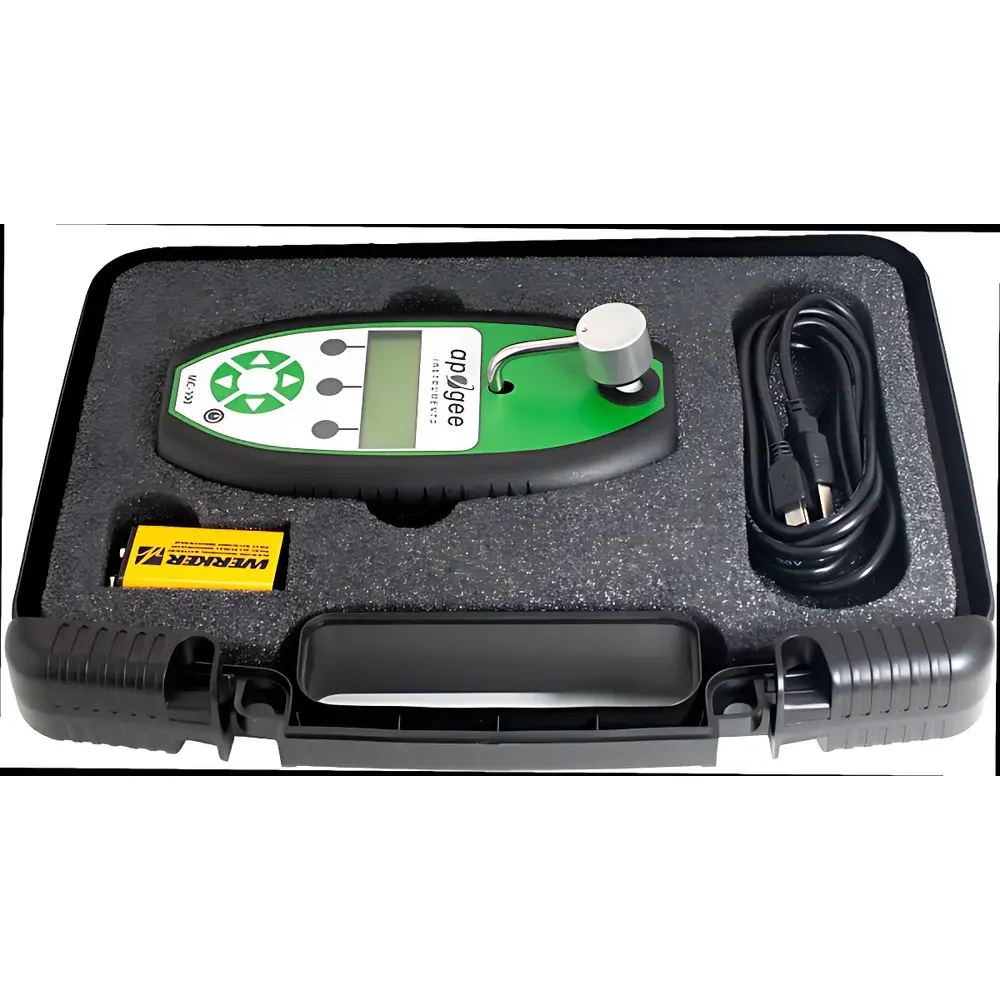
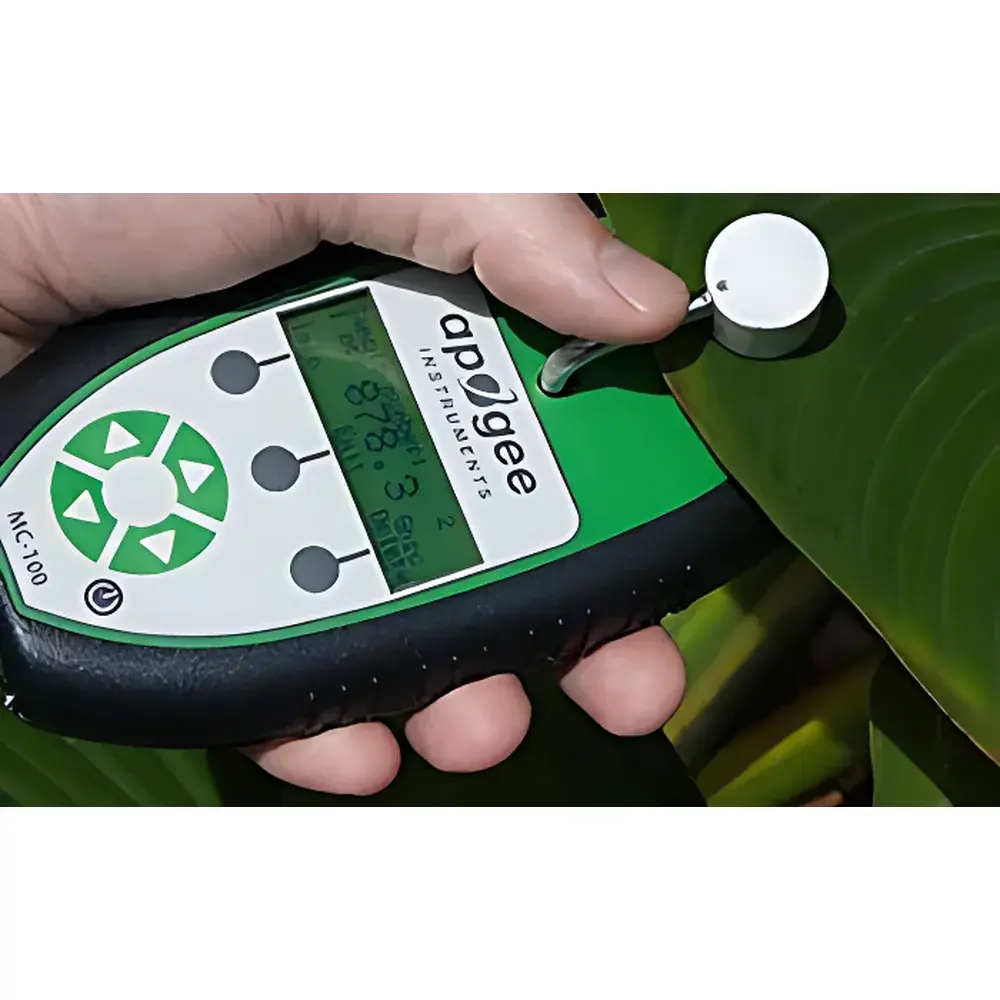
Apogee MC-100 Handheld Chlorophyll Meter
| Brand | Apogee |
|---|---|
| Origin | USA |
| Model | MC-100 |
| Measurement Unit | µmol chlorophyll m⁻² |
| Sampling Area | 63.6 mm² (9.0 mm diameter) / 19.6 mm² (5.0 mm reduced diameter) |
| Resolution | ±10 µmol m⁻² |
| Linearity | ±1% |
| Repeatability | ±1% |
| Sampling Time | 3 s |
| Memory Capacity | 94,000 measurements (8 MB internal) + 160,000 GPS-tagged records |
| Display | 125 × 37.5 px monochrome LCD |
| Interface | USB + RS-232 (GPS-integrated) |
| Operating Temperature | 0–50 °C with full-range thermal compensation |
| Power | 9 V DC alkaline battery |
| Dimensions | 152 × 82 × 25 mm |
| Warranty | 1-year limited warranty, lifetime technical support |
Overview
The Apogee MC-100 Handheld Chlorophyll Meter is a field-deployable, non-destructive optical instrument engineered for rapid, in situ quantification of leaf chlorophyll concentration expressed in absolute units (µmol chlorophyll per square meter of leaf area). Unlike traditional SPAD-style meters that report arbitrary, unitless indices, the MC-100 implements a physics-based dual-wavelength transmittance measurement principle—utilizing discrete red (650 nm) and near-infrared (940 nm) LEDs—to derive chlorophyll content via empirically validated optical absorption models. Its calibration is grounded in peer-reviewed research (Parry et al., Plant, Cell & Environment, 2014), which established the quantitative relationship between spectral transmittance and absolute chlorophyll mass per unit leaf area. This enables traceable, inter-laboratory comparable data essential for longitudinal physiological studies, environmental stress phenotyping, and precision agronomy applications.
Key Features
- Physically calibrated output: Reports chlorophyll concentration directly in µmol m⁻²—eliminating reliance on relative indices and enabling cross-species, cross-study quantitative comparison.
- Thermally compensated optics: Integrated temperature sensors and real-time compensation algorithms ensure stable performance across 0–50 °C ambient conditions without recalibration.
- Dual sampling aperture: Standard 9.0 mm (63.6 mm²) and optional 5.0 mm (19.6 mm²) apertures accommodate both broadleaf and narrow-leaf species—including grasses, conifer needles, and young seedlings—without signal saturation or edge artifacts.
- High repeatability architecture: Optimized LED driver stability, photodiode linearity, and fixed optical path geometry yield ±1% measurement repeatability under controlled conditions (n ≥ 10, same leaf position).
- Integrated geospatial logging: RS-232 interface supports synchronous acquisition of GPS coordinates with each measurement—critical for field mapping, plot-level monitoring, and GIS integration.
- Rugged field design: Compact form factor (152 × 82 × 25 mm), low-power operation (9 V alkaline, >10,000 readings per battery), and high-contrast monochrome display ensure reliability in direct sunlight and variable humidity.
Sample Compatibility & Compliance
The MC-100 is validated for use on intact, undamaged leaves of vascular plants—including dicots, monocots, and gymnosperms—with thicknesses up to 0.5 mm. It is not intended for senesced, wilted, or highly pubescent leaves where light scattering may exceed model assumptions. The instrument conforms to IEC 61000-4-2 (ESD immunity) and meets FCC Part 15 Class B emission limits for portable electronic instrumentation. While not certified to GLP or GMP standards per se, its deterministic calibration protocol, audit-ready data export (CSV via USB/RS-232), and timestamped/GPS-tagged records support compliance with ISO 17025-accredited laboratory workflows and USDA ARS field trial reporting requirements.
Software & Data Management
Data are stored internally in non-volatile memory (94,000 measurements) with optional GPS tagging (160,000 entries). Export is supported via USB mass-storage mode or RS-232 serial communication using ASCII-delimited text format compatible with Excel, R, Python (pandas), and GIS platforms (QGIS, ArcGIS). No proprietary software is required; raw files include columns for timestamp, latitude/longitude (WGS84), chlorophyll value (µmol m⁻²), aperture used, and instrument ID. Firmware updates are distributed as signed binary packages through Apogee’s technical support portal—ensuring version control and traceability in regulated environments.
Applications
- Environmental stress assessment: Quantifying chlorophyll decline under drought, heat, ozone exposure, or heavy metal contamination—serving as an early biomarker preceding visible symptomology.
- Fertilizer response trials: Evaluating nitrogen use efficiency (NUE) by tracking chlorophyll dynamics before and after foliar or soil-applied N treatments.
- Harvest timing optimization: Monitoring chlorophyll degradation kinetics in fruiting crops (e.g., tomatoes, grapes) to define optimal maturity windows aligned with post-harvest quality targets.
- Pest and disease screening: Detecting localized chlorosis associated with aphid infestation, fungal infection (e.g., powdery mildew), or viral pathogens prior to canopy-level spread.
- Genetic phenotyping: High-throughput screening of chlorophyll-related QTLs in breeding populations—leveraging its portability for repeated measurements across large field plots.
FAQ
Does the MC-100 require factory calibration before first use?
No—each unit ships with a NIST-traceable calibration certificate based on leaf-equivalent optical phantoms. Field verification using the included reference standard (certified absorbance filter) is recommended quarterly or after mechanical shock.
Can the MC-100 measure chlorophyll in algae or lichens?
Not reliably—the optical model assumes laminar mesophyll structure and known pigment matrix interactions found only in higher plant leaves. Algal suspensions or crustose lichens violate core assumptions of path-length and scattering behavior.
Is the GPS module internal or external?
The MC-100 has no built-in GPS receiver; it accepts NMEA 0183-formatted position data via RS-232 from external GNSS loggers (e.g., Garmin GPSMAP 66i, u-blox C94-M8P) synchronized at measurement trigger.
How does temperature compensation work?
Onboard thermistors monitor LED junction temperature and detector responsivity drift in real time. Compensation coefficients—derived from empirical thermal characterization across −10 to +60 °C—are applied to raw analog-to-digital converter outputs prior to chlorophyll calculation.
What is the minimum leaf thickness for accurate measurement?
Optimal performance is achieved on leaves ≥0.1 mm thick. Measurements on thinner tissues (e.g., epidermal peels) may exhibit elevated uncertainty due to incomplete light absorption and increased scattering noise.