
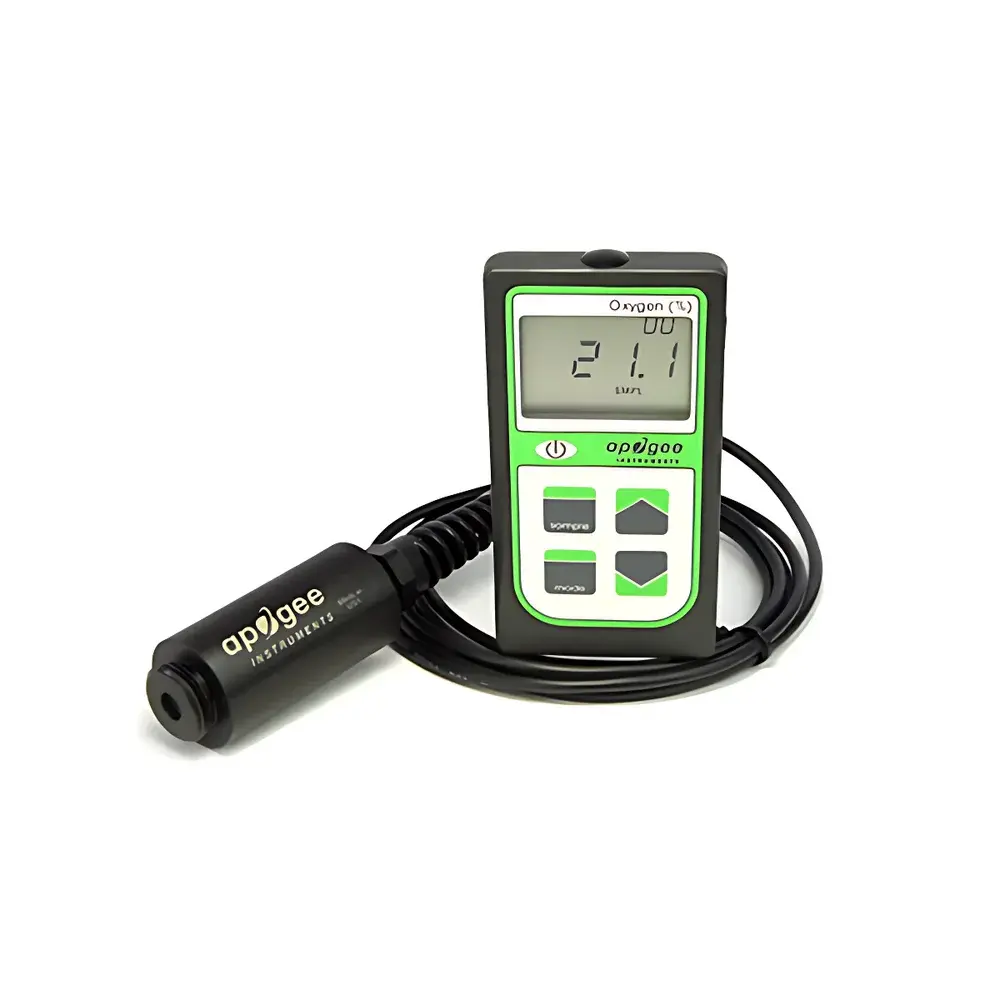
Apogee MO-200 Oxygen Concentration Analyzer
| Brand | Apogee |
|---|---|
| Origin | USA |
| Model | MO-200 |
| Measurement Principle | Electrochemical (Galvanic Cell) |
| Range | 5–100 % O₂ |
| Repeatability | ±0.1 % at 20.9 % O₂ |
| Nonlinearity | <1 % |
| Response Time (t₉₀) | 14 s |
| Operating Temperature | 0–50 °C |
| Relative Humidity Limit | <90 % RH |
| Pressure Range | 60–150 kPa |
| Gas Interference | Immune to CO₂, CO, NO, NO₂, H₂S, H₂, CH₄ |
| Probe Body Dimensions | Ø32 mm × 68 mm |
| Diffusion Cap (A0-001) | Ø35 mm × 35 mm |
| Flow-Through Cap (A0-002) | Ø32 mm × 91 mm |
| Cable Length | 2 m |
| Data Logger Capacity | 99 manual entries |
| Display Unit Dimensions | 126 mm × 70 mm × 24 mm |
| Integrated Temperature Sensor | Yes |
| Heated Membrane | Yes |
| Enclosure Material | Acid-resistant polymer |
| Compliance | CE-marked per EN 61326-1 (EMC), EN 61010-1 (Safety) |
Overview
The Apogee MO-200 Oxygen Concentration Analyzer is a field-deployable, electrochemical gas analyzer engineered for precise, real-time measurement of gaseous oxygen concentration across diverse environmental and industrial applications. Utilizing a self-powered galvanic cell principle—comprising a lead anode, gold cathode, aqueous electrolyte, and gas-permeable PTFE membrane—the instrument generates a current proportional to the partial pressure of O₂ diffusing through the membrane. This analog signal is conditioned via an internal Wheatstone bridge circuit to deliver a stable voltage output, enabling direct integration with data loggers, SCADA systems, or standalone monitoring setups. Designed for long-term unattended operation in challenging matrices—including compost piles, tailings storage facilities, soil profiles, climate chambers, and enclosed pipeline networks—the MO-200 delivers high reproducibility (±0.1 % at ambient air level) and rapid response (t₉₀ = 14 s), making it suitable for dynamic respiration studies, oxidation state tracking, and confined-space safety verification.
Key Features
- Galvanic electrochemical sensor with no external power requirement for sensing element—ensures intrinsic safety and low-maintenance operation.
- Integrated heating element on the PTFE diffusion membrane prevents condensation-induced signal drift during in-soil or high-humidity deployments.
- Chemically resistant probe housing formulated to withstand acidic environments (pH ≥ 3), supporting extended use in composting, mine waste, and wetland soils.
- Dual-configurable sensor caps: A0-001 diffusion cap for passive headspace or soil gas profiling; A0-002 flow-through cap for inline pipe or duct installation with regulated sample flow.
- Onboard temperature sensor enables automatic thermal compensation of O₂ signal—critical for accuracy across 0–50 °C operating range.
- Compact handheld readout unit with three-tiered memory architecture: 99 manually triggered readings, 99 time-weighted 30-minute averages, and 99 daily mean values—supporting GLP-aligned field documentation without external software.
Sample Compatibility & Compliance
The MO-200 is validated for use in non-corrosive, non-oxidizing gas streams where O₂ concentrations fall within 5–100 % by volume. It exhibits negligible cross-sensitivity to common atmospheric and process gases—including CO₂, CO, NO, NO₂, H₂S, H₂, and CH₄—enabling reliable deployment in biogas, landfill, and agricultural settings. Minor interference (<1 % signal deviation) occurs with NH₃, HCl, and benzene; however, exposure to SO₂ must be avoided due to irreversible electrode poisoning, and ozone (O₃) exposure permanently degrades membrane integrity. The device complies with EN 61010-1 (electrical safety) and EN 61326-1 (EMC) standards. While not intrinsically rated for Zone 0/1 hazardous areas, its galvanic design and absence of ignition sources permit use in Class I, Division 2 environments when installed per NEC Article 500 guidelines.
Software & Data Management
Data acquisition is performed directly via the integrated readout unit—no proprietary software required for basic operation. Voltage outputs (0–2.5 V DC, scalable to 0–100 % O₂) are compatible with third-party dataloggers supporting analog input (e.g., Campbell Scientific CR1000X, Onset HOBO UX120). All stored datasets include timestamp, temperature reading, and user-assigned ID. The memory structure supports audit-trail readiness: manual entries record operator-initiated timestamps; auto-averaged sets retain start/end times and sampling interval metadata. For laboratories operating under FDA 21 CFR Part 11 or ISO/IEC 17025 frameworks, external validation of the analog interface and manual logging procedures is recommended to fulfill electronic record integrity requirements.
Applications
- Soil respiration quantification via closed-chamber O₂ depletion kinetics, supporting carbon cycle modeling and microbial activity assessment.
- Oxidation-reduction potential (ORP) proxy monitoring in anaerobic digestion tanks and constructed wetlands.
- Long-term O₂ profiling in compost windrows to optimize aeration cycles and prevent thermophilic stall.
- Confined-space entry verification for maintenance crews in tunnels, silos, and fermentation vessels.
- Process gas monitoring in inerting systems, glove boxes, and pharmaceutical lyophilization chambers.
- Climate-controlled chamber validation for plant physiology and material aging studies.
FAQ
What calibration protocol is recommended for the MO-200?
A two-point calibration using certified zero gas (N₂ ≥ 99.999 %) and span gas (20.9 % O₂ in N₂) is advised prior to first use and every 3–6 months thereafter, depending on exposure frequency and environmental severity.
Can the MO-200 measure dissolved oxygen in water?
No—the MO-200 is strictly a gaseous-phase analyzer. Its galvanic cell requires direct gas-phase diffusion; liquid immersion will damage the membrane and electrolyte.
Is the sensor replaceable as a field-serviceable module?
Yes—the electrochemical cell is supplied as a sealed, pre-calibrated cartridge (part number MO-CELL-1). Replacement requires only mechanical unthreading of the probe cap and insertion of the new unit—no recalibration is needed if using Apogee-certified cells.
Does the readout unit support real-time USB or Bluetooth transmission?
No—the MO-200 readout operates as a standalone logger. Real-time telemetry requires connection to an external datalogger via its analog output port.
How does temperature compensation function internally?
The onboard thermistor measures probe tip temperature continuously; firmware applies a polynomial correction curve derived from factory characterization across the full 0–50 °C range, ensuring O₂ output stability independent of ambient thermal drift.
Related Products







