
Apogee MQ-100 / MQ-200 / MQ-306 Handheld Quantum Light Meters
| Brand | Apogee |
|---|---|
| Origin | USA |
| Model | MQ-100 / MQ-200 / MQ-306 |
| Spectral Range | 410–655 nm |
| PAR Measurement Range | 0–3000 µmol/m²/s |
| Field of View | 180° |
| Calibration Uncertainty | ±5% |
| Repeatability | <1% |
| Long-Term Drift | <2% per year |
| Nonlinearity | <1% (up to 3000 µmol/m²/s) |
| Response Time | <1 ms |
| Directional (Cosine) Error | ±5% at 75° zenith angle |
| Temperature Dependence | 0.06 ± 0.06 %/°C |
| Operating Environment | 0–50 °C, ≤90% RH non-condensing |
| Waterproof Rating | IP68 (MQ-200, MQ-301, MQ-303, MQ-306 probe) |
| Data Logging | Manual (99 samples) or Automatic (30-sec measurement interval, 30-min averaging, 99 daily means) |
| Display | Integrated LCD |
| Interface | AC-100 USB cable |
| Power | CR2320 coin cell (MQ-100/MQ-200), CR2477 (MQ-301/MQ-303/MQ-306) |
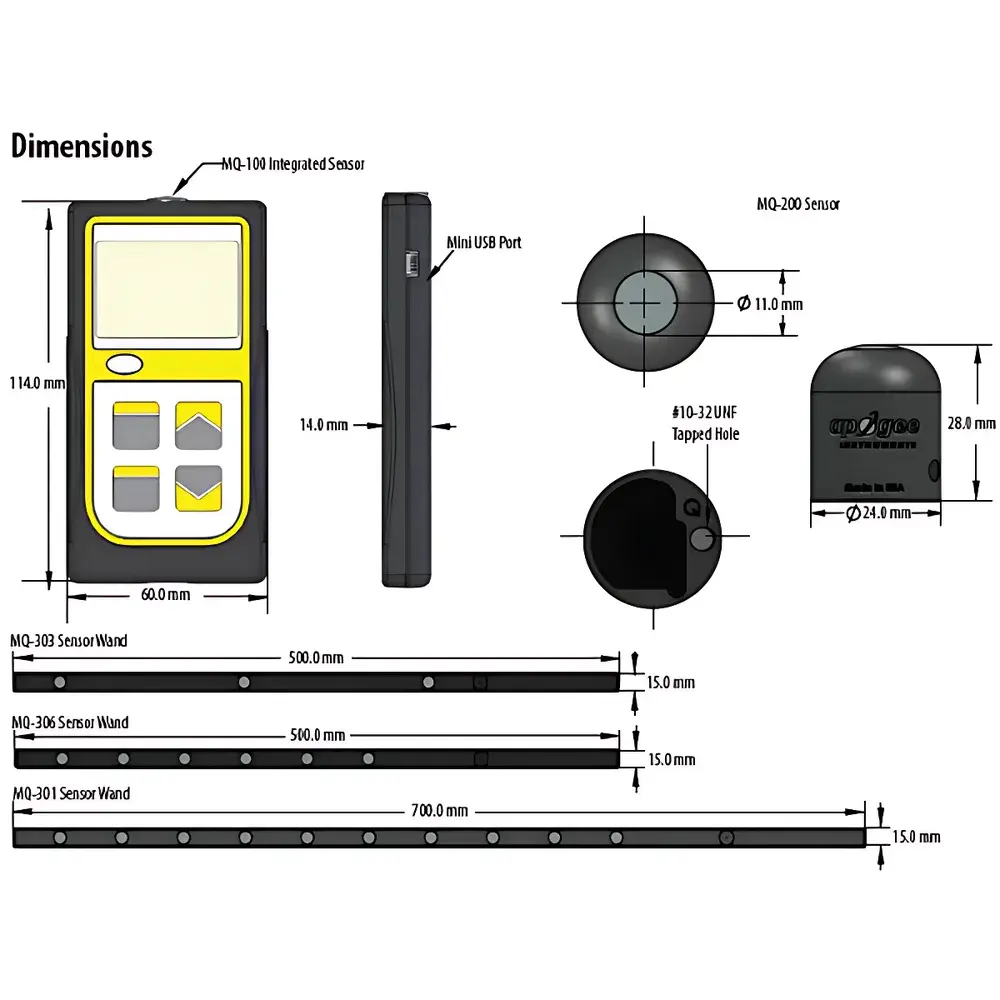
| Dimensions (Meter) | 125 × 70 × 24 mm |
| Weight (Meter) | 150 g (MQ-100), 180 g (MQ-200), 380 g (MQ-301), 300 g (MQ-303/MQ-306) |
| Probe Count | 1 (MQ-100/MQ-200), 10 (MQ-301), 3 (MQ-303), 6 (MQ-306) |
| Probe Cable Length | None (MQ-100), 2 m or 5 m (MQ-200), 70 cm rod (MQ-301), 50 cm rod (MQ-303/MQ-306) |
Overview
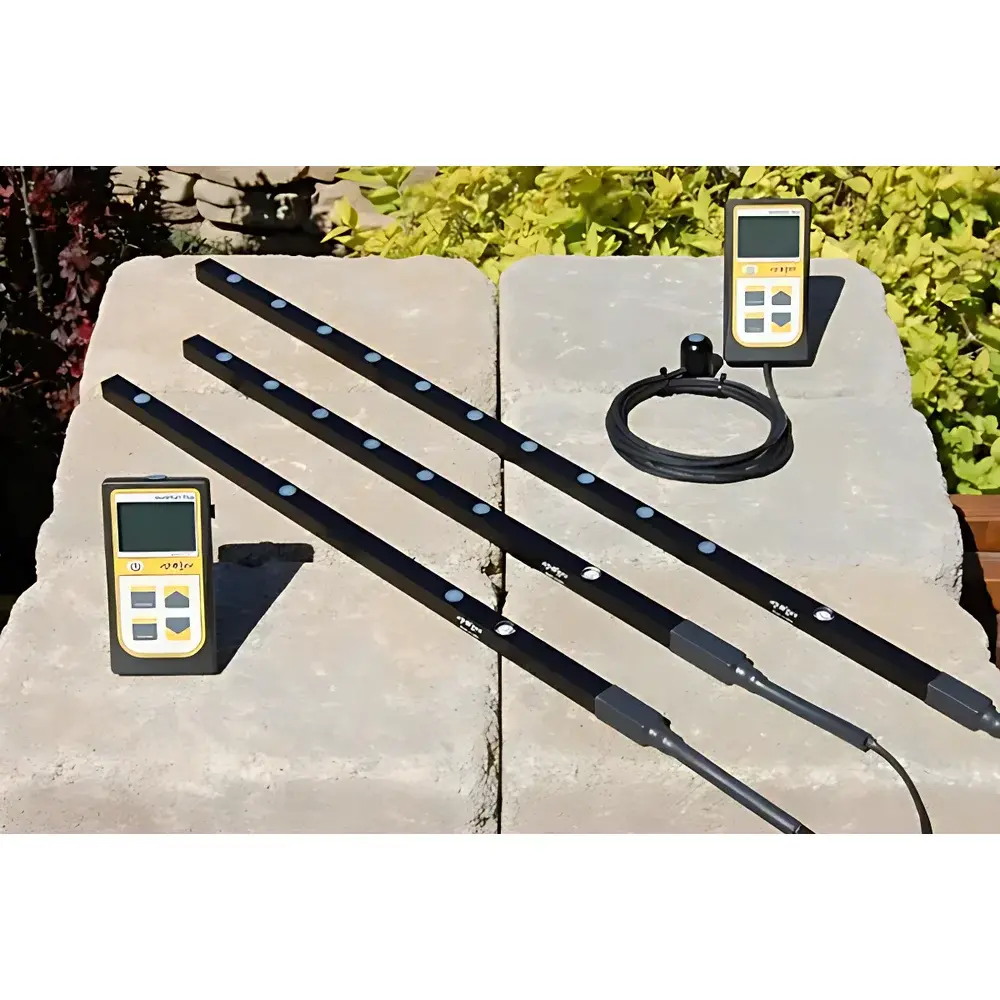
The Apogee MQ-100, MQ-200, and MQ-306 are handheld quantum light meters engineered for precise, field-deployable measurement of photosynthetically active radiation (PAR) across the biologically relevant spectral band of 410–655 nm. These instruments quantify photon flux density as photosynthetic photon flux density (PPFD) in units of µmol/m²/s—critical for plant physiology research, controlled-environment agriculture, greenhouse management, and ecological monitoring. Each model employs a thermally stable silicon photodiode coupled with a proprietary blue-enhanced optical filter that minimizes spectral mismatch errors against natural daylight (direct, diffuse, and canopy-reflected), fluorescent, metal halide, and high-pressure sodium lamps (±5% uncertainty). For modern LED lighting systems—including narrowband blue, green, red, and broad-spectrum white variants (cool, neutral, warm)—the sensors maintain measurement fidelity within ±10% uncertainty. Unlike conventional flat-diffuser quantum sensors, Apogee’s patented curved diffuser geometry improves cosine response, reducing angular error to ±5% even at 75° zenith angle—a critical performance attribute for accurate hemispherical irradiance integration under variable sky conditions or canopy architectures.
Key Features
- Optimized spectral response: 410–655 nm PAR band with blue-enhanced filter for minimal spectral mismatch across diverse artificial and natural light sources.
- High-fidelity cosine correction: Spherically contoured diffuser reduces directional error, ensuring robust performance under low-angle illumination typical in dawn/dusk or dense canopy scenarios.
- Multi-tier data logging: Supports manual capture of up to 99 single-point measurements; automatic mode records every 30 seconds and stores 30-minute averaged values—up to 99 daily means—with onboard LCD display for real-time verification.
- Environmental resilience: IP68-rated probes (MQ-200, MQ-301, MQ-303, MQ-306) enable submersion up to 30 m depth; MQ-100 meter body is IP67-rated for rain and high-humidity operation.
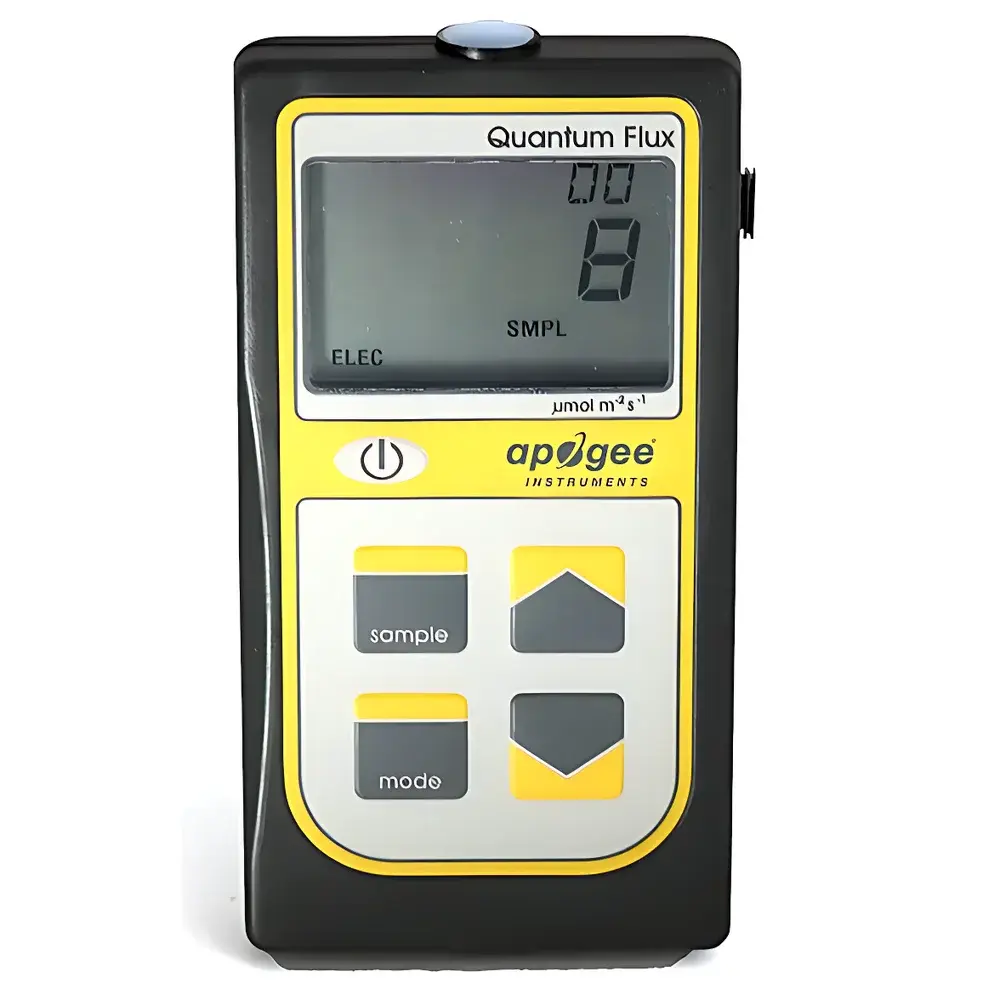
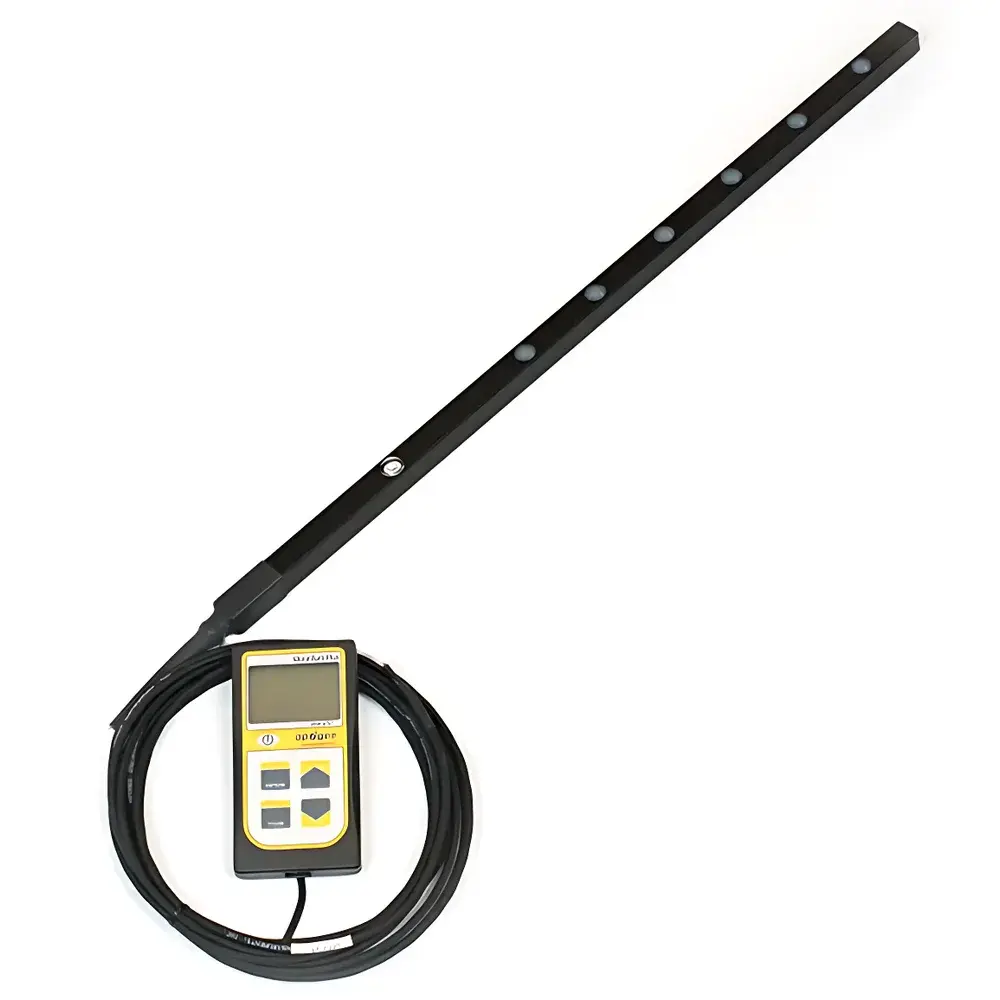
- Modular deployment options: MQ-100 integrates sensor and meter in a pocket-sized unit (125 × 70 × 24 mm, 150 g); MQ-200 separates sensor and display via 2 m or 5 m shielded cable; MQ-301/303/306 feature rigid, waterproof linear probe rods (70 cm / 50 cm) with 10, 3, or 6 co-calibrated sensors respectively for spatial PAR profiling.
- Traceable calibration: Supplied with NIST-traceable certificate; long-term stability <2% per year; temperature compensation applied in firmware (0.06 ± 0.06 %/°C).
Sample Compatibility & Compliance
The MQ series is validated for use across agricultural, horticultural, and limnological applications where quantitative PAR characterization is required under GLP-aligned protocols. Sensor spectral responsivity complies with ISO 17166:2022 (CIE S 026/E:2019) recommendations for plant photobiology instrumentation. The integrated data logging architecture supports audit-ready workflows: timestamped measurements, user-defined session identifiers, and exportable CSV files via AC-100 USB interface facilitate traceability in USDA-NRCS, EPA, or university-based field trials. While not FDA 21 CFR Part 11–certified out-of-box, raw data files and metadata (including calibration date, serial number, and environmental context) meet minimum requirements for scientific reproducibility under ASTM E2912–22 (Standard Guide for Measuring Photosynthetic Photon Flux Density). All models operate reliably within 0–50 °C and ≤90% non-condensing relative humidity—suitable for greenhouse, growth chamber, open-field, and shallow aquatic deployments.
Software & Data Management
Data retrieval is accomplished using the AC-100 USB cable and Apogee’s freely distributed MQ Logger software (Windows/macOS compatible), which enables batch download, time-series visualization, and export to CSV or Excel formats. No proprietary drivers are required—the device appears as a standard HID-compliant serial interface. Each logged entry includes UTC timestamp, PPFD value, measurement mode (manual/automatic), and battery voltage. Daily mean calculations are performed internally and stored separately from raw 30-second samples, supporting rapid assessment of diurnal integrals without post-processing. For integration into larger IoT or SCADA ecosystems, Apogee provides documented ASCII command protocol over USB virtual COM port—enabling custom scripting in Python, LabVIEW, or MATLAB for automated calibration validation, remote polling, or synchronization with environmental loggers (e.g., Vaisala HMP155, Onset HOBO U23).
Applications
- Greenhouse light mapping: Deploy MQ-306’s six-sensor rod horizontally above crop canopies to quantify spatial uniformity of supplemental LED arrays and identify shadow zones requiring repositioning.
- Aquatic primary productivity studies: Use MQ-200 with AM-310/AM-320 telescoping probe handles to profile underwater PPFD attenuation in mesocosms or shallow ponds—validated to 30 m depth with minimal pressure-induced drift.
- Controlled-environment agriculture (CEA) validation: Verify spectral output and photon delivery rates of vertical farming fixtures using MQ-100’s pocket-portable form factor for rapid spot checks across rack levels.
- Phenotyping platform integration: Mount MQ-301’s 10-sensor 70-cm rod on robotic gantries to acquire high-resolution vertical PAR gradients through maize or tomato canopies during growth stage transitions.
- Ecophysiology field campaigns: Combine MQ-200 with AL-100 probe-level leveling base and AL-210 meter base to maintain geometric consistency across multi-site transects under variable terrain and vegetation structure.
FAQ
What is the difference between PPFD and irradiance (W/m²)?
PPFD (photosynthetic photon flux density) quantifies the number of photons in the 400–700 nm range incident on a surface per unit area per second (µmol/m²/s), directly correlating with photosynthetic capacity. Irradiance (W/m²) measures total radiant power, irrespective of wavelength weighting—making it unsuitable for predicting biological response.
Can the MQ-100 be used underwater?
No—the MQ-100 sensor is integrated into the meter housing and rated IP67 (rainproof, not submersible). For underwater use, select MQ-200, MQ-301, MQ-303, or MQ-306, all featuring IP68-rated probes.
How often does the sensor require recalibration?
Apogee recommends annual recalibration against a reference standard to maintain ±5% accuracy; long-term drift is specified at <2% per year under normal operating conditions.
Is the data logger compliant with FDA 21 CFR Part 11?
The standalone MQ meters do not include electronic signature, audit trail, or role-based access control features required for Part 11 compliance. However, exported CSV files retain full metadata and may be incorporated into validated LIMS or ELN systems meeting regulatory requirements.
Does the blue-enhanced filter affect measurement of far-red (700–750 nm) light?
Yes—the MQ series is explicitly limited to 410–655 nm and excludes far-red wavelengths. For extended-range phytochrome-weighted measurements (e.g., R:FR ratio), Apogee’s SQ series quantum sensors are recommended.
Related Products







