
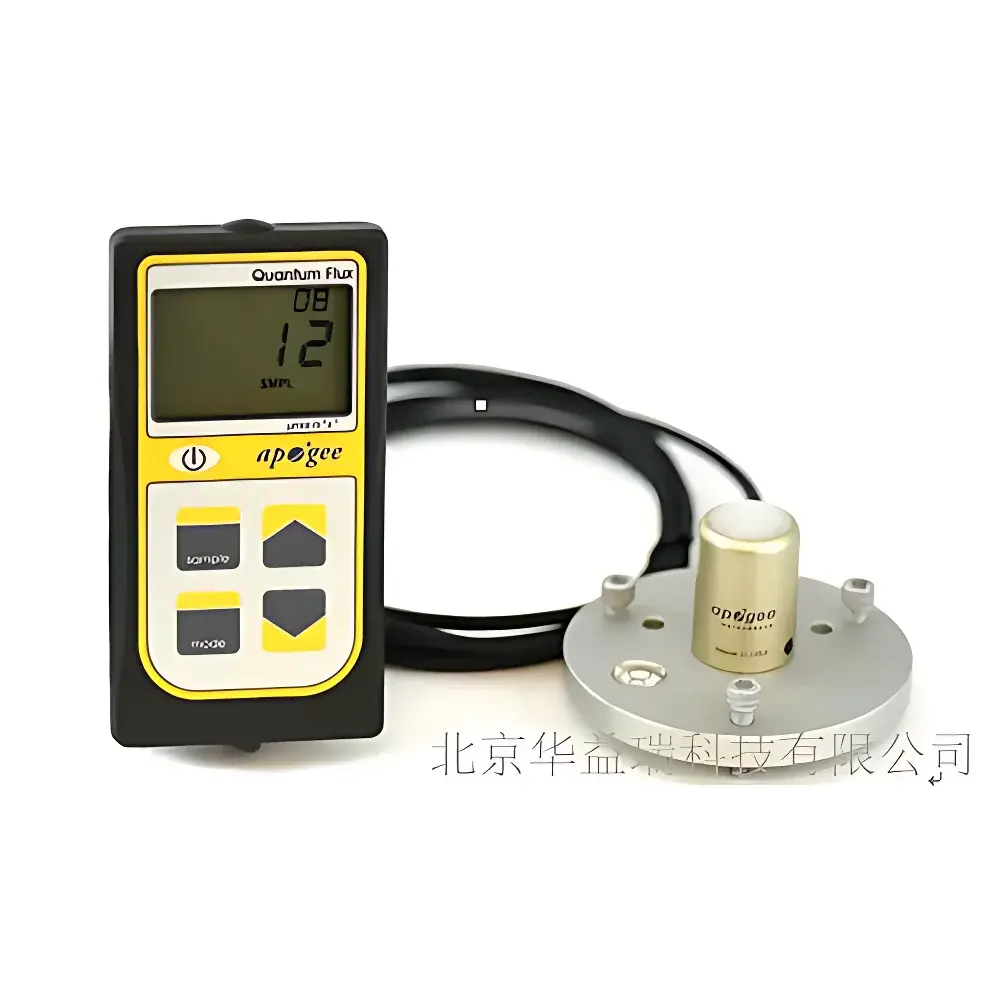
Apogee MQ500 Handheld Quantum Meter
| Brand | Apogee |
|---|---|
| Origin | USA |
| Model | MQ500 |
| Measurement Uncertainty | ±5% |
| Measurement Range | 0–4000 µmol·m⁻²·s⁻¹ |
| Long-term Drift | <2% per year |
| Repeatability | <0.5% |
| Nonlinearity | <1% |
| Response Time | <1 ms |
| Field of View | 180° |
| Spectral Range | 389–692 nm ±5 nm |
| Spectral Selectivity | <10% (412–692 nm ±5 nm) |
| Azimuthal Error | <0.5% |
| Tilt Error | <0.5% |
| Temperature Response | −0.11±0.04 %·°C⁻¹ |
| Ingress Protection Rating | IP68 |
| Dimensions | 24 mm (diameter) × 37 mm (height) |
| Mass | 100 g (including 5 m cable) |
Overview
The Apogee MQ500 Handheld Quantum Meter is a precision optical instrument engineered for accurate, field-deployable measurement of photosynthetically active radiation (PAR) in the 400–700 nm waveband—expressed as photosynthetic photon flux density (PPFD) in units of µmol·m⁻²·s⁻¹. Unlike broadband radiometers or filtered photodiodes lacking spectral fidelity, the MQ500 employs a silicon photodiode with a custom interference filter and cosine-corrected diffuser to deliver spectrally weighted quantum response aligned with the CIE-defined phytochrome action spectrum. Its optical design minimizes angular dependence across hemispherical irradiance conditions, enabling reliable PAR quantification under direct sun, diffuse skylight, and artificial lighting—including LED, fluorescent, and HID sources common in controlled-environment agriculture (CEA), greenhouse horticulture, and ecological field studies. The device operates on passive analog signal conditioning with no internal battery or firmware—ensuring zero self-heating artifact, minimal calibration drift, and intrinsic compliance with long-term monitoring requirements.
Key Features
- High-fidelity quantum sensor calibrated traceably to NIST-standard reference lamps, with spectral responsivity optimized for the 389–692 nm range (±5 nm tolerance) and peak sensitivity centered at ~550 nm.
- Cosine-corrected optical head with 180° field of view and azimuthal/tilt errors <0.5%, validated per ISO 9060:2018 Class C specifications for directional response uniformity.
- IP68-rated housing ensures full submersion resistance (up to 1 m for 30 min), enabling deployment in high-humidity greenhouses, hydroponic chambers, rainforest understory, and outdoor agronomic plots without protective enclosures.
- Sub-millisecond electrical response time (<1 ms) captures rapid irradiance transients—critical for dynamic light environment characterization, such as cloud flicker analysis or pulsed LED lighting evaluation.
- Thermal stability characterized by temperature coefficient of −0.11±0.04 %·°C⁻¹, allowing ambient-temperature compensation via optional Apogee SDI-12 or USB interface modules when integrated into automated data logging systems.
- Compact form factor (24 mm diameter × 37 mm height, 100 g with 5 m shielded cable) facilitates handheld spot measurements, tripod mounting, or integration into multi-sensor phenotyping rigs.
Sample Compatibility & Compliance
The MQ500 is designed for non-contact, non-destructive irradiance assessment across diverse sample geometries and environmental contexts: flat canopies, vertical farming towers, seedling trays, aquatic mesocosms, and soil surface microsites. It does not require sample preparation or optical coupling. Its spectral selectivity (<10% outside 412–692 nm ±5 nm) ensures minimal contribution from UV-A and far-red photons beyond the PAR band—supporting ISO 21348 definitions of photosynthetic photon flux. The sensor conforms to ASTM E2919-22 (Standard Practice for Calibration of Quantum Sensors) and supports GLP-compliant documentation workflows when used with Apogee’s certified calibration reports (NIST-traceable, valid for 2 years). No regulatory restrictions apply to its use in USDA-ARS trials, EU Horizon agri-tech projects, or commercial GMP-aligned cultivation facilities.
Software & Data Management
The MQ500 outputs an analog voltage signal (0–2.5 V) proportional to PPFD, compatible with any data logger supporting millivolt or voltage input channels (e.g., Campbell Scientific CR series, Onset HOBO UX120, Delta-T Devices DL2e). Apogee provides free, open-format calibration coefficients (slope and offset) for linear conversion to µmol·m⁻²·s⁻¹. When paired with Apogee’s AM-100 or AC-100 interface modules, the meter supports SDI-12 or USB-C communication, enabling time-stamped data export in CSV or Excel-compatible formats. All raw datasets retain full audit trail metadata—including sensor serial number, calibration date, and user-defined location tags—facilitating 21 CFR Part 11–aligned electronic records where required for regulated crop science applications.
Applications
- Canopy-level PAR mapping in field trials to quantify light interception efficiency and guide planting density optimization.
- LED grow light spectral validation and uniformity testing across vertical farm racks per ASABE S675.1 standards.
- Long-term PPFD trend analysis in climate-controlled phytotrons, supporting DOE-funded photosynthesis modeling initiatives.
- Under-canopy light profiling in orchard and forest ecology studies to assess shade tolerance thresholds of native species.
- Calibration transfer between laboratory-grade spectroradiometers and portable quantum sensors in multi-site agronomy networks.
- Real-time feedback control in adaptive lighting systems using closed-loop PPFD setpoints derived from MQ500 output signals.
FAQ
Is the MQ500 suitable for underwater PAR measurements?
Yes—the IP68 rating and epoxy-sealed optical head permit short-term immersion; however, water’s refractive index alters cosine response, so measurements should be corrected using published immersion factors or conducted above water with representative geometry.
Does the sensor require periodic recalibration?
Apogee recommends recalibration every 2 years for research-grade accuracy; long-term drift is specified at <2% per year, verified via intercomparison against primary standards in accredited labs.
Can the MQ500 distinguish between photosynthetic photon flux (PPF) and yield photon flux (YPF)?
No—it measures total photons in the 389–692 nm band as PPFD, not YPF (which weights 400–750 nm by photosynthetic efficiency curves); users requiring YPF must apply post-processing spectral weighting algorithms to concurrent spectroradiometric data.
What is the minimum measurable irradiance level with reliable signal-to-noise ratio?
At 0.1 µmol·m⁻²·s⁻¹, the output signal exceeds typical data logger noise floors (≤10 µV) when using 24-bit ADC resolution, supporting low-light applications such as shaded understory or moonlight-influenced circadian studies.
How is cosine correction validated for this sensor?
Each production batch undergoes angular response testing at 0° to 80° incidence angles under collimated light; measured deviations from ideal cosine law are documented in individual calibration certificates and remain <0.5% RMS error across the full 180° hemisphere.







