
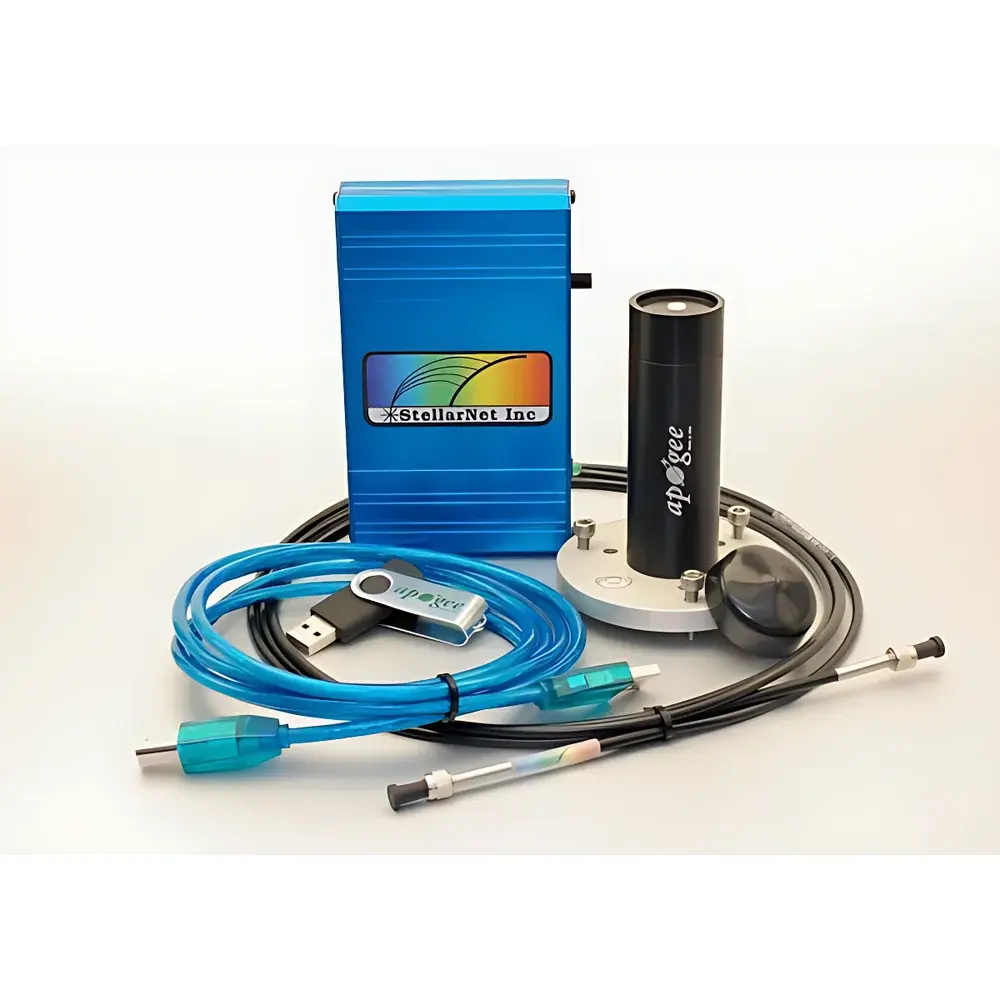
Apogee PS-100 Visible-Near Infrared Spectrometer
| Brand | Apogee |
|---|---|
| Origin | USA |
| Manufacturer Type | Authorized Distributor |
| Origin Category | Imported |
| Model | PS-100 |
| Price | Upon Request |
| Spectral Range | 350–1150 nm |
| Calibration Range | 350–1000 nm |
| Wavelength Resolution | 1 nm |
| Detector | 2048-pixel CCD |
| Grating | 600 g/mm |
| Analog-to-Digital Conversion | 16-bit |
| Signal-to-Noise Ratio | 1000:1 |
| Stray Light | 0.1% at 435 nm |
| Repeatability | <1% |
| Radiometric Accuracy | ±10% |
| Integration Time | 1 ms – 65 s |
| Angular Response (up to 80°) | ±5% |
| Interface | USB 2.0 |
| Power Supply | 5 V DC / 100 mA via USB |
| Operating Temperature | 0–60 °C |
| Fiber Optic Cable Length | 2 m |
| Dimensions | 25 × 75 × 125 mm |
| Weight | 500 g |
Overview
The Apogee PS-100 Visible-Near Infrared (Vis-NIR) Spectrometer is a compact, field-deployable optical instrument engineered for high-fidelity spectral radiance and irradiance measurements across the 350–1150 nm range. Based on a fixed-grating, CCD-based dispersive architecture, the PS-100 employs a 2048-pixel linear CCD detector coupled with a 600 grooves/mm holographic grating to deliver consistent 1 nm spectral resolution. Its optical design minimizes stray light—measured at ≤0.1% at 435 nm and ≤0.5% at 600 nm—ensuring reliable quantification in ambient and variable-light environments. The spectrometer operates without external power: powered solely via USB 2.0 (5 V DC / 100 mA), it supports integration times from 1 millisecond to 65 seconds, enabling flexible adaptation to low-light reflectance studies or high-intensity solar irradiance monitoring. Designed for rugged portability, its aluminum alloy housing (25 × 75 × 125 mm, 500 g) meets operational requirements for vehicle-mounted, handheld, and emergency-response deployments in environmental monitoring applications.
Key Features
- Full-spectrum coverage from ultraviolet-A through visible to near-infrared (350–1150 nm), with NIST-traceable calibration validated from 350–1000 nm
- High linearity and repeatability (<1% intensity variation over repeated acquisitions under stable conditions)
- Integrated cosine-corrected irradiance collector with black anodized cap—optimized for hemispherical light capture and compliant with ISO/CIE angular response standards
- USB-powered operation eliminates need for auxiliary batteries or external power supplies—ideal for mobile labs and rapid-deployment scenarios
- Robust mechanical design rated for continuous operation between 0 °C and 60 °C, including vehicular cabin environments and outdoor field use
- Comprehensive accessory kit: 2-meter low-OH silica fiber optic cable, leveling mounting bracket, telescoping handheld extension pole, protective carry case, and factory calibration certificate
Sample Compatibility & Compliance
The PS-100 is not a sample-contact instrument but a non-invasive optical sensor designed for remote measurement of spectral irradiance (W·m⁻²·nm⁻¹) and relative reflectance (%). It interfaces with natural surfaces—including soil, vegetation canopies, water bodies, snowpack, and man-made materials—via fiber-optic coupling and cosine-corrected optics. Its angular response (±5% up to 80° incidence) conforms to CIE Publication No. 15 and ISO 9060:2018 Class A specifications for broadband irradiance sensors. While the device itself does not require regulatory certification as a medical or safety-critical system, its calibration methodology adheres to ASTM E275 and ISO/IEC 17025 principles. Data generated using the PS-100 may support GLP-compliant environmental reporting when paired with documented chain-of-custody procedures and version-controlled software acquisition logs.
Software & Data Management
The PS-100 ships with Apogee’s proprietary SpectraSuite™ acquisition and analysis software (Windows-compatible, USB driver included), supporting real-time spectral preview, batch acquisition scheduling, dark-current subtraction, and user-defined calibration curve application. All spectral data are exported in ASCII CSV format—compatible with MATLAB, Python (NumPy/Pandas), R, and ENVI—enabling traceable post-processing workflows. The software enforces metadata tagging (timestamp, integration time, GPS coordinates if externally synchronized, operator ID), facilitating audit-ready data packages. Though the PS-100 does not implement FDA 21 CFR Part 11 electronic signature controls natively, its raw output files and acquisition logs can be integrated into validated LIMS or ELN platforms meeting GxP requirements.
Applications
- Field-based vegetation indices (e.g., NDVI, PRI, REIP) for precision agriculture and ecosystem health assessment
- Solar spectral irradiance profiling for PV performance modeling and atmospheric transmittance validation
- Water quality surrogate estimation (chlorophyll-a, CDOM, turbidity) via reflectance spectroscopy
- Soil organic matter and moisture content screening using Vis-NIR chemometric correlations
- Rapid contamination detection (e.g., hydrocarbon films, algal blooms) during environmental incident response
- Educational laboratory instruction in optical physics, remote sensing fundamentals, and spectroscopic instrumentation
FAQ
Is the PS-100 suitable for underwater spectral measurements?
No—the standard configuration includes a cosine-corrected irradiance head rated for air use only. Submersible deployment requires third-party waterproof housing and refractive index correction; Apogee does not validate or warranty such modifications.
Can the PS-100 be triggered externally via TTL or GPIO?
No—acquisition is software-controlled only via USB command protocol. Hardware triggering is not supported in the current firmware revision.
Does the calibration certificate include uncertainty budgets?
Yes—the included NIST-traceable certificate specifies expanded uncertainty (k=2) for spectral responsivity across the 350–1000 nm band, derived from Apogee’s ISO/IEC 17025-accredited calibration facility.
What is the recommended recalibration interval?
Annual recalibration is advised for quantitative applications requiring metrological continuity; biannual verification is acceptable for qualitative trend monitoring under stable operating conditions.
Is the fiber optic cable replaceable with custom lengths or connector types?
Yes—Apogee offers optional SMA-terminated fibers up to 10 meters in length; however, longer cables increase attenuation above 900 nm and may degrade signal-to-noise ratio beyond specification limits.
Related Products







