
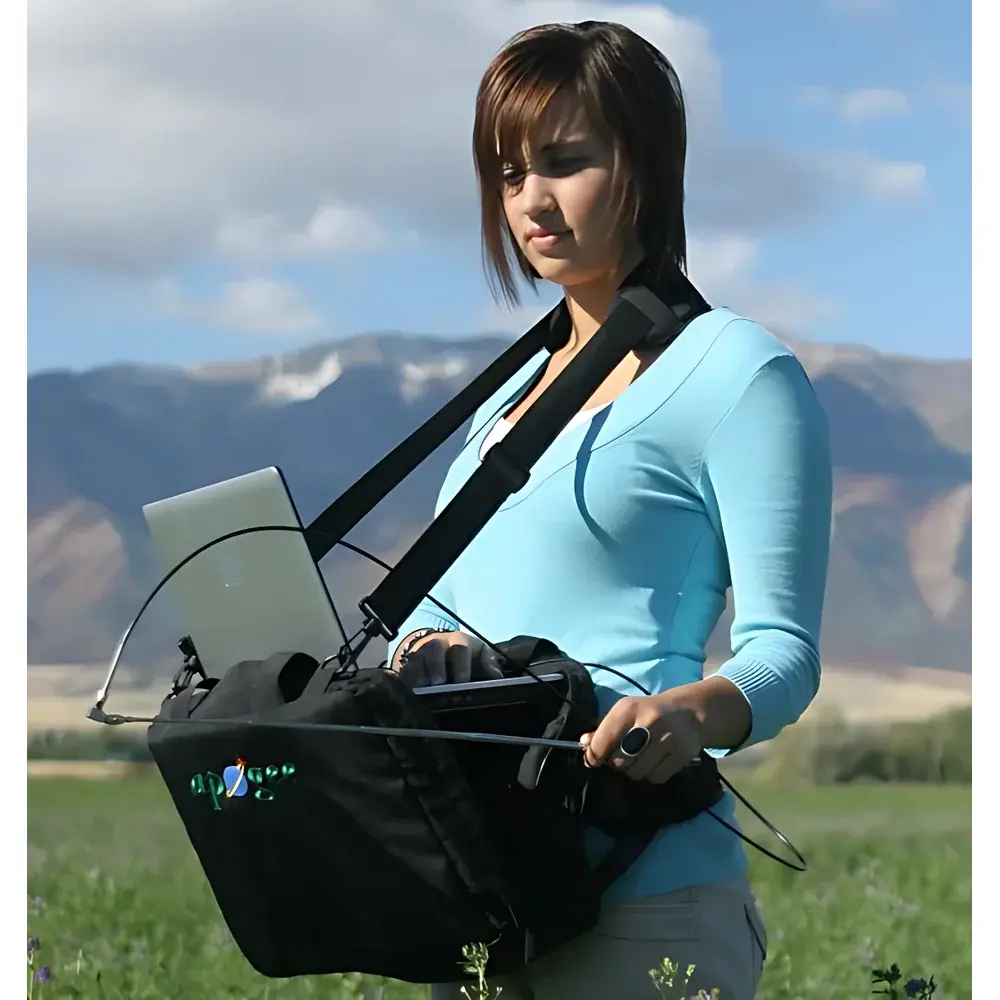
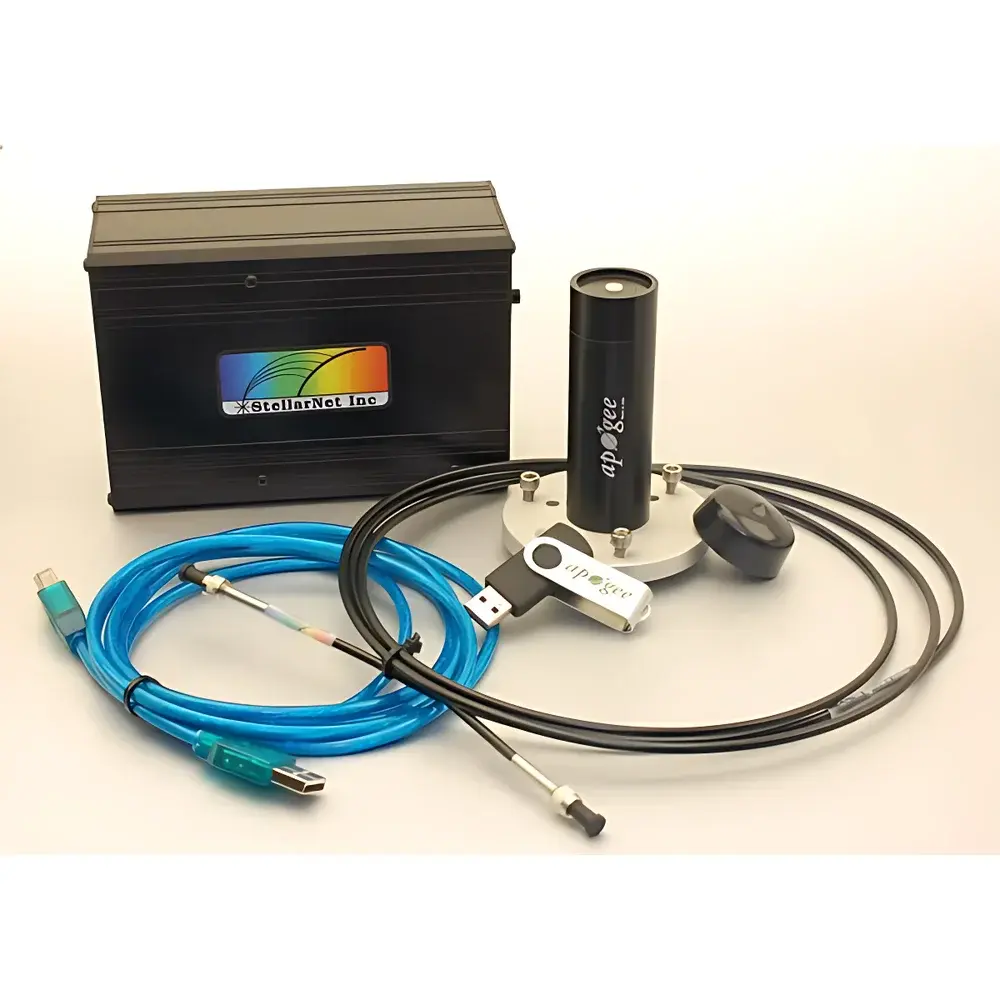
Apogee PS-200 UV-Vis Spectrometer
| Brand | Apogee |
|---|---|
| Origin | USA |
| Model | PS-200 |
| Spectral Range | 190–850 nm |
| Calibration Wavelength Range | 300–850 nm |
| Wavelength Resolution | 0.85 nm |
| Detector | 2048-pixel CCD |
| Grating Density | 590 lines/mm |
| A/D Conversion | 16-bit |
| Signal-to-Noise Ratio | 1000:1 |
| Stray Light | 0.02% at 435 nm |
| Repeatability | <1% |
| Radiometric Accuracy | ±10% |
| Integration Time | 1 ms – 65 s |
| Angular Response (up to 80°) | ±5% |
| Interface | USB 2.0 |
| Power Supply | 5 V DC / 100 mA via USB |
| Operating Temperature | 0–60 °C |
| Optical Fiber Length | 2 m |
| Dimensions | 69 × 100 × 150 mm |
| Weight | 900 g |
Overview
The Apogee PS-200 UV-Vis Spectrometer is a compact, high-performance benchtop spectrometer engineered for quantitative and qualitative spectral analysis across the ultraviolet, visible, and near-visible spectral regions. Based on a fixed-grating Czerny-Turner optical architecture with a 2048-pixel linear CCD array detector, the PS-200 delivers stable, reproducible absorbance, transmittance, reflectance, and irradiance measurements from 190 nm to 850 nm. Its optimized optical path minimizes aberrations and thermal drift, supporting consistent data acquisition in both laboratory and field-deployable configurations. The instrument operates without external cooling or mechanical shuttering—relying instead on precision optical alignment, thermally stabilized electronics, and real-time dark-current compensation algorithms. Designed for integration into analytical workflows requiring regulatory traceability, the PS-200 supports calibration traceable to NIST-traceable standards and complies with fundamental design principles outlined in ISO/IEC 17025 for testing laboratories.
Key Features
- Full UV-Vis spectral coverage (190–850 nm) with calibrated response from 300–850 nm, enabling broad-spectrum characterization of organic chromophores, transition metal complexes, and semiconductor absorption edges.
- High optical resolution of 0.85 nm (FWHM), achieved through a 590 lines/mm holographic grating and optimized slit geometry—sufficient to resolve adjacent absorption peaks in pharmaceutical excipient analysis and dye formulation QC.
- 16-bit analog-to-digital conversion paired with >1000:1 signal-to-noise ratio (at 1 s integration) ensures robust low-light performance for dilute sample measurements and fluorescence emission profiling.
- Integrated cosine-corrected irradiance probe with black anodized cap enables compliant radiometric measurements per CIE S 025/E:2015 and ASTM E308-22, suitable for LED spectral power distribution (SPD) validation and daylight simulation verification.
- USB-powered operation (5 V DC / 100 mA) eliminates need for auxiliary power supplies—ideal for mobile labs, cleanroom carts, and teaching environments where electrical infrastructure is constrained.
- Rugged aluminum housing (69 × 100 × 150 mm, 900 g), IP54-rated optical port sealing, and shock-absorbing transport case support repeated deployment in industrial QA/QC settings and outdoor photobiological safety assessments.
Sample Compatibility & Compliance
The PS-200 accommodates diverse sample geometries via interchangeable fiber-optic coupling: cuvette holders (10 mm pathlength), integrating spheres (for diffuse reflectance), liquid flow cells, and free-space irradiance probes. It meets essential requirements for method validation under USP , EP 2.2.25, and ISO 6502 for spectrophotometric assays. While not pre-certified for FDA 21 CFR Part 11, its software architecture supports audit-trail-enabled data logging, electronic signature integration, and export of raw spectra in ASCII or CSV formats—facilitating compliance with GLP and GMP documentation protocols. Stray light performance (<0.02% at 435 nm) satisfies ASTM E275-21 criteria for high-accuracy absorbance linearity in concentration determination.
Software & Data Management
The PS-200 ships with Apogee’s SpectraSuite™ acquisition and analysis suite (Windows/macOS compatible), offering real-time spectral visualization, multi-curve overlay, peak identification with wavelength/height/FWHM reporting, and customizable calibration curve generation (linear, quadratic, cubic, or user-defined). Raw data files include embedded metadata (integration time, temperature sensor reading, firmware version, serial number) to satisfy ALCOA+ data integrity principles. Export options include PNG, SVG, and XML-based JDX format for LIMS interoperability. Driver-level SDK (C/C++, Python, LabVIEW) enables OEM integration into automated platforms—e.g., inline process monitoring systems or robotic sample-handling workstations.
Applications
- Quantitative analysis of nitrate, phosphate, and heavy metals in environmental water samples using EPA-approved UV-Vis methods (e.g., EPA 365.3, 366.1).
- Stability-indicating assay development for small-molecule APIs, including forced degradation studies monitored at multiple wavelengths.
- Spectral characterization of OLED emissive layers, quantum dot dispersions, and anti-reflective coatings during R&D and pilot-scale manufacturing.
- Educational use in undergraduate physical chemistry labs for Beer-Lambert law validation, kinetics experiments (e.g., iodine clock reaction), and molecular orbital energy gap estimation.
- Photobiological safety testing per IEC 62471, including actinic UV hazard (200–400 nm) and blue-light hazard (300–700 nm) weighted irradiance calculations.
FAQ
Is the PS-200 compliant with ISO/IEC 17025 for accredited testing laboratories?
Yes—the instrument’s calibration certificate includes uncertainty budgets traceable to NIST SRMs, and its performance specifications align with ISO/IEC 17025 clause 6.4.3 for measurement equipment fitness-for-purpose.
Can the PS-200 be used for absorbance measurements in 1-cm quartz cuvettes?
Yes—when coupled with Apogee’s optional fixed-pathlength cuvette holder (PS-CV10), the system maintains optical alignment stability across 190–850 nm with <0.5% pathlength deviation.
Does the software support automated wavelength calibration using mercury-argon lamp lines?
Yes—SpectraSuite™ includes a lamp-line recognition module that auto-aligns pixel-to-wavelength mapping using Hg/Ar emission peaks at 253.7, 365.0, 404.7, 435.8, 546.1, and 577.0 nm.
What is the maximum recommended integration time for low-noise measurement of weakly absorbing samples?
At 65 s integration, the system achieves ~0.002 AU noise floor (RMS) in the 400–700 nm range when using dark-frame subtraction and boxcar smoothing (n=5 pixels).
Is firmware upgradable in the field?
Yes—firmware updates are delivered via SpectraSuite™ and require no hardware modification; each release includes revision-controlled changelogs and regression-tested calibration persistence.





