
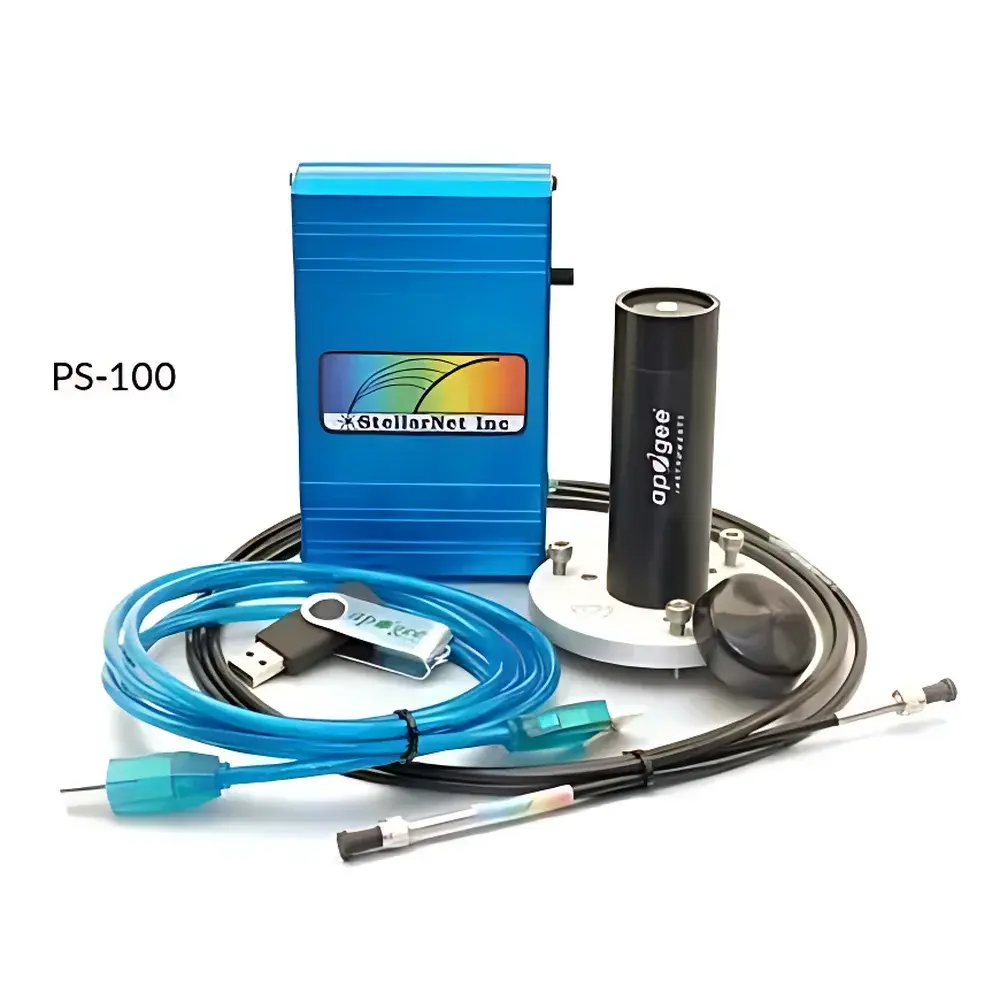
Apogee PS-300 Spectroradiometer
| Brand | Apogee Instruments |
|---|---|
| Origin | USA |
| Model | PS-300 |
| Spectral Range | 220–1100 nm |
| Wavelength Resolution | 1.5 nm |
| Detector | 2048-pixel CCD |
| Grating | Holographic, aberration-corrected, 590 g/mm |
| A/D Converter | 16-bit |
| Signal-to-Noise Ratio | 1000:1 |
| Stray Light | ≤0.02% @ 435 nm, ≤0.2% @ 200 nm |
| Measurement Repeatability | <1% |
| Irradiance Calibration Uncertainty | ±10% (300–1000 nm) |
| Cosine Response Error | ±5% up to 80° zenith angle |
| Integration Time | 1 ms – 65 s |
| Interface | USB 2.0 |
| Power | 5 VDC, 100 mA (bus-powered) |
| Operating Temperature | 0–60 °C |
| Fiber Optic Cable | 2 m armored silica fiber |
| Dimensions | 69 × 100 × 150 mm |
| Weight | 900 g |
Overview
The Apogee PS-300 Spectroradiometer is a high-performance, laboratory-grade optical measurement instrument engineered for absolute spectral irradiance and photon flux density quantification across the ultraviolet, visible, and near-infrared spectrum (220–1100 nm). Unlike broadband radiometers or photometers, the PS-300 employs a calibrated CCD-based spectrometer architecture grounded in diffraction grating spectroscopy—specifically utilizing a holographic, aberration-corrected 590 lines/mm grating—to resolve spectral power distribution with 1.5 nm nominal resolution. Its optical design incorporates a precision cosine-corrected input optic, ensuring angular response compliance within ±5% up to 80° zenith angle—a critical requirement for accurate hemispherical irradiance measurements under real-world illumination geometries. The device operates as a self-contained, USB-powered sensor head, eliminating external power supplies and enabling direct integration into controlled laboratory environments, growth chamber monitoring systems, and field-deployable optical test benches. All factory calibrations are traceable to NIST standards and delivered as wavelength-specific responsivity coefficients embedded in firmware, enabling direct conversion of raw digital counts into physically meaningful units: W·m⁻²·nm⁻¹ (spectral irradiance) and μmol·m⁻²·s⁻¹·nm⁻¹ (spectral photon flux density).
Key Features
- Full-spectrum coverage from 220 nm to 1100 nm—enabling UV-B, photosynthetically active radiation (PAR), and NIR characterization in a single acquisition
- 2048-pixel linear CCD detector with 16-bit analog-to-digital conversion, delivering high dynamic range and low-noise performance (SNR ≥ 1000:1)
- Optimized stray light suppression: ≤0.02% at 435 nm and ≤0.2% at 200 nm—critical for accurate UV spectral fidelity and artifact-free solar simulation analysis
- Programmable integration time (1 ms to 65 s) supporting both pulsed LED characterization and low-light ambient monitoring applications
- Ruggedized mechanical design: aluminum housing, 2 m armored silica optical fiber with SMA 905 connector, and operational stability from 0 °C to +60 °C
- USB 2.0 interface with bus-powered operation (5 VDC, 100 mA), minimizing cabling complexity and enabling plug-and-play compatibility with Windows-based data acquisition workstations
Sample Compatibility & Compliance
The PS-300 is compatible with diverse radiation sources including natural sunlight, xenon arc lamps, LED arrays, fluorescent tubes, and OLED panels. Its spectral calibration is validated against reference sources per ASTM E308-22 (Standard Practice for Computing the Colors of Objects by Using the CIE System) and supports conformance with ISO/CIE 11664 series for colorimetric and radiometric traceability. While not intrinsically certified for GLP or GMP environments, the instrument’s stable calibration, audit-ready metadata logging (via included software), and deterministic spectral response make it suitable for quality control workflows aligned with ISO/IEC 17025 requirements. For regulatory documentation, users may generate calibration certificates with uncertainty budgets compliant with ISO/IEC Guide 98-3 (GUM), referencing NIST-traceable irradiance standards.
Software & Data Management
Apogee provides the proprietary SpectraWin software suite for Windows (7/10/11, 64-bit), offering real-time spectral visualization, batch acquisition scripting, and export to CSV, Excel, and HDF5 formats. The software implements full spectral math functions—including integration over user-defined bands (e.g., PAR: 400–700 nm; UV-A: 315–400 nm), spectral centroid calculation, and chromaticity coordinate mapping (CIE 1931 xy). All acquired spectra retain embedded calibration metadata (date, serial number, responsivity vector), supporting traceability and version-controlled data archives. While SpectraWin does not natively support FDA 21 CFR Part 11 electronic signature functionality, its raw data export capability enables integration with validated LIMS or ELN platforms where audit trails, user access controls, and electronic signatures are managed externally.
Applications
- Photosynthetic photon flux density (PPFD) profiling and spectral balance optimization in horticultural lighting R&D and vertical farming validation
- LED spectral binning and lifetime degradation studies via periodic spectral shift tracking (e.g., peak wavelength drift, FWHM variation)
- Display backlight uniformity and color gamut verification in LCD/OLED manufacturing QA
- Solar simulator classification (Class AAA per IEC 60904-9) through spectral match evaluation relative to AM1.5G reference
- Material reflectance and transmittance spectroscopy when paired with optional integrating spheres or collimated source attachments
- Environmental UV index modeling and ozone layer impact assessment using calibrated erythemal action spectrum weighting
FAQ
Is the PS-300 calibrated for absolute irradiance or relative spectral shape only?
The PS-300 is factory-calibrated for absolute spectral irradiance (W·m⁻²·nm⁻¹) and photon flux density (μmol·m⁻²·s⁻¹·nm⁻¹) across its full 220–1100 nm range, with NIST-traceable responsivity coefficients applied in firmware.
Can the PS-300 measure underwater or in vacuum environments?
No—the instrument is rated for ambient air operation only; the optical fiber and housing are not pressure-rated or waterproof. Submersible or vacuum-compatible variants require custom engineering and are not part of the standard PS-300 product line.
What is the recommended recalibration interval?
Apogee recommends annual recalibration for metrologically critical applications; however, stability testing shows typical drift <0.5% per year under controlled storage and routine use conditions.
Does the PS-300 support triggering or synchronization with external equipment?
No—PS-300 lacks hardware trigger inputs or TTL sync capability. Synchronization must be implemented at the software level via timestamp alignment with external event logs.
How is cosine error characterized, and is correction applied in software?
Cosine response is measured per CIE S 023/E:2020 methodology and stored as a correction factor array in firmware; real-time correction is applied during spectral irradiance computation.





