
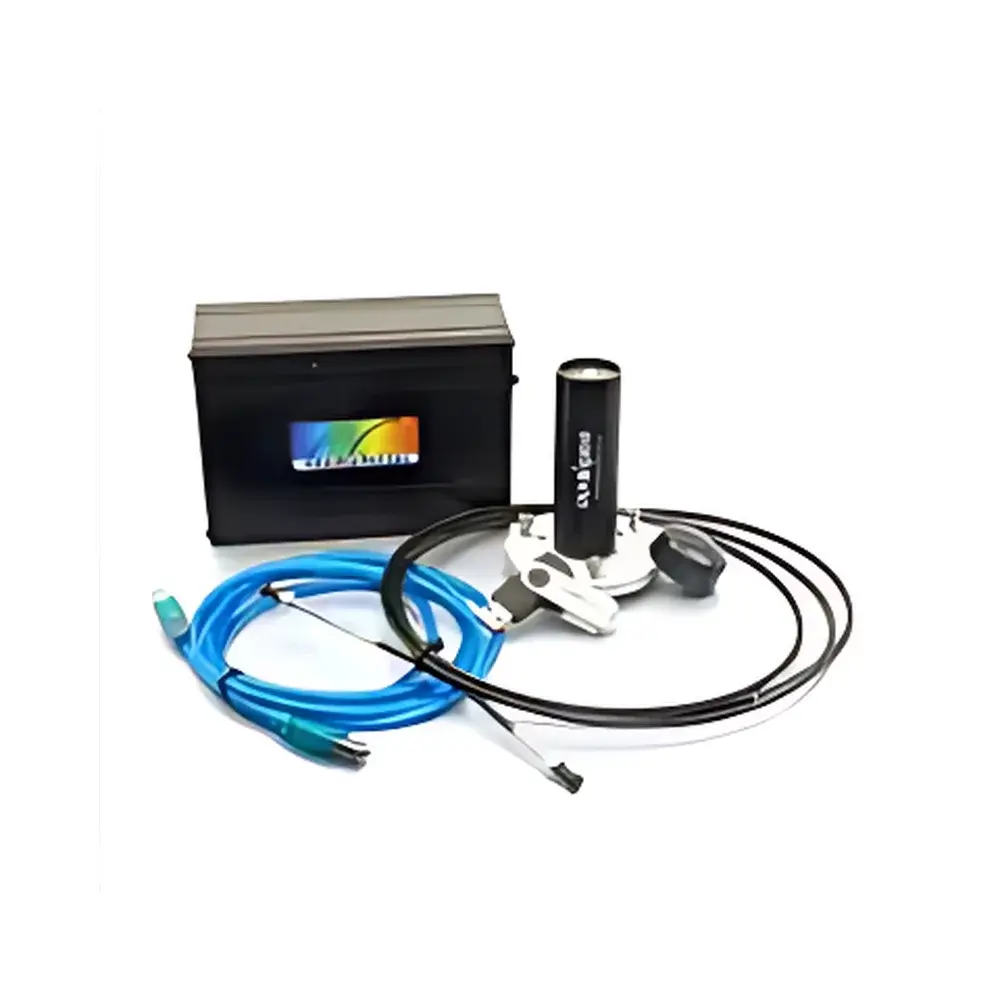
Apogee PS Series Spectroradiometers
| Brand | Apogee |
|---|---|
| Origin | USA |
| Manufacturer Type | Authorized Distributor |
| Product Category | Imported Instrumentation |
| Model | PS-100 / PS-200 / PS-300 |
| Price | Upon Request |
Overview
The Apogee PS Series Spectroradiometers are precision-engineered, USB-powered instruments designed for quantitative spectral measurement across the ultraviolet, visible, and near-infrared (UV-VIS-NIR) regions. Based on a compact Czerny–Turner optical architecture with holographic or Rowland-circle gratings, each model employs a 2048-pixel linear CCD detector and high-fidelity optical calibration traceable to NIST-standard sources. The PS-100 operates over 350–1000 nm (radiometrically calibrated 350–1000 nm), the PS-200 covers 300–850 nm (calibrated 300–850 nm), and the PS-300 extends from 300–1000 nm (calibrated 300–1000 nm). All units deliver calibrated spectral irradiance (W·m⁻²·nm⁻¹), photosynthetic photon flux density (PPFD, µmol·m⁻²·s⁻¹), illuminance (lux), and reflectance/transmittance ratios when paired with appropriate reference standards. Their design prioritizes field-deployable robustness without compromising laboratory-grade repeatability (<1% measurement variation under stable conditions) and angular response fidelity (±5% up to 80° zenith angle), making them suitable for both benchtop photobiological characterization and outdoor environmental monitoring.
Key Features
- Four-year limited warranty—among the longest standard coverage terms in the spectroradiometer segment
- Integrated Apogee cosine-corrected diffuser with optimized angular response for accurate hemispherical irradiance measurements, especially at low incidence angles
- Aluminum enclosure with IP54-rated ingress protection; engineered for thermal stability across 0–60 °C operating range
- Sub-nanometer optical resolution: PS-200 achieves ≤0.85 nm FWHM, PS-100 ≤1.0 nm, PS-300 ≤1.5 nm—enabling discrimination of narrowband LED peaks and chlorophyll absorption features
- Low stray light performance: <0.02% at 435 nm (PS-200), <0.1% at 435 nm (PS-100), critical for UV-sensitive applications including photostability testing and sunscreen efficacy evaluation
- Full 16-bit digitization with >1000:1 signal-to-noise ratio (at 1 s integration) and programmable exposure from 1 ms to 65 s
Sample Compatibility & Compliance
The PS Series is compatible with reflective, transmissive, and emissive samples—ranging from plant canopies and leaf tissues to horticultural LEDs, architectural lighting fixtures, and solar simulator outputs. When used with Apogee’s calibrated white reference panels (e.g., WS-1) or integrating spheres (IS-1000), it supports reflectance and transmittance quantification per ASTM E275, ISO 9050, and CIE S 023/E:2013 methodologies. Radiometric calibrations are performed against NIST-traceable tungsten-halogen and deuterium standards, ensuring compliance with ISO/IEC 17025 requirements for accredited laboratories. Firmware and software support audit trails and user-access controls aligned with FDA 21 CFR Part 11 principles for regulated environments requiring data integrity.
Software & Data Management
Each instrument ships with Apogee’s proprietary SpectraWin software (Windows-compatible), enabling real-time spectral acquisition, batch processing, spectral index calculation (e.g., NDVI, PRI, R/FR), and export to CSV, Excel, or MATLAB-compatible formats. The SDK provides full API access for LabVIEW, Python (via PyUSB), and MATLAB integration—facilitating automated QA/QC workflows in production settings or long-term ecological monitoring networks. All spectral data include embedded metadata: timestamp, integration time, temperature compensation offset, calibration file ID, and detector saturation status—ensuring full traceability and reproducibility per GLP and GMP documentation standards.
Applications
- Horticultural lighting validation: PPFD mapping, photon efficiency (µmol·J⁻¹), and spectral quality assessment (e.g., red:blue ratio, far-red fraction)
- Plant phenotyping: Leaf-level reflectance for chlorophyll content estimation (SPAD-equivalent), water stress indices (NDWI), and nitrogen status modeling
- Architectural daylighting analysis: Daylight factor, circadian stimulus (CS), and melanopic EDI calculations per CIE TN 006:2022
- Material optical characterization: Thin-film interference analysis, pigment stability under UV exposure, and anti-reflective coating verification
- Environmental photometry: Sky luminance distribution, albedo measurement over snow/soil surfaces, and solar spectral irradiance monitoring for PV system modeling
FAQ
Are calibration certificates provided with each unit?
Yes—each PS Series spectroradiometer ships with a NIST-traceable calibration certificate specifying wavelength accuracy (±1 nm typical), irradiance responsivity (A·W⁻¹), and cosine error profile.
Can the PS-200 measure below 300 nm?
No—the PS-200’s UV cutoff is defined by its optical coating and grating efficiency; measurements below 300 nm are not radiometrically valid and are excluded from calibration.
Is fiber optic coupling supported?
Yes—standard 2 m SMA-terminated quartz fiber (200 µm core, UV-VIS-NIR optimized) is included; custom lengths and bifurcated bundles are available upon request.
Does the software support automated diurnal cycle logging?
Yes—SpectraWin includes scheduler functionality for unattended multi-hour spectral time-series acquisition with temperature-compensated dark correction.
How often is recalibration recommended?
Apogee recommends annual recalibration for applications requiring ISO/IEC 17025 compliance; biennial verification is sufficient for routine horticultural or educational use under stable handling conditions.






