
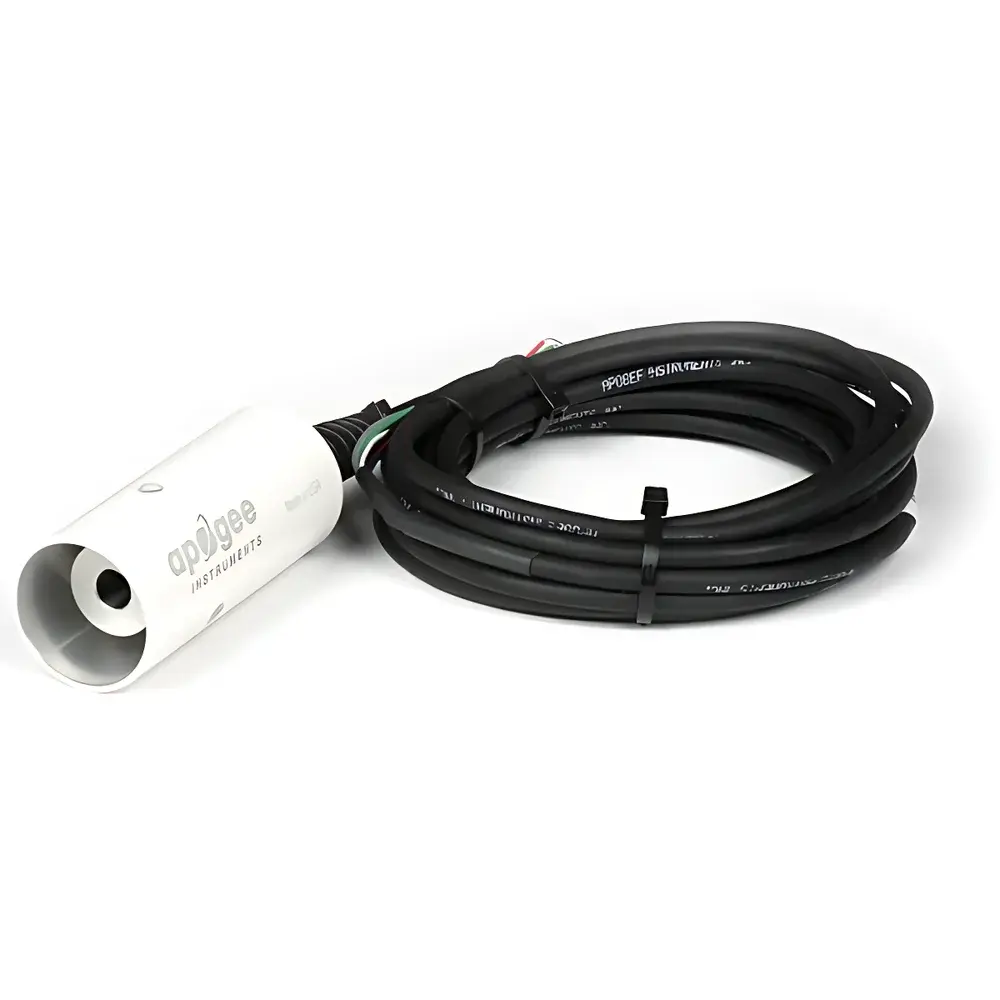
Apogee SI-111 Infrared Radiometer (Surface Temperature Sensor)
| Brand | Apogee |
|---|---|
| Origin | USA |
| Model | SI-111 |
| Operating Wavelength | 8–14 µm |
| Field of View | 22° half-angle |
| Accuracy | ±0.2 °C @ −10 to +65 °C |
| Repeatability | ±0.05 °C @ 10 to +65 °C |
| Response Time | <1 s |
| Output | 60 µV/°C (target), 0–2500 mV (sensor body temperature) |
| Housing | Anodized aluminum with germanium optical window |
| Dimensions | Ø23 mm × 60 mm |
| Weight | 190 g |
| Cable | 4.5 m, 4-conductor shielded |
| Operating Ambient | −55 to +80 °C, 0–100 % RH |
| Power Supply | 2.5 V excitation for thermistor |
Overview
The Apogee SI-111 is a high-stability, non-contact infrared radiometer engineered for precise surface temperature measurement across environmental, agricultural, and geophysical monitoring applications. It operates on the principle of passive infrared thermometry, detecting thermal radiation emitted by objects within the atmospheric transmission window (8–14 µm). This spectral band minimizes absorption by water vapor and CO₂, enabling reliable measurements under variable ambient humidity conditions. The sensor integrates a thermopile detector—calibrated to quantify incoming radiant flux—and a precision thermistor that continuously monitors the sensor’s own housing temperature. Using the Stefan–Boltzmann law, raw thermopile voltage is corrected in real time for sensor body temperature drift, yielding absolute surface temperature with traceable metrological integrity. Designed for unattended field deployment, the SI-111 delivers continuous analog output without internal signal conditioning or digital processing—ensuring compatibility with legacy and modern data loggers alike.
Key Features
- Germanium optical window optimized for 8–14 µm spectral response, offering superior transmittance stability and reduced sensitivity to atmospheric moisture compared to silicon alternatives
- Dual-sensor architecture: thermopile (differential output) for target radiation detection and embedded thermistor (single-ended output) for real-time sensor body temperature compensation
- High absolute accuracy of ±0.2 °C over the primary operating range (−10 to +65 °C), validated against NIST-traceable blackbody sources
- Rapid thermal response (<1 second) to step changes in target temperature, supporting dynamic surface monitoring in canopy energy balance or snowmelt studies
- Robust anodized aluminum housing rated for extreme environments: −55 to +80 °C ambient temperature and 0–100 % relative humidity
- Compact form factor (Ø23 mm × 60 mm, 190 g) with integrated 4.5 m shielded 4-conductor cable—designed for low-noise signal transmission in electrically noisy field settings
Sample Compatibility & Compliance
The SI-111 measures surface temperature of any material emitting within the 8–14 µm band, including vegetation canopies, bare soil, snowpack, water bodies, asphalt, and building envelopes. Its 22° half-angle field of view defines a conical measurement geometry; users must ensure full target coverage at the intended standoff distance to avoid edge effects or background contamination. Emissivity correction is applied externally via post-processing or logger firmware using user-supplied emissivity values (typically 0.92–0.98 for natural surfaces). The sensor complies with IEC 60751 (industrial platinum resistance thermometer reference standards for calibration traceability) and meets requirements for long-term stability per ISO 9001-certified manufacturing processes. While not intrinsically certified for hazardous locations, its passive design and lack of active electronics make it suitable for Class I, Division 2 environments when installed with appropriate conduit and grounding.
Software & Data Management
The SI-111 outputs two analog signals: a differential millivolt signal from the thermopile (60 µV/°C) and a single-ended voltage from the thermistor (0–2500 mV). These are compatible with any data acquisition system supporting high-resolution (≥16-bit) analog inputs and programmable excitation (2.5 V for thermistor). Apogee provides open-source calibration coefficients and documented conversion algorithms—including full implementation of the Stefan–Boltzmann equation with sensor-body temperature correction—in Python, MATLAB, and LabVIEW. Raw data supports audit-ready traceability: timestamped voltage readings enable full recalibration years after deployment. When integrated into FDA-regulated or GLP-compliant workflows (e.g., controlled-environment agriculture trials), the sensor’s analog-only architecture avoids software validation burdens associated with embedded microcontrollers—facilitating 21 CFR Part 11 compliance through external logging systems with electronic signatures and audit trails.
Applications
- Plant physiology research: continuous canopy temperature monitoring for stomatal conductance estimation and drought stress detection
- Micrometeorology: surface energy balance modeling using net radiation partitioning between sensible and latent heat fluxes
- Cryosphere studies: snow surface temperature mapping to infer melt onset, refreezing events, and albedo feedback mechanisms
- Agricultural irrigation scheduling: spatially resolved soil surface temperature gradients as proxies for evapotranspiration demand
- Urban climate monitoring: pavement, roof, and façade surface temperatures for heat island intensity quantification
- Environmental compliance reporting: long-term surface temperature trends aligned with ISO 14064 greenhouse gas inventory protocols
FAQ
Does the SI-111 require periodic recalibration?
No routine recalibration is required under normal operating conditions. Apogee specifies a calibration stability of ±0.1 °C per year based on accelerated aging tests. Users may verify performance annually using a calibrated blackbody source at ambient temperature.
Can the SI-111 measure through glass or plastic covers?
No. Standard glass and most plastics absorb strongly in the 8–14 µm band. Only specialized IR-transparent materials (e.g., polyethylene film or germanium windows) permit transmission—such configurations require empirical recharacterization.
What is the minimum target size for accurate measurement?
At a 1-meter standoff distance, the 22° half-angle FOV yields a circular measurement area ~0.78 m in diameter. Target diameter should exceed this value by ≥2× to ensure >95 % radiant energy capture.
Is the output signal linear with temperature?
The thermopile voltage is linear with incident radiant flux, but target temperature calculation requires fourth-root transformation per the Stefan–Boltzmann law. Apogee supplies pre-validated linearization equations for common logger platforms.
How does humidity affect measurement accuracy?
The germanium window and 8–14 µm band selection minimize atmospheric attenuation. Under typical field conditions (RH < 90 %), humidity-induced error remains below ±0.1 °C at distances ≤5 m. For longer paths (>10 m), empirical path-length correction is recommended.



