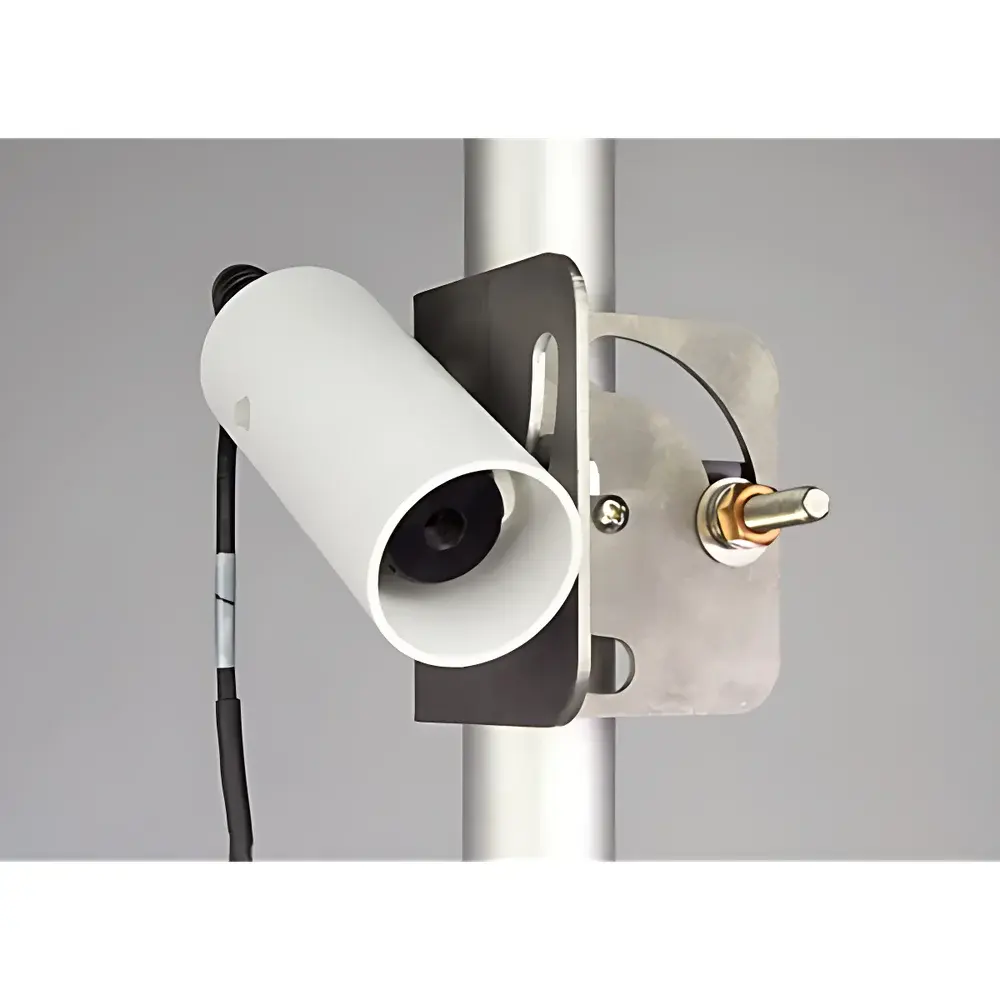
Apogee SIL-411 Infrared Temperature Sensor
| Brand | Apogee |
|---|---|
| Origin | USA |
| Model | SIL-411 |
| Field of View (Half-Angle) | 22° |
| Measurement Range | 0 to 50 °C |
| Accuracy (0–50 °C, target and sensor within 20 °C) | ±0.5 °C |
| Repeatability | <0.05 °C |
| Long-Term Drift | <2 %/year |
| Response Time | 0.6 s |
| Spectral Range | 8–14 µm |
| Operating Environment | −50 to 80 °C |
| Dimensions | Ø23 mm × 60 mm |
| Weight | 190 g (including 5 m cable) |
| Cable | 5 m, 4-conductor shielded twisted pair with TPR jacket |
| Warranty | 4 years |
Overview
The Apogee SIL-411 Infrared Temperature Sensor is a precision non-contact radiometric instrument engineered for continuous, passive measurement of surface temperature across natural and engineered terrestrial surfaces. It operates on the principle of broadband infrared radiometry within the atmospheric transmission window (8–14 µm), where emitted thermal radiation from surfaces correlates directly with their kinetic temperature via Planck’s law and the Stefan–Boltzmann relationship. The sensor integrates a thermopile detector with a precision germanium lens and calibrated optical path, delivering stable output in millivolts proportional to target emissivity-corrected radiance. Its 22° half-angle field of view ensures spatially representative sampling over defined surface areas—critical for applications requiring areal averaging rather than point measurements. Designed for unattended outdoor deployment, the SIL-411 maintains metrological integrity across extreme ambient conditions (−50 to 80 °C) and high humidity (0–100 % RH, non-condensing), supported by a ruggedized, UV-stable thermoplastic elastomer (TPR) cable jacket and internal temperature compensation circuitry.
Key Features
- Non-contact surface temperature measurement via calibrated 8–14 µm infrared radiometry
- SDI-12 digital interface enabling direct integration with Campbell Scientific, Onset, Decagon, and other SDI-12–compatible data loggers without external signal conditioning
- Fast 0.6-second response time optimized for dynamic environmental monitoring (e.g., diurnal surface cooling, frost onset detection)
- High repeatability (<0.05 °C) and long-term stability (<2 %/year drift) validated under accelerated aging protocols per IEC 60751 and ISO/IEC 17025 traceable calibration practices
- Rugged mechanical design: stainless steel housing, IP68-rated connector interface, and TPR-jacketed 5 m shielded twisted-pair cable rated for sub-zero flexibility and UV resistance
- Onboard temperature compensation and linearized analog output (0–2.5 V) alongside SDI-12 digital output for redundancy and cross-verification
Sample Compatibility & Compliance
The SIL-411 is optimized for measuring surfaces with emissivity ≥0.90—such as vegetation canopies, bare soil, water bodies, snowpack, and asphalt pavements—without requiring user-applied emissivity correction during standard operation. Its 22° half-angle FOV provides a ~2.1 m diameter measurement footprint at 5 m distance, minimizing edge effects in heterogeneous landscapes. The sensor conforms to ASTM E1933-19 (Standard Test Methods for Measuring and Compensating for Emissivity Using Infrared Imaging Systems) for field-deployable radiometric accuracy. It supports GLP-compliant data acquisition workflows when paired with SDI-12 loggers featuring audit-trail-capable firmware (e.g., Campbell CR6 with OS v6+). No regulatory certification (e.g., FDA, CE) applies, as it is a Class I environmental sensing device not intended for medical or safety-critical control applications.
Software & Data Management
Data acquisition is fully compatible with industry-standard environmental software platforms including LoggerNet (Campbell Scientific), HOBOware (Onset), and EdiLogger (Decagon). Raw SDI-12 commands return calibrated temperature values in °C with 0.1 °C resolution and embedded checksum validation. When integrated into automated networks, the SIL-411 supports time-synchronized polling intervals down to 1 Hz, enabling high-frequency energy balance modeling. All calibration coefficients—including spectral responsivity, nonlinearity correction, and temperature-dependent offset—are factory-programmed into non-volatile memory and accessible via SDI-12 interrogation. Exported datasets comply with CF Metadata conventions and support direct ingestion into R (‘eddyproc’, ‘flux’ packages) and Python (‘pandas’, ‘xarray’) for flux partitioning and land-surface model validation.
Applications
- Plant physiology studies: Canopy temperature differentials (Tc – Ta) for stomatal conductance estimation and drought stress monitoring
- Transportation infrastructure: Pavement surface temperature logging for anti-icing decision support systems and winter maintenance optimization
- Hydroclimatology: Snow surface temperature profiling in alpine catchments to constrain melt timing and runoff generation models
- Eddy covariance towers: Upward longwave radiation component derivation for surface energy balance closure analysis
- Agricultural irrigation scheduling: Real-time soil surface temperature mapping to infer evaporation rates and root-zone moisture status
- Urban climate monitoring: Thermal heterogeneity assessment across impervious vs. vegetated surfaces in heat island studies
FAQ
Does the SIL-411 require periodic recalibration?
Yes—Apogee recommends NIST-traceable recalibration every two years for research-grade applications, or annually under continuous high-UV or thermal cycling exposure. Field verification using a blackbody reference source (e.g., CI Systems BC-200) is advised prior to critical campaigns.
Can the sensor measure through glass or plastic covers?
No—standard silicate glass and most polymers absorb strongly in the 8–14 µm band. Direct line-of-sight to the target surface is required for valid radiometric measurement.
Is the SDI-12 output compatible with Arduino or Raspberry Pi?
Yes, provided the microcontroller implements full SDI-12 protocol compliance (including 1200-baud asynchronous serial, command echo, and timeout handling); open-source libraries such as ‘SDI12’ for Arduino and ‘pysdi12’ for Python/Raspberry Pi are verified functional.
What is the minimum measurable surface size?
At 1 m distance, the 22° half-angle yields a ~0.8 m diameter measurement area. Targets smaller than 50 % of this diameter introduce significant cosine error and reduced effective emissivity; use is not recommended for objects <0.4 m in extent at that range.
How does ambient temperature affect accuracy?
The SIL-411 incorporates internal thermistor-based compensation; accuracy specifications assume ≤20 °C difference between target and sensor body temperature. For larger gradients, optional emissivity input (via SDI-12) improves correction fidelity in post-processing.