
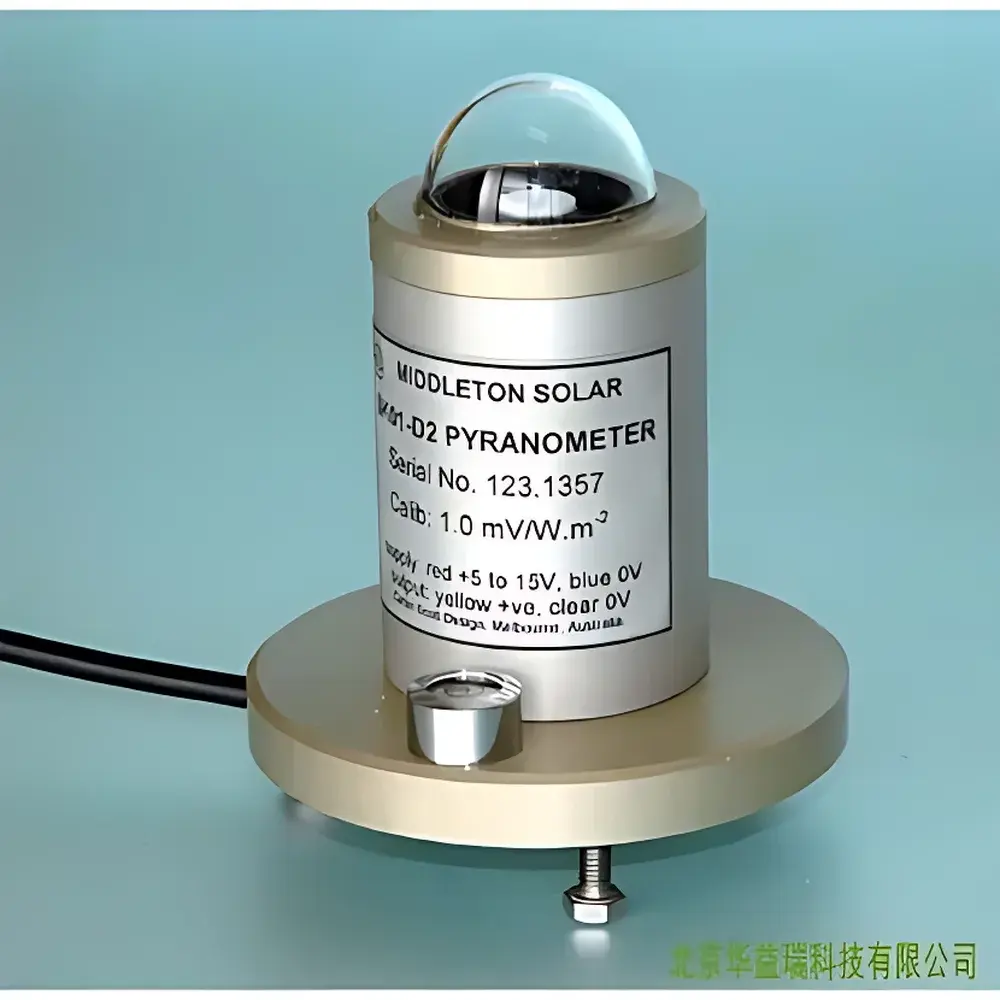
Apogee SK01-DP2 Photosynthetically Active Radiation (PAR) Sensor
| Brand | Apogee |
|---|---|
| Origin | USA |
| Model | SK01-DP2 |
| Spectral Range | 400–700 nm |
| Output Sensitivity | 0.5 mV per μmol·s⁻¹·m⁻² |
| Measurement Range | 0–3000 μmol·s⁻¹·m⁻² |
| Response Time (95%) | 30 ms |
| Long-Term Drift (per year) | < ±2% |
| Nonlinearity | < ±1% |
| Directional Response (30°–80° zenith angle) | < ±30 W·m⁻² (ISO 9060 Class II compliant) |
| Temperature Response | < ±0.15% per °C |
| Operating Temperature | −35 to +60 °C |
| Power Supply | 5.5–14.5 VDC, 3 mA |
| Housing | Anodized aluminum, IP67 rated |
| Cable Length | 3 m |
| Weight | 0.3 kg |
| Dimensions (L×W×H) | 150 × 150 × 150 mm |
| Calibration Uncertainty | ±3% |
| Spectral Responsivity Match (vs. CIE PAR action spectrum) | ±6% (overcast) to +2% (thin cloud) |
Overview
The Apogee SK01-DP2 is a precision-calibrated, silicon photodiode-based photosynthetically active radiation (PAR) sensor engineered for high-fidelity quantification of photon flux density in the 400–700 nm spectral band—the wavelength range most directly utilized by terrestrial and aquatic photoautotrophs for photosynthesis. Unlike broadband pyranometers or unfiltered photodiodes, the SK01-DP2 incorporates a proprietary optical interference filter that tightly constrains its spectral responsivity to match the CIE-defined PAR action spectrum, minimizing out-of-band response errors from near-UV and NIR radiation. Its design adheres to ISO 9060:2018 Class II specifications for directional response and thermal stability, making it suitable for deployment in long-term ecological monitoring, greenhouse climate control systems, agronomic field trials, and controlled-environment plant physiology laboratories. The sensor operates on a passive analog output principle—generating a millivolt signal proportional to incident photosynthetic photon flux density (PPFD)—and requires no internal digitization or firmware, ensuring deterministic linearity and immunity to electromagnetic interference common in industrial agricultural settings.
Key Features
- Silicon photodiode detector with spectrally tailored interference filter optimized for 400–700 nm PAR band conformity
- Chopper-stabilized amplifier architecture providing stable zero-offset compensation and enhanced DC signal integrity
- Anodized aluminum housing rated IP67 for full submersion resistance and long-term corrosion resilience in humid, saline, or dusty environments
- Optically flat fused quartz hemispherical dome with anti-scatter surface treatment to minimize cosine error across 30°–80° zenith angles
- Integrated desiccant chamber (non-toxic orange silica gel) maintaining internal dryness under sustained high-humidity exposure
- Onboard overvoltage and reverse-polarity protection circuitry safeguarding against common field wiring faults
- M5 mounting thread with adjustable leveling feet and integrated circular bubble level for rapid, repeatable angular alignment
- NIST-traceable calibration certificate supplied with each unit, specifying spectral mismatch correction factors under standard sky conditions
Sample Compatibility & Compliance
The SK01-DP2 is intended exclusively for measurement of natural solar irradiance or calibrated artificial light sources whose spectral power distribution closely approximates daylight (e.g., full-spectrum LED grow lights with documented spectral output). Due to its wavelength-specific responsivity profile, it is not recommended for use with narrowband monochromatic sources (e.g., red/blue LEDs without broad spectral support) or high-pressure sodium lamps without application-specific correction factors. The sensor conforms to ISO 9060:2018 Class II requirements for directional response and thermal drift, and its calibration methodology follows ASTM E2848-21 guidelines for PAR sensor characterization. It supports GLP-compliant data acquisition when paired with validated analog-input data loggers featuring 16-bit resolution and cold-junction compensation. No software-based audit trail or electronic signature functionality is embedded, as the device outputs an analog voltage signal only—making it inherently compatible with legacy SCADA systems and FDA 21 CFR Part 11-compliant validation protocols when integrated into validated instrumentation networks.
Software & Data Management
The SK01-DP2 produces a direct analog output (0.5 mV per μmol·s⁻¹·m⁻²), requiring external analog-to-digital conversion via a compatible data logger or PLC input module. Apogee Instruments provides freely downloadable Excel-based calibration correction tools and MATLAB/Python script templates for applying spectral mismatch corrections based on measured sky conditions or lamp spectra. While the sensor itself contains no onboard memory or wireless interface, its low-power analog output (3 mA draw) enables seamless integration with industry-standard platforms including Campbell Scientific CR series loggers, Onset HOBO UX120, and NI CompactDAQ systems. Raw voltage readings are converted to PPFD using the factory-determined sensitivity factor; users must apply temperature compensation coefficients (±0.15% per °C) manually or programmatically when operating outside 20–25 °C ambient ranges. All calibration certificates include uncertainty budgets traceable to NIST Standard Reference Radiometers, supporting ISO/IEC 17025-accredited laboratory reporting.
Applications
- Long-term phenological monitoring in USDA Climate Hubs and FLUXNET eddy-covariance sites
- Daily light integral (DLI) calculation for horticultural crop scheduling in vertical farms and glasshouse operations
- Validation of spectral output and uniformity mapping for commercial LED grow light installations
- Field validation of satellite-derived PAR products (e.g., MODIS, Sentinel-3 OLCI) in ground-truth campaigns
- Photosynthetic efficiency studies in aquatic mesocosms and phytoplankton culture systems
- Regulatory compliance testing for energy-efficient lighting standards (e.g., DLC Horticultural Lighting Program)
- Climate-controlled growth chamber qualification per ASTM E1822-20 Annex A1
FAQ
Can the SK01-DP2 be used under artificial lighting such as LED or fluorescent lamps?
Yes—but only if the lamp’s spectral power distribution has been characterized and appropriate spectral mismatch correction factors are applied. The sensor is calibrated under natural daylight; uncorrected use under narrowband sources introduces systematic bias.
Is the calibration valid for underwater measurements?
No. The sensor is designed for above-water, air-interface irradiance measurement. Water immersion alters angular response and spectral transmission; dedicated underwater PAR sensors with pressure-rated housings and water-specific cosine correction are required.
Does the SK01-DP2 require periodic recalibration?
Apogee recommends recalibration every two years for critical applications or after exposure to extreme thermal cycling (>50 °C diurnal swings) or mechanical shock. Annual verification against a reference standard is advised for GLP/GMP environments.
What is the significance of the orange silica gel indicator inside the housing?
The desiccant maintains internal relative humidity below 40% RH. When the gel turns colorless, it indicates saturation and requires replacement—typically every 18–24 months in temperate climates or sooner in tropical deployments.
How does the SK01-DP2 differ from the SK01-D2 model?
The SK01-D2 measures total solar irradiance (300–1150 nm) in W·m⁻², while the SK01-DP2 is PAR-optimized (400–700 nm) and outputs in photosynthetic photon flux units (μmol·s⁻¹·m⁻²), with distinct spectral filtering and calibration traceability.




